

If you asked the free version of ChatGPT to “crunch a World Civilizations text book and solve for ‘blood and soil’ in the voice of an Israeli wellness influencer and make sure to mention AI,” you might get something like Alana Newhouse’s “Zionism for Everyone,” published in Tablet in March 2026. That said, even a first generation bot would be able to parse enough published language to confirm that Israel was sponsored first by the British, contrary to Newhouse’s claim that “what the Zionist movement accomplished” was not due to the backing of an “outside power” such as “the British or the Americans.” Newhouse, in full, writes that “it was the determined pragmatism and wild hope of a few thousand men and women” that gave the world Israel. “That state,” she claims, “started with many fewer resources than its neighbors, who were backed by the British Empire, but would soon exceed them all in military and economic power.”
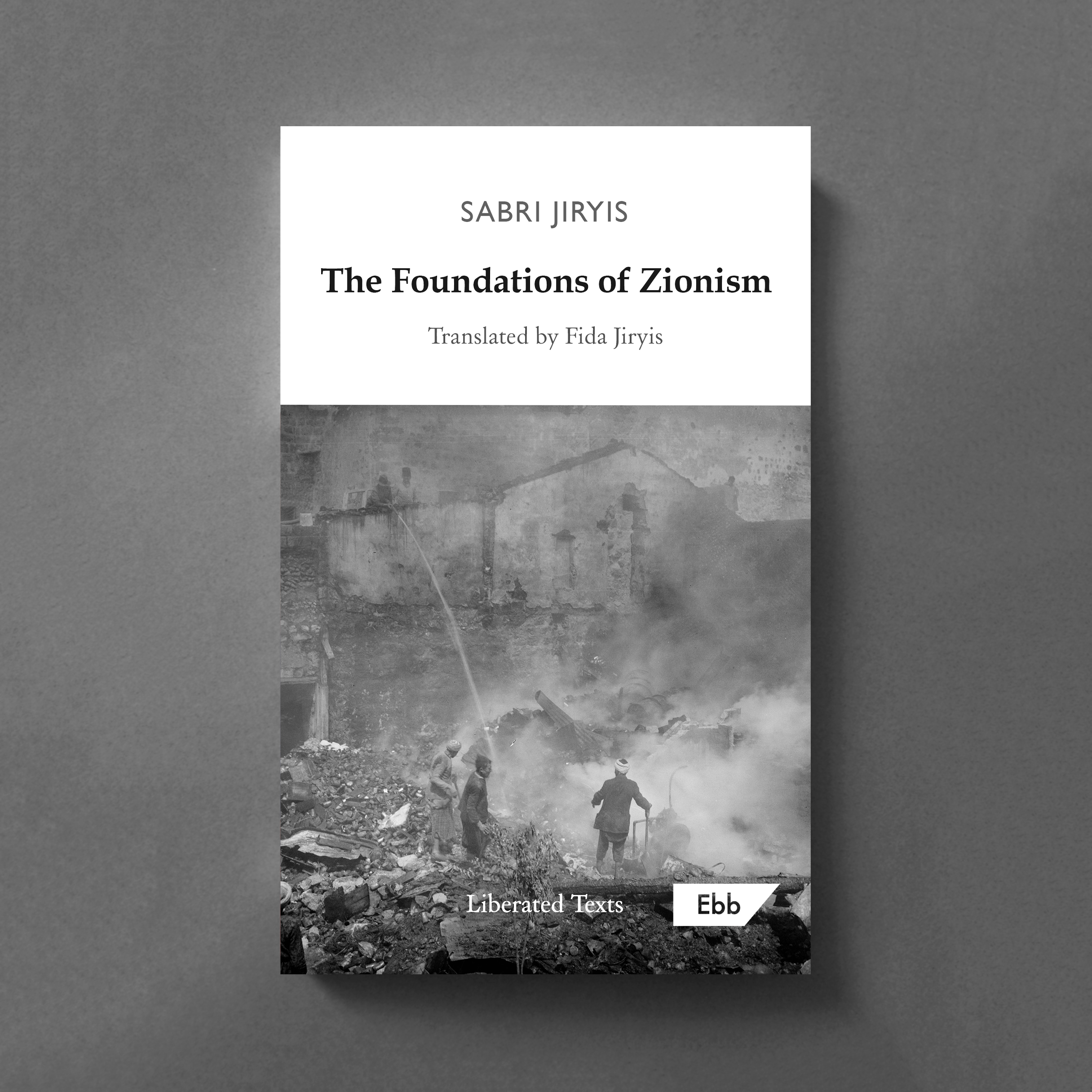
If you were to ask a serious scholar—someone, say, like Sabri Jiryis—you would of course receive a very different answer. This is fortunately not a hypothetical. With respect to the foreign backing that Newhouse alleges did not exist, both the Balfour Declaration of 1917 and the ensuing British Mandate over Palestine—with its attendant anti-Arab and pro-Zionist measures—are documented over the course of two hundred seventeen of the six hundred pages in Jiryis’ The Foundations of Zionism, newly translated by his daughter, Fida Jiryis, and published last last year by Ebb Books and Liberated Texts.
Sabri Jiryis, born in Mandatory Palestine in 1938, is a lawyer and writer who served as director of the Palestine Research Center from 1978 to 2004. The original publishing of The Foundations of Zionism happened over two volumes, issued in 1977 and 1986, which have been condensed now to one volume. Fida Jiryis made the decision to translate the book in 2020, after she read it in its entirety while researching her memoir, Stranger in My Own Land. Her father was excited by the prospect, as few in the West had access to the original texts he used. “The difficulty in working on it was that I was writing about Zionism while seeing its practical, gruesome actualization,” Fida Jiryis told me.
Sabri Jiryis worked primarily from Hebrew sources “in order to not be accused of being racist et cetera,” as he told me in late 2025, when he spoke with me over Zoom from Fassuta, the village he grew up in, which the Israeli military occupied in 1948, and where he lives again now. “‘It is what you, Israelis, my good Israelis, said.’ As to the forefathers of Zionism, it is their product. I took it from their own words, from their books and their pamphlets and their articles.” As for powers facilitating the occupation of Palestine, the British mandate was established with the approval of all the Allied countries, none of it “secretly.” As for whether or not Tel Aviv is “one of the sexiest cities in the world,” you’ll have to consult Newhouse and her source, a 2014 Times of Israel blog post based on a 2014 Thrillist post written by Gianni Jacoma, whose most recent publication was a 2021 essay titled “8 Delicious Cocktail Mixers on Amazon That Will Level Up Your Home Bar.” It is unclear if the IDF’s recent torture of a one-year-old child with lit cigarettes is considered “sexy” or “brave” by the Israelis who “sip lattes,” but it is at least a documented event.
It feels as if Jiryis knew pieces like “Zionism for Everyone” were coming when he wrote The Foundations of Zionism. The slow march of documentation is not exactly a smooth read, though the clarity of each successive fact builds up a kind of low empirical flame. On every page, there is a fact about Zionism published originally by a Jewish writer that contradicts some part of today’s hasbara machine. Jiryis was one of the few Palestinian scholars who had studied inside the Israeli school system and knew the Zionist program first hand. The Foundations of Zionism, as he said, is an academic book that is “not for the street,” but it was written in Arabic, and aimed at other Palestinians. “I thought to write that book exactly because there was too much ignorance about Zionism and Zionists,” he told me. “Our people were daily saying that they should fight for their rights, they should fight the Zionists but they almost knew nothing about them. The same was correct and right for the whole Arab world.” This process echoed how so many people encountered Zionism in the last two years, seeing Israeli depravity for the first time in any number of videos, many posted willingly by the Israelis in question.
The book stops in the 1920s, long before the state of Israel was established. His voice is subdued in the main text, as he scrupulously avoids editorializing and bending the material to any aims but its own. His decision has aged well, leaving the Newhouses of the future to argue with the early Zionists themselves. (Perhaps they, too, will turn out to be antisemitic.) But in this edition, Jiryis has appended a new conclusion written in 2025, “Zionism in the Service of Colonialism,” which is a welcome intervention. As the title suggests, the existence of Israel comes down to “a convergence of interests between colonialism and Zionism.” This fact reasserts itself again and again through the course of Foundations: that the Zionists never once imagined that they could go it alone in any part of the world, even had they instead chosen Argentina or Uganda (both considered) as the new Zionist homeland. Israel, amongst other things, has always been something of a circuit in the undead circulation of the colonial project, a circuit we can see playing out now in the Strait of Hormuz. As Jiryis told me, the Zionists of the late 19th century were “a pliable tool that could be exploited to enhance British colonial control over the countries, people, and natural resources of the Levant during and after the First World War.” There is only increased interest in those resources now.
The Foundations of Zionism—expansive in its breadth—is filled with relatively minor points that alternatively feel like revelations or simple clarifications, often both. The Zionists’ consistent entreaties to imperial powers are well known, but the space which Jiryis dedicates to these early attempts at state-formation-by-dependency casts the present Israeli dependency on the U.S. in a stark light.
As the book so thoroughly demonstrates, the impulse to expand the presence of Jews in Palestine came, unsurprisingly, from outside Palestine, not from those Jews who had lived in Palestine for many hundreds of years. “It’s always been the same number,” Jiryis told me. “Since the second temple was destroyed in the 70 A.D., you’ve had something like 60,000 Jews in Palestine. No more, no less. Which shows that the notion that they were dreaming of their homeland and they wanted to get back, et cetera, et cetera, is a very big lie.” The move towards Palestine has always involved a negotiation between Zionists and European powers. For one, spare a thought for Baron Edmond de Rothschild and his settlements in Palestine, where trouble bloomed in 1890. The Zionist settlers who Rothschild paid to farm the vineyards performed no actual farming: that was done by Arabs hired to till the land they knew. The supervisory chain led all the way up to a chief gardener, in Paris, who sent his instructions from there. Le peuple d’Israël est vivant!
In 1878, a Viennese pamphlet attributed to the Russian-Jewish poet, Judah Leib Gordon, contained a call for Jews to return to the “land of Israel,” solving the Jewish question “naturally, like any common national problem.” The idea of the nation was front and center at the Congress of Berlin in 1878, where Romania, Serbia, and Bulgaria were recognized as independent and sovereign states. Gordon’s pamphlet was aimed at piggybacking on a new wave of independence, and the idea of the nation state itself.
In his 1884 pamphlet, Lilienblum understood that, while the wave of nationalist independence movements were sweeping Europe, the Zionist project would need to establish a relation of dependence on empire before it could ever hope to stand on its own two legs (which it has, as of yet, remained unable to do). He wrote that “[t]he leaders of our people in Europe should mediate with the leaders of all countries to help us reach our sacred goal,” going on to specify that 10 million rubles would be necessary to begin buying land from the Ottoman government.
“Without any exception, all of them, they were stressing one single notion,” Jiryis said to me. “They wanted a colonialist European power to protect them. To take them into its custody and help them to establish a state in Palestine in return for being an agent for that state and for the whole European colonialism against the Arab world.”
Theodor Herzl, often cited as the founding father of Zionism, was no exception. He is an odd national hero: a Viennese dandy who spent much of his life denigrating Jews, he came to Zionism late, and was only part of the campaign from 1895 to 1904, when he died at the age of 44. His 1896 pamphlet, The Jewish State, Proposal of a Modern Solution for the Jewish Question, seemed to rally enough people to the Zionist congresses—but much of the foundation of Zionism was laid before he got involved, and all of the heavy lifting happened after his death.
“All of his life,” Jiryis told me, “Herzl was running from one European ruler to another trying to get their support to adopt Zionism and help it make a state in Palestine for giving services to the colonialists.” Herzl was rebuffed by Barons Hirsch and Rothschild, the Pope, several kings, and a good number of his fellow Zionists. His political Zionism involved getting the established powers to recognize the project and clear a path for settlement in Palestine. The more practical and influential Zionists at the turn of the century simply advocated that Jews move en masse to Palestine and sort out the paperwork later.
The project to acquire the land went hand in hand with the project to construct a cohesive Hebrew Nation. It is striking the degree to which Zionists employed a concept the Nazis only got to 40-odd years later: the friend and enemy dialectic, a concept given its most famous and most robust articulation by philosopher, jurist, and Nazi Carl Schmitt in the 1920s. This approach to fascist political world-making has been far more flexible than appeals to blood and soil, which demand a fair amount of cloaking to conceal their esoteric logic. The constitutive enemy is not a competitor or someone against whom one harbors resentments—this enemy can even exist both “theoretically and practically,” because (in shades of Trumpism) it is sometimes “advantageous to engage with him in business transactions,” as Schmitt writes in 1927’s The Concept of the Political. This enemy must be “something different and alien,” such that conflicts remain plausible. And this status must scale up from the individual to the group, or else action will not follow. We have only found the enemy that animates our cause when “one fighting collectivity of people confronts a similar collectivity.” For the Nazis, that enemy was the Jew (among others). Many decades earlier, the Zionists chose the hatred of Jews—antisemitism, at they would have it—as their enemy.
But the diffuse nature of this particular constitutive enemy meant that its avatar was malleable, potentially everywhere and everyone. In an 1884 pamphlet called “On the Revival of the Jewish People in the Land of Our Fathers,” Moshe Leib Lilienblum, a Russian, wrote that hatred of Jews had been the a priori condition for close to two thousand years. His claim is that this source is “an inner feeling that cannot be remedied,” —at once sounding in the register of the individual subject and the metaphysical. Lilienblum pivots quickly to the social and asserts that Jews “are strangers, everywhere.” He combines both philosophy and the natural sciences when he concludes that there “will never be, nor can there be, complete equality between strangers and family, for this contradicts human nature, and no civilization will change it.” Antisemitism, then, places somewhere between an allergy and a party affiliation. In The Jewish State, Herzl wrote that “the nations in whose midst Jews live, are all either covertly or openly anti-Semitic.” Again, an immutable condition with an eminently mutable carrier.
Antisemitism has become such a stubbornly common concept in civic life that it is a great help to be held to a considered and deliberate pace with Jiryis as he goes through document after document, congress after congress, showing us how an idea moved from direct experience into affective cloud. The hatred that is antisemitism, something that is simultaneously a state of being and a bias, was willed into an abstract kind of zombie life. It began from a verifiably empirical basis, as seen in the violence against Jews that spread across Europe in the 19th century and the pogroms in Russia that were waged against working class Jews, socialists, and shopkeepers. From there, the idea was dematerialized and projected—a true paranoia—into a world that had no idea it was being roped into this psychological formation. Antisemitism became a ghost never given up, a uniform that can be draped over anyone, and a justification for the state of eternal war in which Israel has always existed. You, the bystander, have turned out to be antisemitic, no matter what.
Another Russian Jewish writer, Peretz Smolenskin, called by some “the father of the idea of Jewish nationality,” argued that others see the Jewish people as “a large, frightening animal.” Thus, “all peoples despise the Jewish people, in their hearts, because their religion and beliefs are different from their counterparts, with respect to any other people.” When your constitutive enemy includes “all peoples,” the chances of establishing a state that can peacefully blend into the international order seem slim.
In the years leading up to the British mandate, the various Zionist factions did not all subscribe to this bleak idea of enmity. One group that settled in Palestine, the Hashomer Hatzair, set themselves apart and espoused a variant of what they called “revolutionary Marxism.” Their demand was for a bi-national state of Arabs and Jews in Palestine. The United Workers Party, also know as Mapam, was an outgrowth of this movement and formally established itself in 1948.
Jiryis expanded on this to me: “Mapam were left Zionists and they took the partition plan of their own seriously and they really wanted to have a Palestinian state. But in the end, they could do nothing. It was Ben Gurion who was prevailing, the main Zionist theme.” Force won the day, and we know what followed.
None of this is a purely academic matter for Jiryis. In February 1983, when he was the director of the Palestine Research Center, Israeli forces set off a car bomb in front of the Center’s headquarters in Beirut. Hanneh Shaheen—Sabri’s wife and Fida’s mother—was killed in the attack. Sabri, on the fifth floor when the attack happened, survived. But decades of such violence have not deterred Jiryis nor, in general, helped to realize the Zionist goal of a Jewish national homeland free of Arabs. In the 2025 conclusion, Jiryis writes that the bottom line goal of Zionism “is the West’s colonial quest to control the Arab Levant.”
“Historically speaking, they have just failed,” Jiryis said to me. “I will tell you why. If we start from 1882, when they established the first settlement in Palestine up to today, that is 150 years minus two or three years. There are still five million Palestinians, and if you take the Arabs in Israel, it is almost seven million. Between the river and the sea now, the number of Jewish people and Arab people are almost equal. These are statistics even published by the Israelis themselves. This trend or this policy of getting the Arabs out of Palestine and making it totally Jewish and imperialist and et cetera, et cetera, it just failed, 100%. No kidding, no playing.” ♦
