

July 3rd, 2026.
The sun rises on the tents of the displaced in Gaza. It has been one thousand and one days, and the deliberate, quotidian work of genocide continues. Nearly all of Gaza’s two million inhabitants are without permanent shelter. Some survivors attempt to fabricate cement by grinding down the ubiquitous rubble into a toxic dust to mix with binding agents. It’s expensive, dangerous, and inadequate for building anything to last. But since October of 2023, not a single shipment of concrete has crossed the siege. And still, hell continues to rain from the sky. Over one thousand Palestinians in Gaza have been killed, many by airstrikes on tent encampments, since the so-called ceasefire in October 2025. The rate of annihilation has merely been modulated to evade the attention of an international community habituated to Palestinian death.
Israel’s ratissage of the Tel al-Sultan refugee camp near Rafah clears space for a newer, more tractable concentration camp—one in which Palestinians can be screened, surveilled, and herded like livestock through the channels set by the occupation. The panopticon will be policed by the currently non-existent supranational mercenary forces of the U.S.-led Board of Peace, which has been setting up a new military base and logistics hubs to dole out just enough humanitarian aid to keep its subject population alive. A representative of the Board announces that it—and not UNRWA, the agency that for decades has provided aid and other essential services to Palestinians in Gaza—will be the only game in town. Exclusive control over the means of reproduction, over sustenance itself, is the best and only mechanism by which to cut off Palestine’s guerrilla resistance from its land and from its people. Palestine must not be allowed to reconstitute itself: over five hundred Palestinian children born in the past thousand days have already been killed.
This unconscionable state of affairs has been crafted deliberately by the United States, which, in coordination with Israel, has used control over the flow of humanitarian aid to Gaza—and control over the conditions of life more broadly—in an attempt to forcibly pacify the Palestinians of Gaza into a state of permanent and peaceable subjugation. During the Biden administration, this involved supplying Israel with near-limitless weaponry to destroy vital civilian infrastructure with both shelling and aerial bombardment. It also involved suspending funding to UNRWA, the UN aid agency which, again, had long been a key supplier of food, shelter, and education in Gaza.
In May 2024, the Biden administration, in a report to Congress, determined that Israeli restrictions on aid to Gaza did not violate U.S. laws on the provision of military assistance. During the Trump administration, the U.S.-backed Gaza Humanitarian Foundation took over and significantly limited aid distribution in the Strip, resulting in a series of massacres in which Israeli forces and U.S. contractors fired upon Palestinians desperate for food. The U.S. now leads the Board of Peace, which, as a part of its post-war plan for Gaza, is establishing the new concentration camps and leveraging the possibility of reconstruction against the complete disarmament of the Palestinian resistance.
July 3rd, 2026.
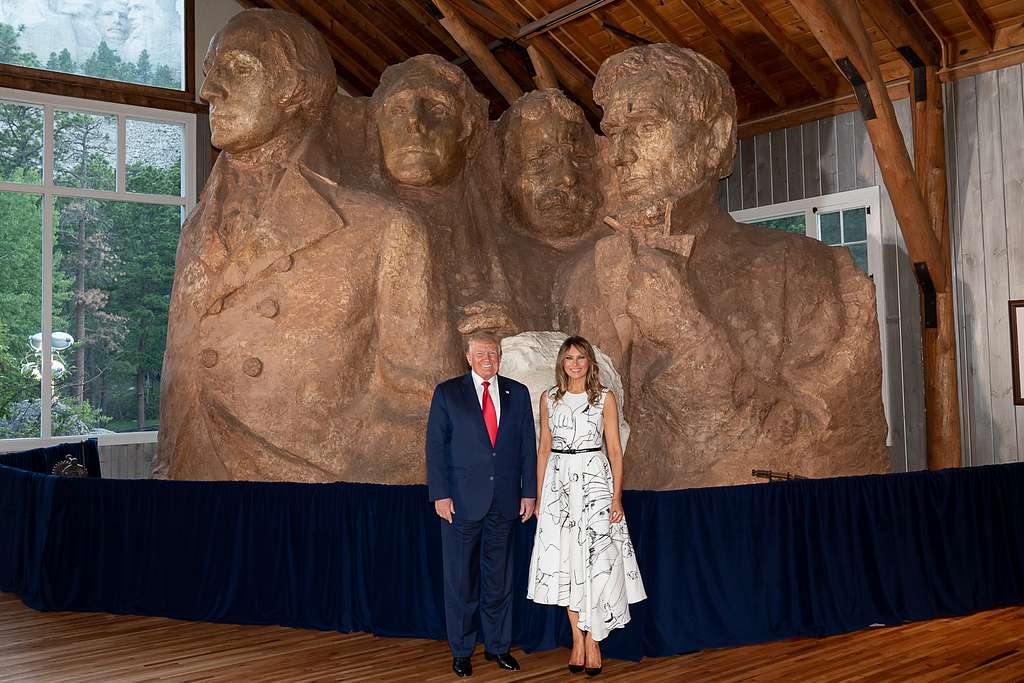
The sun rises on the Black Hills of Keystone, South Dakota. Flood lights switch on to illuminate the faces of Washington, Jefferson, Roosevelt, and Lincoln, casting the uncarved remainder of the mountain face into darkness. Below the monument, Donald Trump stands glistening at a podium before the crowds that had gathered to celebrate 250 years of American nationhood. His speech, its length constrained by the heat, quickly shifts from pablum about unity into a declaration of continued war. Thirty-five years after the end of the Cold War, Trump pronounced that “Communism” is “the enemy of July 4th, 1776.” His subsequent remarks made it clear that his message was primarily a racial one. America was built on settlement and conquest, and so she would continue:
“As for those who peddle Marxist lies about our heritage, tell our children that we live on stolen land or that our heroes were oppressors, they’re doing something much worse than slandering our past. They are slandering and attacking our future… They’re trying to tear down the great American character to destroy the people who declared independence, who crossed the Delaware, who settled the West and conquered the skies.”
The spirit of Trump’s message would not have been unfamiliar to the four presidents above him, whose lives spanned the transformation of the United States from a fragile settler republic into an intercontinental empire. Jefferson, paragon of America’s founding ethos, imagined territorial expansion as the very condition of freedom. Urging the conquest of the trans-Appalachian West during the Revolutionary War, he argued that it would “add to the Empire of Liberty an extensive and fertile Country,” while “converting dangerous Enemies into valuable friends.” Those “dangerous Enemies” were not European monarchs but the Indigenous nations—or, as Jefferson wrote in the Declaration of Independence, the “merciless Indian savages”—whose lands stood between the young republic and the world it sought to possess. Jefferson foresaw that settlement would depend not only upon defeating Indigenous nations militarily, but also upon breaking their political independence and incorporating their lands, and eventually those who remained upon them, into the expanding republic.
Lincoln would later turn some Jefferson’s proclamations against him. In Lincoln’s hands, the Declaration’s promise that “all men are created equal” ceased to be merely a justification for colonial independence and became an indictment of chattel slavery. That transformation formally expanded the class of persons who could claim America’s promise of freedom, and ultimately helped destroy the institution on which the Southern planter class had built its power. But it did not fundamentally displace the territorial logic that Jefferson had embedded within the republic. Even as Lincoln fought to redefine the moral boundaries of American citizenship, the United States continued to expand across Indigenous lands, treating Native nations as obstacles to be removed, pacified, or incorporated. As the egalitarian horizon of the republic widened, the imperial machinery through which it grew remained largely intact. A quarter-millennium on, it has not run out of enemies.
One hundred and fifty years before Trump’s address, at the time of America’s first centennial, the United States government stole the Black Hills from the Sioux Nation.
In 1862, the expansion of 150,000 white settlers into the lands of the Santee Sioux had forced the Indigenous population into a concentrated tract along the Minnesota River—a reservation on which much of the wild game had long since disappeared. Their attempts to return to their traditional hunting grounds were met with settlers who shot to kill. Facing starvation, a group of Sioux led by chief Little Crow, who had grown disillusioned that any lasting peace with the White man was possible, decided to attack. Over a series of assaults, his men killed hundreds of white settlers and took hundreds more hostage. For this aggression, 303 Sioux, both militants and civilians, were captured and sentenced to death. President Lincoln intervened—at the request of Bishop Henry Whipple—to prevent the majority of the executions. Still, Lincoln authorized the hanging of 32 Natives, in the largest mass execution in U.S. history. Most of the remaining Sioux were expelled, with some making their way to the Black Hills, which was formally recognized by treaty as exclusively Sioux land in 1868.
But by 1876, the U.S. had changed its mind. Gold had recently been discovered in the Black Hills, and the federal government was having a hard time keeping enterprising settlers from trespassing onto Sioux land—not least because they government wouldn’t deign to take any legal action against the trespassers. Lincoln’s former general Ulysses Grant, now president, was under pressure to resolve the issue by clearing away the Natives. Congress offered them a paltry sum to leave, and in exchange demanded access rights to mine the gold. Several bands of Sioux under the command of Crazy Horse and Sitting Bull, along with their Cheyenne allies, rejected negotiations with the federal government and refused to cede any territory—the land was not for sale. In early summer, the 7th Cavalry Regiment of the U.S. Army attacked. Crazy Horse, experienced by then in fighting the Bluecoats, was ready in response. Rather than allow the soldiers to set up defensible lines, his warriors drew them apart from one another with quick hits and then strategic retreats followed by ambushes. When the battle was over, 260 U.S. soldiers had been killed—a humiliating defeat for the Americans.
In response, the U.S. would change its strategy. Rather than defeat the Indigenous resistance with firepower alone, it would move to comprehensively control the conditions of life itself. The U.S. awarded itself rights to the land by fiat, and General Sherman received instructions to treat all remaining Natives as prisoners of war. But instead of another frontal attack, Bishop Whipple was dispatched by Grant to convey to the Sioux that the continuation of food rations depended on surrender:
“When the Great Council made the appropriation this year to continue your supplies they made certain provisions, three in number, and unless they were complied with no more appropriations would be made by Congress. Those three provisions are: First, that you shall give up the Black Hills country and the country to the north; second, that you shall receive your rations on the Missouri River; and third, that the Great Father shall be permitted to locate three roads from the Missouri River across the reservation to that new country where the Black Hills are… The Great Father said that his heart was full of tenderness for his red children, and he selected this commission of friends of the Indians that they might devise a plan, as he directed them, in order that the Indian nations might be saved, and that instead of growing smaller and smaller until the last Indian looks upon his own grave, they might become as the white man has become, a great and powerful people.”
For the natives, who were facing ecocide at the hands of settler destruction of their hunting lands, this was no choice at all—without the rations, they would starve. The Black Hills were stolen.
The lesson would not remain confined to the frontier. The United States had discovered that an insurgency could not be broken by purely military means, defeating its combatants—instead, survival of the people themselves must be made contingent upon submission. By the turn of the 20th century, the continental frontier had closed, and the international frontier was being pried open. The Spanish-American War and its spoils brought the possibility of overseas colonization to Americans hungry for further expansion. One commander in that war, Theodore Roosevelt, had cut his teeth as a settler in the Dakotas, hunting bison and developing a firm set of beliefs about the advance of civilization and the retreat of savagery. He would soon become president.
Roosevelt inherited a war in the Philippines. Once again, a campaign in which the U.S. had initially pressed for a conventional military victory had devolved into a decentralized rural insurgency. Now, for the first time, methods forged against Indigenous resistance on the North American frontier could be systematically adapted to an overseas colonial war. Two weeks after Roosevelt came into office, on September 28th, 1901, U.S. troops occupying the island of Samar came under surprise attack by the local residents of the port town of Balangiga. In an effort to starve out the local resistance in the interior, U.S. forces had been pursuing a policy of food deprivation, and the troops were on the coast of Samar to shut down the ports. Early in the morning, the villagers raided the soldiers. They had amassed weaponry the night before by disguising themselves as women carrying caskets of dead children, whom they claimed had been stricken by cholera. But the children were only pretending to be dead, and had laid atop caskets filled with weapons. The insurgents struck while the U.S. troops were eating breakfast, killing 54. It was the largest defeat of the U.S. army since the fight with Crazy Horse in the Black Hills.
In response, Roosevelt ordered the total pacification of Samar. His commander—Adna Chaffee, a veteran of the Indian Wars—took the opportunity to implement a brutal policy of retaliation against the region as a whole that amounted to a war of extermination. The new policies were developed alongside General Franklin Bell, who soon extended them across southern Luzon. In Batangas, Bell ordered the entire rural population into concentration camps ringed by what he called “dead lines.” Everything outside those lines was systematically destroyed: crops, food stores, livestock, houses, and boats. Entire communities were uprooted so that the guerrillas would be left with neither shelter nor sustenance. And within the fenced-off camps, the overcrowded, aid-dependent population suffered from disease and famine. Similar measures had already been quietly introduced on the island of Marinduque, where Army General Arthur MacArthur assured the War Department that the forced concentration of civilians had “effectively suppress[ed] insurrection” and was “carried out without objectionable or offensive features.”
To Army planners, there was nothing objectionable about reducing a countryside to ash if doing so could successfully sever a people from the material basis of resistance. Bell’s superiors later defended the destruction of Filipino homes on the grounds that they were inexpensive to rebuild. In the cold calculus of imperial administration, the cheapest way to pacify an insurgency was to destroy the conditions under which it could reproduce itself. Military victory would no longer be sought primarily through decisive battles. It would be achieved by reorganizing civilian life—concentrating populations, controlling movement, monopolizing food, and rendering whole territories dependent on the occupying power for survival. Though Roosevelt would declare victory on July 4th, 1902, the insurgency would carry on for years. But the frontier had broken free of its continental constraints, and Roosevelt had cemented his legacy as, in the words of Trump, “the man who built America into a global superpower.” The Philippines campaign had demonstrated that the methods first improvised against the natives at home could be transformed into a general doctrine of imperial pacification.
In 1967, the United States found itself facing the same strategic dilemma, this time on a far larger scale. The most powerful military force on the globe was mired in a Cold War anti-communist crusade in Southeast Asia. Though General William Westmoreland’s forces routinely prevailed in conventional engagements, they proved unable to extinguish the Viet Cong’s decentralized rural insurgency, particularly in the Iron Triangle northwest of Saigon, where the insurgents had constructed an extensive political and military infrastructure rooted in village life. The crisis reached a turning point on January 8th, 1967, when the U.S. launched Operation Cedar Falls, then the largest American ground operation of the war. After years of bombing, artillery barrages, and search-and-destroy missions had failed to uproot the insurgency, American commanders concluded that entire villages, including the village of Ben Suc, had to disappear. (Months earlier, South Vietnamese officials had assured villagers that any building flying the government flag would be spared from attack. The National Liberation Front responded by mischievously hoisting the South Vietnamese flag above the village’s communal rice storehouse. American aircraft bombed it anyway.)
Before dawn on January 9th, American and South Vietnamese troops surrounded Ben Suc while helicopters swept overhead with loudspeakers, broadcasting demands for the population to assemble. Soldiers moved through the village house by house. Families were told they could retain their possessions—but in practice, they could bring only what they could carry or could haul to the waiting trucks. Those closest to the loading points made attempts to salvage pigs, sacks of rice, furniture, and farming implements; many others were forced to abandon nearly everything they possessed. More than three thousand villagers were transported to a government resettlement camp, where they found little more than hastily erected tents and barbed wire. Behind them, American engineers and bulldozers systematically erased Ben Suc, flattening homes, orchards, schools, and ancestral graveyards, before aircraft returned to bomb the ruins a second time. Cedar Falls represented the fullest expression of a historically familiar strategy: if the insurgency could not be separated from the countryside by defeating its fighters, then the countryside itself would be reorganized—or destroyed—until it could no longer sustain resistance.
Early the next year, the Viet Cong and the North Vietnamese army launched a surprise counterattack, dubbed the Tet Offensive, which caught the U.S. and its South Vietnamese allies on the back foot. Though the maneuver was ultimately repelled, it inflicted thousands of fatalities on U.S. troops, severely dampening domestic support for the war. In the wake of Tet, the U.S. doubled down on its brutal methods of pacification. It had already been uprooting millions of rural Vietnamese, like those of Ben Suc, and concentrating them into fortified “Strategic Hamlets,” separating civilians from the countryside that sustained the insurgency and confining them in settlements that were easier to police and administer. At the same time, U.S. aircraft systematically defoliated the countryside by spraying Agent Orange, the plant killer that would later prove to be contaminated with severely toxic dioxins, in an attempt to deprive the Viet Cong of natural cover. [Ed. note: Airborne spraying of the same type of chemical defoliants as a counterinsurgency tactic was pioneered by the British in Malaysia, developed during the so-called “Malayan Emergency” and deployed against, once again, communist insurgents struggling for independence from colonialism and a collaborator regime.]
But these policies had another welcome effect: they rendered the rural areas—the support base for the insurgency—increasingly uninhabitable, while the populations that were displaced into concentrated settlements and rapidly expanding cities became far easier to control politically.
“In an absent-minded way the United States in Viet Nam may well have stumbled upon the answer to ‘wars of national liberation,’” wrote political scientist Samuel Huntington in late 1968; in other words, that:
“The effective response lies neither in the quest for conventional military victory nor in the esoteric doctrines and gimmicks of counter-insurgency warfare. It is instead forced draft urbanization and modernization which rapidly brings the country in question out of the phase in which a rural revolutionary movement can hope to generate sufficient strength to come to power.”
What Huntington presented as a novel solution to a novel problem was neither. The proposition that resistance could be defeated by reorganizing the conditions of life, rehearsed on the Great Plains and refined in Batangas, was now being expanded across Vietnam. From the reservations to the concentration camps to the “strategic hamlets,” the military objective remained remarkably constant: to sever an insurgency from the material conditions that allowed it to reproduce itself. So too did the political claim that surrender of land and assimilation into the cold reality of U.S. and U.S.-aligned power is a form of modernization.
It should come as no surprise, then, that the United States recognized in the Palestinian resistance another incarnation of the enemies of 1776. In the aftermath of October 7th, the machinery of empire lurched into action as Israel and the U.S. sought to forcibly separate the Palestinian insurgency from the land in which it was rooted via strategies of annihilation and containment. This has been a gruesome process, and a politically disruptive one, as images of violence at the frontier shake the consciences of those safely behind it. Gaza, like Vietnam before it, has inspired a moral reckoning—not simply because of the depravity of the genocide, but because Gaza reveals America’s truth to itself.
Trump is correct in asserting that this country’s past is connected to its future. But that continuity is not the immeasurable greatness of the American spirit, nor is it an aspirational commitment to liberal universalism. It is the persistence of a settler imperialism that has repeatedly regenerated itself by discovering new enemies along new frontiers. That history—which has extended through the conquest of North America, the world wars, the Cold War, the War on Terror—presents an uncomfortable problem for those who seek, like Lincoln, to reclaim the American tradition rather than reject or deconstruct it. Commitment to the task of rescuing the Declaration from the Founders who wrote it, of rescuing the republic from its own history, presupposes that Jefferson’s formulation of American power was wrong, and that freedom, imperium, and dispossession are divisible. But Gaza and its precedents point to a more troubling possibility: that the promise and the conquest have never been separable—that this is, indeed, the empire of liberty.
Much of the contemporary left has inherited Lincoln’s political method. On July 3rd, hours before Trump’s speech, New York City mayor Zohran Mamdani, flanked by newly naturalized citizens and seated behind George Washington’s desk, issued his own public address: “The frontier may be closed. We may have walked on the moon. But the work of fulfilling the values first enshrined in the Declaration of Independence—that work endures, and it belongs to us all.” Mamdani, whose surprising ascendancy derived in no small part from popular outrage over Gaza, has sought to cohere a maximally inclusive vision of political subjectivity to advance a wide suite of largely class-based demands. Congresswoman Alexandria Ocasio-Cortez, another prospective left standard-bearer, has likewise invoked the Revolution as an inspiration for class-based populism, calling it a fight against “the billionaires of their time.”
Whether these are gross anachronisms or clever rhetorical inversions is beside the point. The fundamental challenge, which neither Lincoln nor his inheritors have overcome, remains the persistence of the frontier. American liberalism has repeatedly survived crises of legitimacy by expanding the circle of inclusion without abandoning the imperial form of the state. This is possible because American expansion and American inclusion are not competing forces, but rather are mutually constitutive. If the United States is exceptional, it is precisely because it is the richest and strongest nation, and it has used that position to reshape the world in its image. And it is the richest and strongest nation not because of the power of its ideals, but because it has set out to reshape the world.
America needs its enemies. And so the imperial form, which reaches both outward to plunder the world and inward to police the internally dispossessed, will continue to produce them until it is undone. Invariably, some of those enemies will heroically resist submission, and the genocidal cycle of forced assimilation and violence will continue.
An expansion of egalitarian inclusion will not result in some future transcendence of the frontier, unless that inclusion is radical and universal enough to destroy the very concept of citizenship itself. This is a prospect that cannot be contorted to fit within a story of American redemption. The alternative is not a more perfect republic but the abolition of the political form that has tethered freedom to domination from the beginning, leveraging control over the conditions of life to curtail the political possibilities of its subject populations. The task is therefore not to complete the American project, but to bring it to an end—to abolish the frontier as a principle of political life, to reject the world it has organized, and to construct in its place a universalism that no longer depends upon conquest for its realization. ♦
