

As Annie McClanahan began to read at this year’s English Institute meeting, the atmosphere of the room shifted. Those who had sat wilting in their chairs perked up. The notetakers’ pens started scurrying across the page. A current seemed to shoot through the otherwise stuffy, grey lecture hall, charging the space with animated attention. The feeling only intensified as McClanahan continued. A sense of lucidity settled over us. The crowd seemed agitated by the picture that she painted of university teaching labor; this sudden activation seemed to suggest the possibility of a nascent, or perhaps reawakened, sense of political direction. In our experience as graduate students, to undergo such a rallying of affect—a dawning recognition in which more or less all of the attendees are implicated—at an academic event is a rarity indeed. It would be easy to dismiss this surge of energy as being attributable to all sorts of things—but in that moment, it felt like a spark of collective power.
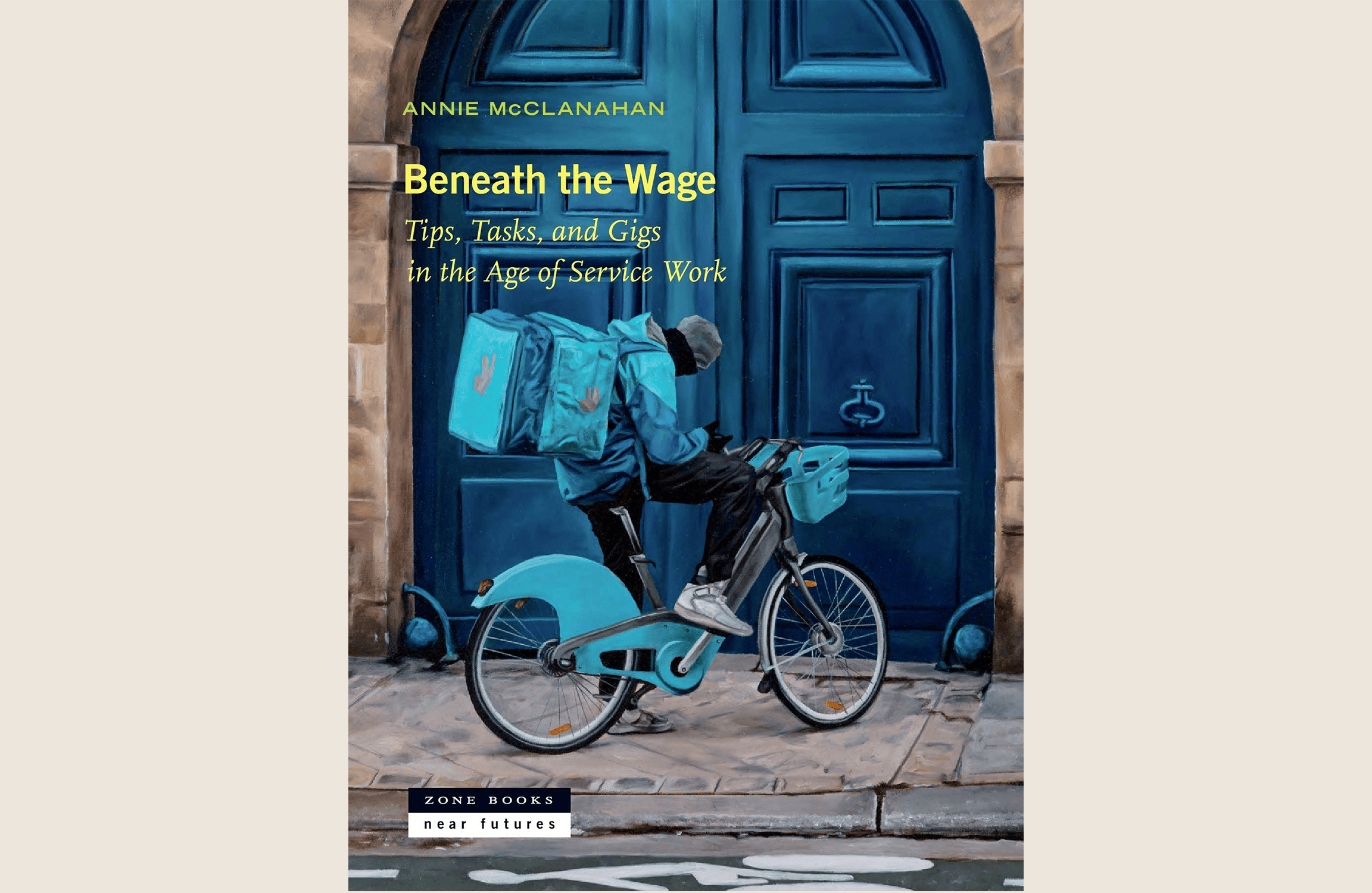
We experienced this moment last October, when we took (mostly unpaid) time off from our various service jobs to attend the English Institute’s annual meeting in Irvine, California—motivated in no small part by the chance to hear this new paper by Annie McClanahan. Her paper at the EI furthered some ideas that have now appeared in the coda of her new book, Beneath the Wage: Tips, Tasks, and Gigs in the Age of Service Work, published by Zone Books. In the course of her illuminating traversal of history, pop culture, and political economy, McClanahan also examines the discourses around (and the immediate pressing threats against) a type of work that one could assume united most of us in that room: teaching labor. With an undertone of urgency, McClanahan’s paper swiftly analyzed the histories and fantasies that construe the university as a place that harbors forms of work that are ostensibly immune to, somehow outside of, advances in technology and automation. Yet in the post-pandemic university, with the rise of AI and other labor-replacing educational technologies, what it means to teach, or to engage in teaching labor, seems to be in a period of ontological destabilization—heading, many fear, towards obsolescence.
The paper spoke pointedly to the types of people who find themselves at such academic conferences, who are intimately and professionally affected by such devitalization: chiefly, professors, adjuncts, and graduate students. Without collapsing differences in expertise and experience, and yet while remaining conscious of the need to push back against the rigid stratifications of academia, McClanahan issued a challenge of sorts: that all of us in that room begin urgently to identify ourselves with a label many academics have shied away from, have dismissed as politically unnecessary, or have even looked down upon—that is, to understand ourselves as workers.
After her reading concluded, when we had all sat down after a long and much-deserved standing ovation, bursts of conversation suddenly erupted. The room buzzed as if converted into a rally, where workers suddenly asked each other: Our work is being eroded, outsourced, deskilled, and informalized—so what are we, together, going to do about it? This question is the animating force of Beneath the Wage.
Annie McClanahan opens Beneath the Wage with a reminder of the well-known fact that the overwhelming majority of American workers are employed in service jobs—some 80%, with the other 20% being “goods-producing.” Teachers, nurses, drivers, consultants, therapists, cleaners, nannies, doctors, lawyers, baristas, truckers, janitors, fast-food workers, bartenders—we are conclusively in the Age of Service Work. Though much has been made of the offshoring and decline of the American manufacturing base, McClanahan argues that a service-predominant mode of labor is nothing new:
“What this book calls ‘the age of service work’ is not just a new way to describe the recent present. Nor is it yet another name for the postindustrial era that began in the 1960s when services-providing labor expanded while goods-producing labor contracted, ushering in a ‘long downturn’ of falling profits. Instead, this phrase is a prompt to rethink the whole history of capitalism’s wage through the paradigm of low-waged service work. Once we realize that service work is neither exceptional nor anachronistic, we will begin to grasp that its defining features (superexploitation, intensification, deskilling, informalization) are not residual processes or temporary exceptions, but the abiding and enduring tendencies of wage labor under capital.”
Beneath the Wage is concerned with no less ambitious an aim than to shift our paradigmatic understanding of the history of waged labor under capitalism. Service work, although growing in prevalence within the ever-deepening “long downturn” of post-industrial stagnation, has always been a part of the story of waged labor. We are talking about types of work which have been racialized and feminized, and incompletely included in the category of work. McClanahan’s title, Beneath the Wage, refers at once to service workers’ exploitation under the wage and their exclusion from “wage labor’s promises of freedom, autonomy, and equality.”
In surveying the literature on service work, McClanahan is concerned with the popular tendency to theorize the differences, rather than the continuities, between manufacturing and service. She begins with Arlie Hochschild’s influential 1983 book The Managed Heart, which attempts to grapple with the particular exploitation of service workers but ultimately focuses on their unique psychic estrangement. While it’s been rightly popularized for elucidating the value of emotional labor in service work, Hochschild’s intervention ultimately reifies the false dichotomy between manufacturing and service labor. This confusion, McClanahan contends, is taken up by post-Marxists via their continued focus on worker subjectivity, such as Maurizio Lazzarato’s “immaterial labor” or Michael Hardt’s “affective labor.” The search for such novel forms of accumulation, posited as discontinuous from the long history of worker resistance to the wage, is perhaps most thoroughly distilled in Jodi Dean’s term “neofeudalism.”
McClanahan, though, is opposed to such characterizations of work and capitalism, writing, “The forms of control and rationalization used to manage service workers today are neither residual and ‘pre-capitalist’ nor evidence of a return to a ‘feudal’ mode of accumulation.” Instead, McClanahan argues for the “coconstitution” of manufacturing and service, and looks to identify strategies of intensification, elongating days and quickening paces, that were first developed in the management of service work, and which were often, in turn, implemented in the manufacturing sector. The familiarity of concepts like Taylorization and rational management has too often been taken to imply a unidirectional causality, flowing from goods to services; McClanahan contends that the mechanisms in play are far more complex. To take service work seriously as work that is just as scientifically managed as manufacturing, McClanahan seeks to update Harry Braverman’s labor process theory and Eric Hobsbawm’s rationalized time. Thus, Beneath the Wage is concerned with the conditions of service work and the effects of “wages, management, and mechanization.”
Each chapter of Beneath the Wage looks at one of three exemplary and prevalent forms of service work—tipwork, clerical microwork, and gigwork—and uses each as an opportunity to theorize broad tendencies of contemporary capitalism: superexploitation, deskilling, and informalization. Indeed, it is these tendencies that service work and service workers are most vulnerable to, which degrade our everyday experience and precaritize our lives.
To theorize the pervading effects of these processes, each chapter attends to three aspects of each respective type of service work: its workplace, legal, and intellectual histories, its cultural representations, and historico-speculative methods for organizing. The chapters are distinct and highly structured, and each analytic aspect and theoretical concept builds elegantly upon the last. These are interwoven layers, not rigid sorting compartments. Taken together, these considered approaches lend an affective density to the book—a limned set of meanings that both requires and rewards deft navigation, perhaps not unlike the maneuvers needed to meet the flexible, interleaved requirements of service work itself. The result of such a density of information, so conceptually well-integrated, is that the book serves all at once as a guide, a structured argument, and a parseable archive.
Most of us encounter tipwork daily; a significant portion of us have worked for tips, and tipwork is on the rise, with one in ten workers making tips for wages today. Yet, as McClanahan points out in the first chapter, the history of in-person tipwork has been obscured by the feminization of its work conditions and its exclusion from legal protections for centuries. McClanahan makes a historical argument to show that tipwork is not a recent development in waged labor, nor has it been popularized only as the country has gravitated towards service work. Instead, as a form of sub-minimum waged labor, tipwork has historic precedents in another analogous form of feminized service work: waged domestic servitude.
In the 18th and 19th century in Britain and the U.S., live-in domestic servants were employed in a limitless “on-call” mode—their services could be requested at any moment of the day. Instead of receiving an exact daily or hourly wage (in other words, wages that corresponded to the time-stamped exactitude of industrial labor), waged domestic servants like maids, farmhands, and apprentices were granted “in-kind wages”: unpredictable remuneration, often involving payment in the form of housing, hand-me-down clothing, and leftover food. Because domestic servitude required a blurring of temporal boundaries between the worker’s time and the boss’s time, the inconsistency of in-kind wages was thought to be appropriate; the employer’s whims were paramount, and the full contributions of domestic workers (which included help with childcare, household operations, and numerous affective tasks) could not be quantified.
A kernel of this logic has persisted in the laws and policies around tipwork today: tipwork, it’s thought, is inconsistent work, and therefore it’s fair for it to be compensated with inconsistent and sub-wage pay. Unlike the commodity-producing work of the white, male, breadwinning industrial worker, a significant amount of the output of tipwork comes in the form of emotional lubrication for the customer: expectations of a servile sensibility and a nearly clairvoyant attunement to needs. The compensation structure of tipwork, at least in the majority of U.S. states, relies on this assessment of tipwork labor as unquantifiable, helping to justify the practice of sub-minimum tip-credit wages.
The middle of the chapter turns to what McClanahan calls “Tipwork TV,” a genre of television that encodes our cultural beliefs and attitudes about work. McClanahan theorizes the ways that popular service-workplace shows like Roseanne, Broad City, Insecure, and The Bear illustrate the necessary comportment of the individual worker in the service industry: flexibility, grindset, zaniness (borrowing from Sianne Ngai)—and, at the same time, a pragmatic unflappability. Unlike manufacturing labor, which would be boring to watch (sorry, How It’s Made), or even workplace sitcoms, which usually involve predictable or only tangentially or thematically work-related debacles between a stagnant cast of coworkers, Tipwork TV, like real service work, captures the inherent unpredictability and precarity that often characterize the experiences of real service workers. Like many of us working in the service industry, the protagonists of Tipwork TV ride the waves of adrenaline, from the exhausting overwhelm of customer rushes to the highs of breaks, free family meals, and big tips—all the more relieving because the rewards for a given shift worked are never a certain thing.
McClanahan identifies how the representational fluidity inherent to Tipwork TV has been strategically employed by political solidarity campaigns and projects like One Fair Wage’s (OFW) “essential worker” advocacy and the militancy of sex worker-organizers. OFW reinterpreted the aesthetics and symbolic connotations of Rosie the Riveter into Elena the Essential Worker in order to disrupt the distinction between industrial and service work. By centering their campaign on the portrayal of tips as a fundamental method of superexploitation within the wage system, rather than as an exception to it, the OFW has made efforts to “resignif[y] service work.”
McClanahan goes on to connect the history of piece-rate wage intensification and mechanized deskilling in agricultural labor to the microwork of Amazon Mechanical Turk (AMT). Output, rather than temporal duration, dictates and disciplines the piece-rate wage. This pay-by-task scheme dissects work into tiny, discrete units, incentivizing workers to manage themselves as they work as intensely as possible for irregular periods, forced to pile up miniscule shavings of wages to yield even a minimally viable take-home pay.
Historically a common practice in sectors like clerical and farm work, the piece-rate wage has been introduced into new markets via platforms like AMT, thanks to which its usage has swelled by orders of magnitude. Technologies that mechanize labor—which on the surface may appear to relieve workers of tedious and “preindustrial” work—can in many cases serve merely to increase the availability of the most exploitative and deskilled tasks. In the case of farm labor, the mechanization of more involved processes like peach pitting or packing vegetables has produced a deskilled, largely migrant workforce. The perverse effect of automating somewhat complex processes has been to funnel more workers into less-skilled work in the fields, to perform tasks that are even more rote but are simply more difficult to automate, like picking fruit and other delicate tasks best done by human hands. (Importantly, when McClanahan uses the term “deskilled,” she clarifies, she is “referring to a process of rationalization and efficiency, and not to a fundamental quality of the work or the worker.”) The upshot is that mechanization and automation can thereby augment mass production while sharing less and less of the proceeds with workers, increasing the ranks of the precarious workers who are left to perform the most deskilled tasks.
Treating both as aesthetic representations of piece-rate work, McClanahan closely reads two works of conceptual poetry, Fred Benenson’s Emoji Dick and Nick Thurston’s Of the Subcontract, both written using the outsourced labor of microworkers. The latter are paid extremely low wages per micro-task and are disproportionately concentrated in the Global South. McClanahan suggests we read these pieces in the tradition of proletarian verse: as work which formally reveals the obscured relationship between art and exploitation, and which can be read for evidence of the kinds of sabotage and work-to-rule resistance that have been so prevalent in the history of piece-rate labor.
If taken “as an anthology of superexploited microworker poetics” rather than a pointedly ghostwritten conceptual monograph, then the abundance of cliché in Of the Subcontract looks less like bad and error-riddled writing and more like a sort of informal labor refusal. After all, the poems are produced by subcontractors working for the service, not by any automation within the service itself. The continuity of this production with the history of labor refusal then calls into question the so-called automation, or what Astra Taylor terms “fauxtomation,” of AMT as a sign of the limits of mechanized automation. Yet this argument obscures the way in which the work of those humans is deskilled and superexploited. Indeed, building on the work of Aaron Benanav and Jason Smith, McClanahan argues that mechanized automation and superexploitation are not opposed forces, and neither operate at dichotomized extremes.
McClanahan also picks apart various contradictory ideological conceptions of app-based gig drivers like Lyft and Uber (somehow, “both independent hustlers and vulnerable victims”) by looking at the regulatory and technological management of these workers alongside the “gigwork fiction” that represents their desires and anxieties. McClanahan names these algorithmically controlled drivers “circulation gigworkers,” in part to align her argument with Joshua Clover’s account of circulation, which she expands to include app-based delivery and rideshare drivers alongside truckers and Amazon’s employee drivers. Although these gigs are clearly part of Jason Smith’s contemporary “servant economy,” she writes, the technological and rationalized time-control of these workers has more in common with the labor process of industrial logistics than domestic servitude: the algorithmic control of circulation gigworkers is not new, but rather is historically linked to technological innovations in the indirect management of train workers and long-haul truckers.
Following Clover’s argument that circulation, rather than production, is the contemporary site of both accumulation and struggle, McClanahan looks to the unique avenues of resistance that circulation gigwork affords. One such avenue is the workers’ inquiry—a genre that McClanahan argues could be fruitfully reenvisioned to be “focused not just on production, but also on reproduction, and not just on wages, but also on subsistence.” She reads both gigwork fiction and gigworker inquiries for a kind of mutually implicated complicity that might be better interpreted as a uniquely urgent form of solidarity. The historical shift from productivity to circulation leads her to tenant organizing for a model of struggle that centers what she terms the “reproductive rift”—the deprivation of “the very sustenance and social care they [service workers] labor to provide for others.” Here McClanahan usefully expands the “metabolic rift,” Marx’s theory of ecological degradation, to reveal similarly degraded social relations. We are alienated not only from “natural” resources, but also from our own reproductive labor.
This review was written in Portland, Oregon during the state’s first-ever community college strike; over 2,000 staff and faculty at Portland Community College walked out for over a week. Students without final grades, facing potential lapses in financial aid and other uncertainty, nevertheless responded by overwhelmingly and rightfully blaming PCC administration for failing to bargain with workers. The intricate network of solidarity between college faculty, the students they serve, and the administrative and maintenance workers that serve both is exactly the kind of implicated solidarity that McClanahan points us toward—solidarity that requires our political imaginations to co-habitate social worlds writ large and small, all at once on a global level and on the scale of the quotidian experience.
“Service work’s embeddedness in daily life has been exploited by service-sector employers and the intimacy thus often feels […] like complicity. But we might also think of it as the basis for solidarity. Whereas the feeling of complicity mystifies our interconnectedness, the fact of solidarity politicizes it.”
The results of McClanahan’s inquiry and cogent analysis make for an extraordinary read. Of course, many great books help us to think differently, or to recognize distortions in what we understand as truth and reality. But this book’s subject, the sheer pervasive everyday-ness of service work, prevents all of us from retreating to an insulating intellectual distance, from shying away from the histories, conditions, and praxis of solidarity that McClanahan so carefully describes.
Service work is altogether intimate. It is “…the work conducted in what Marx calls the ‘noisy sphere of circulation’ and thus far more visibly and inextricably embedded in our daily lives than other kinds of labor.” For those of us whose professions or services have long been discounted, dismissed as undeserving of the title of “real” work—or have otherwise gone unappreciated and unpaid, presumed to be naturally unworthy of compensation on a basis of gender, race, citizenship, or disability—this book will serve as a critical adjustment of perspective, perhaps allowing us to finally recognize the all-encompassing scope and historical character of our invisibilization: to acknowledge, at least, the realities that have for so long been obscured by their very ubiquity.
We can’t unfeel the real degradation of the conditions of our labor. But we can—and this is the part of the book McClanahan so beautifully offers us—organize against it. To do so, we need to recognize our labor as work and ourselves as workers, living together beneath the wage. ♦
