

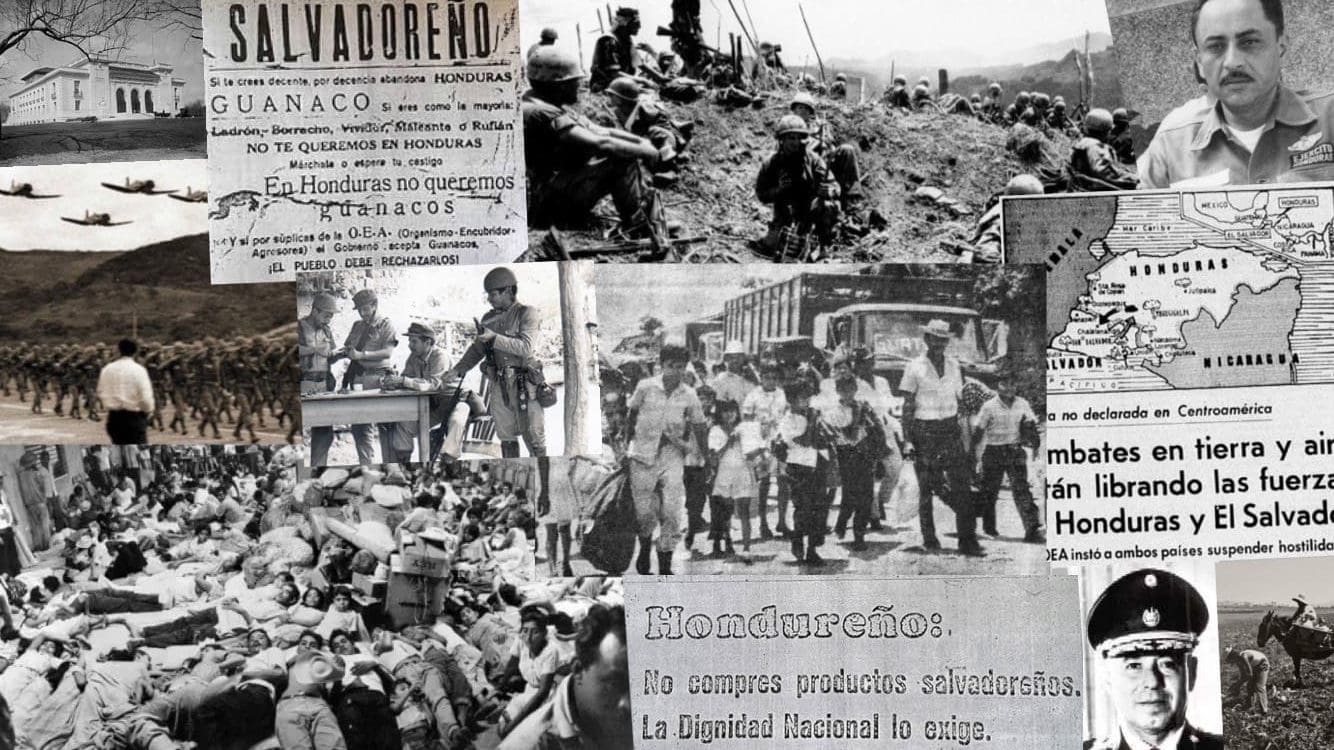
“There are no ‘mysteries of history,’” writes Roque Dalton, killed fifty years ago this past May. “There are falsifications of history, / lies by those who write History. / The History of the so-called “Football War” / has been written by the CIA and the Pentagon / and the intelligence services of the governments / of El Salvador and Honduras.” Against the lie that these two countries went to war over the World Cup qualifiers in 1969— a fun fact, a strange and forgettable testament to Latin American irrationality —Roque gives us a corrective poem-essay of u.s. imperialism and its maneuvering in a Central America ready for revolution. “War is politics…” narrates the creation of a stateless mass of tens of thousands wandering hungry, of a ruling class that saw itself in the zionist mirror as the “Israelites of the Isthmus,” the “people chosen by God to bring progress to Central America.”
This text, whose title combines Clausewitz’s famous phrase with one of Lenin’s, is one of Roque’s great achievements as a theorist of imperialism and an anti-imperialist poet. It is typical of his reception in the English-speaking world (which makes Roque the “poetry, like bread, is for everyone” guy instead of the communist who wrote poems listing the names of every CIA agent known to be active in El Salvador) that sections IX and XVI have, as far as I know, always been anthologized decontextualized from the work’s 35 other sections. This is probably because although all of them are marked by his unmistakable voice, not all of the collage-essay’s sections are lyric — they’re not all ‘poems.’ But that is exactly what Roque’s accomplishment is here. A poem, which has its own logic and must obey formal impulses if it wants to be successful, is not the best vehicle for political analysis. “This poem has its own concerns / which are different from mine,” Maged Zaher wrote three decades after “Materials for a poem” was published. Instead of sacrificing poetry or raising it over politics, Roque makes a cadre out of verse, putting it to work in the organization of the essay. He would have been ninety-one this year.
I.
Tegucigalpa, May 25, 1969 (Associated Press). The Foreign Minister of Honduras, in a speech on the effects of Central American economic integration in his country, pointed to Salvadoran Colgate toothpaste as a factor in the increase of cavities among Honduran children.
II.
San Salvador, May 26, 1969 (United Press International). El Salvador’s Undersecretary of Economic Integration (Economy Minister), responding to accusations by the Honduran Foreign Minister regarding the alleged low quality of certain Salvadoran products imported by Honduras, argued sharply that Glostora pomade, a Honduran product, causes dandruff.
III.
Managua, May 27, 1969 (Agence France-Presse). The ambassadors of Honduras and El Salvador in this capital accused each other of serving “a dictatorship” and of being agents of economic aggression of one country against another. Honduras accuses El Salvador of smuggling large quantities of whisky adulterated in the latter country into Honduran territory. El Salvador accuses Honduras of introducing Belgian-made shirts with Honduran tags into the Central American Common Market in order to harm El Salvador’s clothing industry.
IV.
Mexico, May 27, 1969 (AP). Former president of Honduras Dr. Ramon Villeda Morales, in statements to the Associated Press, said that Salvadoran industrialists, backed by powerful foreign monopolies, are attempting to destroy Honduras’ nascent industrial sector in order to take its traditional place as supplier of foodstuffs and other agricultural raw materials to El Salvador. Former President Villeda, popularly known across Central America as the Little Bird, advised Salvadorans not to “bite the hand that feeds you.”
V.
Guatemala, May 28, 1969 (AFP). The ambassadors and military attachés of the United States in Guatemala, El Salvador, Honduras, Nicaragua and Costa Rica met for three days in Guatemala to examine the situation in Central America along with senior State Department and Pentagon officials. US diplomats declined to comment on the content of the meeting, which they described as “routine.”
VI.
Havana, May 30, 1969 (Prensa Latina). The official newspaper Granma published an article noting that the artificial aspect of Central American Economic Integration consists in the fact that the region’s five national economies are competitive and not complementary. Each country competes to place its coffee, bananas, or sugar on the world market, and the situation is aggravated by the competition between all of them to place their industrial production in the Common Market. Central American integration, says Granma, benefits only imperialism.
VII.
San Salvador, May 30, 1969 (La Prensa Gráfica). The Confederation of North, Central America and Caribbean Association Football (CONCACAF) has set dates for the matches between the national teams of Honduras and El Salvador to determine which of the two countries will participate in the World Cup to be held in Mexico in 1970.
VIII.
“Social problems of Central America” (Editorial in Opinión Estudiantil, San Salvador). For various reasons (the 1932 massacre, eviction from their lands, chronic unemployment and hunger), a strong emigratory current has left overpopulated El Salvador and gone abroad. More than 35 thousand Salvadorans live in San Francisco, California. In Mexico there are 60 thousand, many illegally. In Guatemala there are some 75 thousand. In Honduras, the Salvadoran population has risen to over 350 thousand, the better part of whom are poor campesinos, squatting on virgin land in underpopulated Honduras.
IX. Love poem
They widened the Panama Canal
(and were listed as silver roll and not
gold roll),
they repaired the Pacific fleet
on California bases
they rotted in the jails of Guatemala
Mexico, Honduras, Nicaragua
because they were thieves, smugglers, conmen
because they were starving
the primary suspects, always, for everything
(“allow me, Your Honor, to refer to the defendant
accused of suspicious loitering
with the aggravating factor of being Salvadoran”)
they packed the bars and the brothels
in all the region’s ports and capitals
(The Blue Cave, The G-String, Happyland)
planters of corn deep in foreign jungles,
kings of the police blotter,
no one ever knows where they’re from,
the world’s best craftsmen,
they were gunned down crossing the border,
they died of malaria
or scorpion stings or pit viper bites
in the hell of the banana plantations
they cried along drunk to the national anthem
under cyclones in the Pacific and snow in the north
the deadbeats, the beggars, the stoners
the Salvi sons of bitches
the ones who barely made it back
the ones who got a little luckier
the forever undocumented
the do-anythings, sell-anythings, eat-anythings
the first to pull a knife,
the sad, the saddest of all,
my people,
my brothers.
X.
Tricontinental magazine, 1969: Said General Westmoreland, yankee theorist of special warfare, at a conference of Latin America’s top military commanders held recently in Rio de Janeiro: “Raising the prestige of native Armed Forces is an indispensable condition for the anti-communist counterinsurgency the United States is proposing on the continent.”
XI.
Facts for tourists: El Salvador has a total area of 21 thousand 393 square kilometers and a population of 3 million 750 thousand people. Honduras has an area of 141 thousand square kilometers and a population of 2 million 250 thousand inhabitants. While Honduras has some 15 inhabitants per square kilometer, El Salvador has around 178. The president of Honduras is General Oswaldo López Arellano, trained in U.S. military academies. The president of El Salvador is General Fidel Sánchez Hernández, trained in U.S. military academies, a military observer to the Korean conflict appointed by the U.S.’s U.N., and former president of the Inter-American Defense Board.
XII.
Guatemala, May 31, 1969 (Dispatch by foreign correspondent of London’s The Economist). International commentators project optimistic outlooks for Central America after the Sánchez government in El Salvador overcame, using limited violence, nearly two years of workers’ strikes on the national scale as had not been seen in that country in 40 years, and after the Guatemalan military government affirms having liquidated the revolutionary movement disturbing the country of eternal spring. In Honduras, however, the Arellano government has not completely consolidated itself due to a strong agrarian-type peasant movement that could develop towards more violent forms of struggle, determined liberal opposition towards the most right-wing sector of the armed forces, and growing discontent among students and teachers which have produced strikes and disturbances.
XIII.
Official statement by the Presidency of Honduras: The Government of Honduras, in accordance with the order of the day and attending exclusively to the greatness of the nation, without deviating an iota from the constitutional democratic regime and leaving the rights of private property and free enterprise untouched, has decreed and ordered Agrarian Reform in the entirety of the country.
XIV.
Monologue by a Honduran planner, progressive and skilled at the same time (Orlando Fernández’s version): To carry out the agrarian reform that the Alliance for Progress is demanding, we have to distribute some land. To affect the properties of the U.S. United Fruit Company is taboo. The problem is which land to distribute. If we touch the properties of the big Honduran landowning bourgeoisie, the agrarian reform would be communist. To touch our national forests would be too expensive. That means that the only land left is that worked by the Salvadoran migrants, some 370 thousand hectares. If we expropriate those guanacos, we’d be showing our sense of patriotism, since the land we’d be recovering for Hondurans is in foreign hands. The United Fruit Company is foreign too, you say? Because they’re yankees? Irrelevant. It’s simple math: the Salvadorans who threaten Honduran land by residing on it number 300 thousand. There are no more than three thousand yankee residents, and they help civilize us. Better yet, it would highlight our practical spirit: we’ll be like the yankee agrarian reformers who handed out the land they took from the Indians. And, lastly, to show that we’re radicals, we’d decree the expropriation of the Salvadorans with no compensation.”
XV.
Brilliant idea by a Honduran lawyer: “If we want to take away land from the Salvadorans who live in Honduras, all we have to do is apply Article 68 of the Agrarian Reform Law, which establishes that only Hondurans by birth can be beneficiaries of the reform. And to get the Salvadorans out of the country, all we have to do is broadly apply the migration laws.”
XVI. Poem
The laws are made
for the poor to follow
The laws are made by the rich
to give a little order to exploitation.
The poor are the only followers of the laws
of history.
When the poor make the laws
the rich will be no more.
XVII.
Tegucigalpa, June 1969. Honduras beat El Salvador by two goals to one in the first of a two-game series to decide which team would go on to the World Cup. The previous night, Honduran soldiers and hundreds of car owners were stationed outside the hotel where the Salvadoran players were staying, setting off fireworks and sounding loudspeakers so as to keep them from sleeping and have them wake up exhausted.
XVIII.
San Salvador, first week of June (Editorial board, La Prensa Gráfica). Well-known Salvadoran landholder and businessman don Atanasio Guirola Álvarez gave strong statements to our paper on the situation in Honduras. “As long as it happens in another country,” Mr. Guirola said, “we are indifferent on the topic of agrarian reform. But I don’t see why we should be picking up the pieces of the agrarian reform in Honduras. If General López Arellano wants to do communistoid demagogy, let him do it without bothering his neighbors. If the 350 thousand Salvadorans who eke out a living in Honduras were to come back to our country, unemployment would be multiplied by 350 thousand and the national situation would be on the brink of revolution. And that has to be avoided. No matter the cost.” [These statements were not published, as the editor in chief of La Prensa Gráfica considered them to be “inconvenient.”]
XIX.
Tegucigalpa, first week of June (El Día, morning edition). The Finance Minister of Honduras said: “Salvadoran illegals must leave Honduras. Let El Salvador deal with its own demography.”
XX.
San Salvador, first week of June 1969 (El Mundo). The president of the Industrial Promotion Society, the engineer Gabriel Pons, asserts that El Salvador’s most serious problem is unemployment: for every three people, two are out of work.
XXI.
Washington, June 8, 1969 (AP). “From the military standpoint,” Pentagon special operations attaché General Theodore C. Handkerchief declared before a congressional committee, “the weak link in our security apparatus in Central America is the Honduran army.” “The Honduran command,” he added, “doesn’t understand that we’re living in the second half of the 20th century.”
XXII.
San Salvador, June 15, 1969 (AFP). Reports out of Honduras indicate that Honduran paramilitary groups, among them a far-right gang known as La Mancha Brava, are forcefully evicting from their plots hundreds of Salvadoran campesinos who have been settled in Honduras for years. There is talk of numerous atrocities. Hundreds of Salvadoran families have begun arriving in the country, crossing the border in what appears to be the beginning of a mass exodus that may come to encompass the entire Salvadoran population in Honduras.
XXIII.
San Salvador, June 16, 1969 (PL). The Salvadoran press has unleashed an intense campaign against alleged atrocities against Salvadoran residents in Honduras who have been ejected from their land. The newspaper El Mundo reports hundreds of Salvadorans murdered, women raped by Honduran mobs, and shacks burned down with their inhabitants still inside. El Mundo inserts an interview with a Salvadoran woman who came from Honduras on foot, crossing forests and rivers, and whose breasts were cut off by members of La Mancha Brava. Indignation has spread among the Salvadoran people. El Mundo is a semi-official newspaper belonging to a corporation owned by several notable figures in the Sánchez government.
XXIV.
San Salvador, June 17, 1969 (AFP). The national press is unanimous in its demand to the Sánchez government: “Drastic measures must be taken against Honduras.”
XXV.
Washington, June 20, 1969. El Salvador accused Honduras of “genocide by expulsion.” Honduras denied the charges and accused El Salvador of plotting aggression against her. Costa Rica, Guatemala, and Nicaragua have offered to serve as mediators to solve the conflict. There are reports of sporadic clashes between the border patrols of Honduras and El Salvador. In generally well-informed circles, there are rumors of an imminent breaking-off of diplomatic relations between the two countries.
XXVI.
San Salvador, June 23, 1969 (UPI). At the National Stadium in San Salvador, the Salvadoran national team defeated Honduras by two goals to one, tying the series for a place in the World Cup. The Honduran players arrived at the stadium in individual Volkswagens escorted by soldiers with machine guns and were led in this manner to the edge of the pitch. The night before, groups of Salvadorans led by Head of Intelligence and Director of the National Guard of El Salvador, General José Alberto Medrano (who dissidents accuse of being the CIA’s man in the country), attempted to create disturbances in front of the hotel where the Honduran players were staying in order to prevent them from sleeping. The disturbances multiplied and the police eventually fired on onlookers. Two unidentified civilians were killed and seven university students were detained. Near the scene of the disturbances, a Molotov cocktail set a door of the central mail building on fire. At the National Stadium, some Hondurans who had come to cheer their team on were mistreated and insulted by groups of Salvadoran fans. When the band played the national anthem of Honduras, many Salvadoran fans whistled or sang along using obscene lyrics. The tie-breaking match will be held on a neutral pitch, presumably in Guatemala or in Mexico.
XXVIII.
Car windshield sticker that was sold by certain companies in Tegucigalpa, including the U.S. company that manufactures and distributes Glostora pomade: “Honduran! Get a stick, kill a Salvadoran.”
XXVIII.
San Salvador, June 25, 1969 (AP). El Salvador has decided to break off diplomatic relations with Honduras. El Mundo editorializes saying that El Salvador must take up the mission of civilizing Honduras through force. “Perhaps this is the destiny that Providence has laid out for El Salvador in Central America,” says the editorial penned by the newspaper’s director, the lawyer, diplomat, poet and writer Waldo Chávez Velasco, “like Israel in the middle of the dark Arab world.”
XXIX.
Reflection by an old Salvadoran writer, a liberal democrat dissident, locally famous for his sarcasm: “Now we’re told that El Salvador is the people chosen by God to bring progress to Central America, come hell or high water. They say we’re the Israelites of the Isthmus and the Hondurans are the Arabs. Our Moshe Dayan is General Fidel Sánchez. He’s not one-eyed, but he’s a midget. And that counts for something.”
XXX.
San Salvador, June 30, 1969 (AFP). The exodus of Salvadorans from Honduras has intensified notably. Information from official sources indicates that upwards of 75 thousand Salvadorans have now reentered national territory and that the pace of the exodus increases by the hour. In statements that were not published by the local press, noted landlord and industrialist don Emeterio Regalado Borghi expressed that “The hour of the rifles has arrived. Either we fire them at the government of Honduras or very soon we’ll have to fire them at the excess of Salvadorans in this country.”
XXXI.
San Salvador, July 1, 1969 (Opinión Estudiantil). Mrs. Carmen de López complained to the Supreme Court that her husband, the well-known union leader Alberto López, was kidnapped by a group of men armed with machine guns in a car without plates after they had loudly accused him of being a Honduran spy. López was shot while trying to flee and his wife fears for his life.
XXXII.
San Salvador, July 5, 1969 (Opinión Estudiantil). National Reconciliation Party deputy to the Legislative Assembly Dr. Juan Doño Altamirano, accompanied by a group of armed men, wreaked terror in the neighborhood of Panamericana, abducting various high school and university students and attempting to shoot them in a nearby ravine under the accusation of being Hondurans distributing poisoned candy to Salvadoran children. Neighbors and local parents prevented the executions from taking place. Deputy Doño Altamirano showed no signs of being under the influence of alcohol or heroic drugs.
XXXIII.
San Salvador, July 13, 1969 (AP). The Americans reached the moon: this was the news sidelined from the headlines of San Salvador newspapers by the conflict with Honduras. In a speech before the nation, the Salvadoran president comments that “It is now safer to walk on the moon than down the streets of Honduras.”
XXXIV.
HONDURAS INVADED BY SALVADORAN TROOPS ON TWO FRONTS.
IN DARKNESS, SAN SALVADOR AWAITS ATTACK
BY HONDURAN AIR FORCE.
BLOODY CLASHES REPORTED IN BORDER REGION.
SALVADORAN ARMY ADVANCING RAPIDLY.
AERIAL COMBAT SUCH AS NOT SEEN SINCE WORLD WAR II.
EL SALVADOR’S STRATEGY: OCCUPY TERRITORY
TO IMPOSE NEGOTIATIONS.
PARADOX OF WAR: MORE CIVILIANS REPORTED DEAD THAN SOLDIERS.
WASHINGTON ANNOUNCES OAS WILL INTERVENE
TO IMPOSE PEACE.
MARXIST ORGANIZATIONS IN HONDURAS AND EL SALVADOR
“CRITICALLY” SUPPORT THEIR RESPECTIVE GOVERNMENTS
AND CALL FOR NATIONAL UNITY AGAINST THE RESPECTIVE ENEMY.
SALVADORAN ARMY OCCUPIES BROAD SWATHES OF TERRITORY
IN HONDURAS.
HEADLINE OF A SALVADORAN NEWSPAPER:
“WE’LL HAVE AN ATLANTIC PORT.”
SMALL ARTICLE IN A SALVADORAN NEWSPAPER:
“COULD THEY BE FOOLING US?
SOMETHING IS ROTTEN IN DENMARK.”
SALVADORAN UNIVERSITY STUDENTS CALL FOR SERVICE
IN DEFENSE OF THE HOMELAND
HONDURAN UNIVERSITY STUDENTS TOO.
SMALL GROUP OF MEDICAL STUDENTS AND
A PHYSIOLOGIST EX-DEAN OF THE UNIVERSITY:
ONLY PEOPLE IN EL SALVADOR TO SUSTAIN
THAT THE WAR IS A PLOY BY THE DOMINANT CLASSES
AND SALVADORAN IMPERIALISM.
SALVADORAN ARMY 75 KILOMETERS FROM TEGUCIGALPA.
OAS ASKS FOR CEASEFIRE.
SALVADORAN TROOPS WILL ONLY WITHDRAW FOR ASSURANCES
THAT 350 THOUSAND SALVADORANS CAN REMAIN IN
(OR RETURN TO) HONDURAS.
“BUT THAT MUST BE SOON” — INSISTS WELL-KNOWN SALVADORAN
LANDOWNER DON MARIO DUENAS MEZA —
“BECAUSE THE DEPORTEES ARE ARRIVING IN DROVES.
WE HAVE TO STOP THEM TOO. IF THE WAR ENTERS
THE NEGOTIATION PHASE AND THIS IS DRAWN OUT,
WE’LL HAVE TO USE BULLETS TO STOP THESE UNGRATEFUL
SALVADORANS, WHO HAVE JUST NOW REMEMBERED
THEY HAVE A HOMELAND AND WANT TO COME
TO TAKE OUR CHILDREN’S BREAD AWAY.”
OAS MISSION ARRIVES IN EL SALVADOR AND HONDURAS.
SALVADORAN GOVERNMENT CREATES
MAJOR POPULAR SUBSCRIPTION TO BUY NEW WEAPONS ABROAD;
“NATIONAL DIGNITY” BONDS FOR SALE.
AVERAGE HONDURAN INFANTRY SOLDIER IN THE WAR
USES SPRINGFIELD BOLT-ACTION RIFLE USED IN FIRST WORLD WAR.
SALVADORAN SOLDIERS USE G-3 AUTOMATIC RIFLES MADE IN WEST GERMANY
WITH CARTRIDGES OF 20 TO 30 BULLETS
FIRST SALVADORAN SOLDIERS RETURN ON LEAVE FROM BATTLEFIELD TO CAPITAL,
RECIEVED AS HEROES.
OAS PROPOSES NEGOTIATED SETTLEMENT.
SALVADORAN GOVERNMENT ACCUSES HONDURAN GOVERNMENT
OF BEING COMMUNIST AND RECIEVING AID FROM FIDEL CASTRO AND
GUATEMALAN GUERRILLAS.
GOVERNMENT OF HONDURAS ACCUSES SALVADORAN GOVERNMENT OF BEING
COMMUNIST AND RECIEIVING AID FROM FIDEL CASTRO AND GUATEMALAN AND
NICARAGUAN GUERRILLAS
SOLDIERS RETURNING FROM BATTLEFIELD TO SALVADORAN CAPITAL
HAVE SPREAD VARIOUS RUMORS ABOUT COWARDICE OF OFFICERS DURING
FIGHTING AND ABOUT ATROCITIES COMMITTED AGAINST HONDURAN CIVILIAN
POPULATION; LEAVE CANCELLED. RECREATION FOR TROOPS WILL HENCEFORTH
TAKE PLACE IN VICINITY OF BATTLEFIELD. SALVADORAN ARMY’S LOGISTICS
DIVISION HAS BEGUN IMPLEMENTING OPERATION “MOONBEAM.” AMONG OTHER
SOURCES OF RECREATION, 850 SALVADORAN PROSTITUTES HAVE BEEN SENT TO
THE FRONT.
BOTH ARMIES ACCEPT CEASEFIRE. NEGOTIATIONS SET TO BEGIN
FOR TROOP WITHDRAWAL.
XXXV. A few questions
“El Salvador accuses the López Arellano government of genocide. The government of El Salvador, through the Red Cross and with the effective aid of the whole people, offers these refugees immediate aid: they are given food and assistance for a day or two at maximum and are later scattered across the whole country under the pretext of taking them back to their places of origin… If the government has been incapable of solving the problem of the first 17 thousand people who have returned from Honduras, what solution will they be able to offer facing the return of a hundred or two hundred or three hundred thousand Salvadorans?” Luis Fuentes Rivera, The Honduras-El Salvador conflict, 1969.
“Why did the government of El Salvador decide to invade Honduras without waiting for the OAS Human Rights Commission report?” Op. cit.
(“… the OAS’s position was not favorable to Honduras, nor did it intend to declare the government of Honduras as genocidal and therefore take concrete measures to stop the return of the Salvadorans. Indeed, the Human Rights Commission’s report condemned El Salvador more than it did Honduras: it condemns the passiveness both governments showed when it came to avoiding the conflicts sparked by football, especially the government of El Salvador, where disturbances were greater, and emphasizes that the government of this country has not adopted effective measures to make the displacement of Salvadorans to Honduras unnecessary. In other words, it criticizes El Salvador’s internal structure as a cause of emigration…”) Op. cit.
An important fact: during the week of the war, Salvadoran radio (in addition to transmitting false information that this or that city had been seized) constantly called upon Salvadorans living in Honduras to “do their duty,” i.e., to commit sabotage and aid Salvadoran troops. Even a radio station set up in Honduras (allegedly run by Salvadorans) put out this this kind of call. In a situation of war, statements of this kind were nothing less than an invitation to Hondurans to redouble persecution and revenge against Salvadoran residents of Honduras; a call for their extermination. If the war was declared in order to defend the lives and property of Salvadoran residents of Honduras, how are we to understand this call to self-destruction? How could that defenseless civilian population fight the Honduran army? Might the true objective not have been to stop those Salvadorans from returning to their country? They could stay in Honduras or die, but they should never come home. Op. cit.
El Salvador asserted that before it could withdraw its troops, the Honduran government had to a.) guarantee the life, property, and residence of Salvadorans in Honduras and b.) punish the perpetrators of abuses against them. Salvadoran troops eventually withdrew without those conditions being met. If El Salvador was in control of the situation in military terms and had publicly repudiated the position of the OAS, what force caused the withdrawal of those troops?
Who — what forces — walked away with concrete gains as a result of the Honduran-Salvadoran conflict?
XXXVI. Reflection
There are no “mysteries of History.”
There are falsifications of History,
lies by those who write History.
The History of the so-called “Football War”
has been written by the CIA and the Pentagon
and the intelligence services of the governments
of El Salvador and Honduras
and the scribblers of both countries’ oligarchies,
the publicity agents of the Industries of Integration
the experts in Public Relations and Marketing in Central America
the wise and generally anonymous editorials
and the chroniclers and reporters
of the Big Press of the Isthmus (TV and radio included),
the Information and Psychological Warfare divisions
of the Chiefs of Staff assembled in the Central American Defense Council, etc. etc.
The falsification of the history of that war
is its continuation by other means
the continuation of the real war that developed
under the appearance of a war between El Salvador and Honduras:
the bourgeois-imperialist-oligarchic-state war
against the peoples of Honduras and El Salvador.
XXXVII. Some results of the conflict (to date)
BETWEEN 250 AND 300 THOUSAND DEAD AND WOUNDED PER ARMY
MORE THAN 5,000 DEAD CIVILIANS (MAINLY HONDURANS).
VARIOUS HONDURAN BORDER TOWNS WIPED OFF THE MAP
WITH ARTILLERY AND BAZOOKA FIRE.
HATE BETWEEN TWO TRADITIONALLY SISTERLY PEOPLES.
CONCENTRATION CAMPS FOR SALVADORANS IN HONDURAS.
TENS OF THOUSANDS OF SALVADORANS HARASSED
AND EXPELLED FROM THEIR LANDS.
LOOTING OF HONDURAN TOWNS TAKEN BY SALVADORAN ARMY.
HONDURAN CITIZENS MURDERED IN EL SALVADOR
FOR BEING HONDURAN.
SALVADORAN AND HONDURAN REVOLUTIONARIES AND DISSIDENTS
MURDERED IN BOTH COUNTRIES UNDER ACCUSATION
OF BEING NATIVES OF THE “ENEMY” COUNTRY.
20 MILLION DOLLARS RECOGNIZED AS COSTS OF EACH COUNTRY’S
MILITARY MOBILIZATION (PROVISIONS, DESTROYED EQUIPMENT, ETC.) TEMPORARY CONSOLIDATION OF BOTH MILITARY DICTATORSHIPS
ON BASIS OF SO-CALLED NATIONAL UNITY
AGAINST ENEMIES OF THE COUNTRY.
ORGANIZED LEFT OF BOTH COUNTRIES DEBILITATED
BY WAVE OF CHAUVINISM.
DIVISION IN HEART OF ORGANIZED LEFT OF BOTH COUNTRIES
FACED WITH CHOICE OF WHETHER OR NOT TO SUPPORT
THEIR RESPECTIVE “NATIONAL” GOVERNMENTS.
MONOPOLY CONCENTRATION IN VARIOUS INDUSTRIAL BRANCHES
OF SALVADORAN AND HONDURAN ECONOMIES
AS NUMEROUS SMALL COMPANIES FAIL
DUE TO SHRINKING MARKET FOR THEIR PRODUCTS
WHEN HONDURAS-EL SALVADOR COMMERCE CUT OFF.
MAJORITY OF MONEY RAISED VIA POPULAR SUBSCRIPTION
(THROUGH SALES OF “NATIONAL DIGNITY BONDS”) STOLEN
BY HIGHEST OFFICIALS OF THE SÁNCHEZ HERNÁNDEZ REGIME
IN EL SALVADOR. THE PART OF THE MONEY ACTUALLY INVESTED
IN WEAPONS BOUGHT OLD HELICOPTERS AND WEAPONS,
VIRTUALLY USELESS CASTOFF MATERIAL FROM U.S. STOCKS
OF SURPLUS WAR PRODUCTION.
REARMING AND MODERNATION OF SALVADORAN ARMY
UNDER U.S. GUIDANCE.
REARMING AND MODERNIZATION OF HONDURAN ARMY
UNDER U.S. GUIDANCE.
REINFORCEMENT OF THE U.S. MILITARY AND SECURITY APPARATUS
ACROSS ALL OF CENTRAL AMERICA.
GREATER PENETRATION OF U.S. AGENCIES IN THE STATE APPARATUS
OF BOTH COUNTRIES THROUGH ADVISEMENT PLANS
IN EMERGENCY SITUATIONS, INCREASED TECHNICAL TRAINING, ETC. ACCELERATED RISE IN COST OF CONSUMER PRODUCTS IN BOTH COUNTRIES. MILITARIZATION OF THE STATE AND LEGISLATION IN HONDURAS
AND EL SALVADOR. THE ARMY HAS BECOME THE ESSENTIAL
REPRESSIVE INSTRUMENT OF DEVELOPMENT, THE CREATOR
OF THE DOMESTIC AND INTERNATIONAL POLICY OF BOTH
REGIMES, THE ONLY SOURCE OF POWER IN THE ALLEGEDLY
“NATIONAL” GOVERNMENT, THE FORCE THAT SETS THE LIMITS
OF SOCIAL AND INDIVIDUAL RIGHTS.
INCREASED UNEMPLOYMENT IN BOTH COUNTRIES
AND REAL DECREASE IN REAL AND NOMINAL WAGES.
TENS OF THOUSANDS OF SALVADOR WANDER HUNGRY
FROM HONDURAS TO EL SALVADOR AND FROM EL SALVADOR
TO HONDURAS. IN HONDURAS THEY NOW HAVE NO LAND.
IN EL SALVADOR THEY HAVE NEITHER LAND NOR WORK.
THEY ARE NEITHER SALVADORAN NOR HONDURAN: THEY ARE POOR.
