

Among the gallery of screens in our regime of images, one illusion still manages to fool the eye. On December 19th, 2020, then President Donald Trump declined the ritual graces of a presidential lame duck and posted, in the borrowed style of any organizer, “Big protest in D.C. Be there, will be wild!” Dutifully, from Trump’s fingers to the people’s ears, a website was born: “www.wildprotest.com,” a now defunct hub that roused patriots out of the woodwork to storm the U.S. capitol’s ramparts, while the rest of us gallantly streamed. Once the building was breached in the afternoon of January 6th—finding that the flag was still there and Trump still president—a miraculous transfiguration occurred: the insurrectionists became national tourists in their own land, taking in the interior as if in a museum where everything was apparently up for grabs. They had been permitted to enter but not seize the U.S. state.
Though a symbolic law had been breached, there was nothing for the motley crew to take. After all, they were there to “stop the steal,” a fitting slogan mobilized to defend the incumbent government. The antechamber of electorally incumbent power was revealed to be the even vaster chamber of institutional civic hegemony, which the Capitol insurgents were unable to seize, and which punished those who attempted with the really existing law. Undeterred, Trump triumphantly returned to the White House by legal means four years later. He then pardoned his native flock under executive authority. Many have lost the faith, though just as many seem ready to “be wild” yet again: “QAnon Shaman” Jake Angeli is now a turncoat running for Arizona governor to do things his way, while true believer Jake Lange was recently driven out of Minneapolis by its residents during an abortive anti-Islam and pro-ICE demonstration. Prosecutor Jack Smith, Lange’s counterpart in self-belief, still wages a lonely bureaucratic war of one to charge Trump with criminal conspiracy. At least four Capitol police on the scene that monumental January day have since committed suicide.
The spectacle’s illusion can be swiftly conceptualized—or so contends Belgian historian and involuntary yankophile Anton Jäger in his latest book. In his eyes, January 6th is a parallel sequel to the separate but equal George Floyd uprisings, both landmark cases of what he calls “hyperpolitics.” Hyperpolitics is the author’s coinage, its meaning rather intuitive: generically, political activity is on the rise, and our era is characterized by a high level of politicization and mobilization but a low level of institutionalization. “Everything is political!” people say, sometimes followed by an exhale of exhaustion.
As if in anticipation of this theorization, The Harvard Business Review innovated the term in its 2022 article, “Strategy in a Hyperpolitical World,” claiming, “Almost everything about business today is political… requir[ing] consideration of a wide range of often controversial ethical, social, and ecological issues.” If you’ve had interpersonal business exchanges impinged by political controversy, one virtue of this slim intervention is that Hyperpolitics gives a social-scientific sheen to the feeling of such exclamations—the uneasiness and fatigue included.
Jäger outlined in his column for The New York Times that the dynamic is “on the one hand, intense political activity; on the other, continued institutional sclerosis.” At its best and worst, Hyperpolitics offers a curious kind of affect theory, averring that our “hyperpolitical age” produces “a state of frenzied activity,” where the undifferentiated public is too acutely affected to be durably effected. Hence the simplified subtitle: “Extreme Politicization without Political Consequences.”
If hyperpolitics names a structure of feeling—one which I certainly share—what’s the idea stitched within it? This is where things get trickier. A novel political concept is an attractive idea, or at least an eminently marketable one—with a unique word, SEO takes care of itself. Typical of the on-demand model of today’s book production, Jäger’s treatise is built around a sample of already-published essays with a prefaced entree to whet the palate, or serve as the whole meal. Animated by his engaging epigrammatic manner, the modular essays are brought together with sparse explanatory connective tissue, so it’s difficult to suss out the substance of his coinage to describe the political realm.
Jäger is aware of his “tentative definition,” and hedges accordingly: “Instant analysis is always perilous. Like a high-speed camera, histories of the present risk falling prey to the fluidity and indeterminacy of the situation they seek to capture, wedged between impressionistic detail and grand abstraction… the unfolding ‘polycrisis’… is always one step ahead in its awesome abstractions.” Awesome or not, on a recent panel, Jäger declaimed further with the disclaimer that “hyperpolitics” may already be a thing of the past. So what was the hype of hyperpolitics, and is it still on the menu?
The thesis is mapped according to an impressionistic periodization of the long 20th century that gradually saw the decline of institutions facilitating mass politics in the liberal capitalist west, particularly the cornerstones of traditional parties and trade unions. At the turn of the 21st century, there was a massive resurgence of political feeling against the prevailing neoliberal consensus at the end of history, but that same consensus had hollowed out or violently destroyed the institutions that might have directed and nurtured this political feeling. Jäger says that politics now only obeys the law of consumption markets—booming and busting according to personal sentiments and cultural trends shorn from institution-building—while drawing upon Robert Putnam’s notion of “social capital” to explain general atomization and isolation as a matter of voluntary associations.
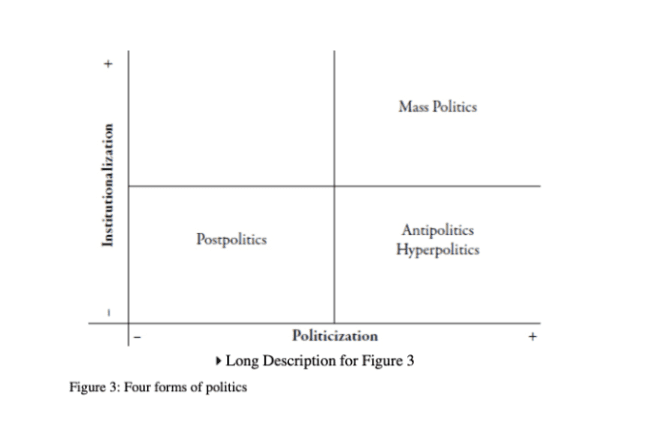
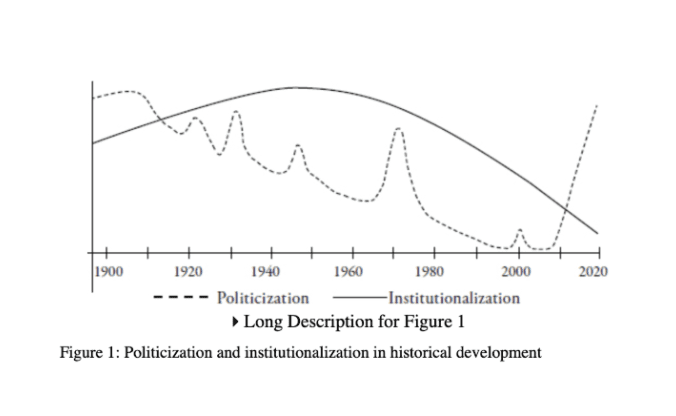
There are two skeleton key graphs—one chronological, one classificatory—that periodize and hastily summarize an expansive landscape of social history. The figures, by design, are not an exact representation of history but an “intuitive diagram, synthesizing fragments of existing graphs—of trade union density, incidence of political assassinations, size and frequency of demonstrations.” What the historian sounds out about mass politics is worth spelling out before attending to the hyperpolitical present, where all the action apparently takes place.
Broadly speaking, the proletarianized 19th-century Euro-American masses were gradually integrated and enfranchised into industrially specific, but still vastly exclusionary, national workforces, during what has been aptly summarized by the journal Endnotes as “The rise and fall of the workers’ movement, 1883-1982.” As historian Donald Sassoon once chronicled in One Hundred Years of Socialism, 20th-century liberal capitalist states saw a continually renegotiated “party truce” of budding or established social democracy between nation-states, trade unions, and international working-class movements to create historically brief and selectively beneficial “affluent societies,” whereby labor, socialist, and communist parties gradually revised down their internationalist and anti-capitalist aims or became marginalized in the name of pacifying class war.
This trend ultimately resulted in the ensuing “history of separation” of the collective worker from their historical destiny as the appointed revolutionary subject, and each generation of militants rediscovered new versions of what they saw as a betrayal of a worker-led global revolution. Jäger, strangely, does not bother to draw upon this account, or the other competing descriptions of this well-documented historical development. It’s enough to say the theoretical plank underlying Jäger’s intuition is sturdy enough, but how does he arrive at it and by what perspective?
“What was mass politics?” Jäger asks and answers: “At its height, in the immediate aftermath of the First World War, Max Weber offered a canonical definition: politics, for the German sociologist, was a ‘slow, strong drilling through hard boards,’ requiring ‘both passion and a sense of judgement.’” This choice of spokesman for mass politics is amusing and bemusing in equal measure, given Weber’s ideal type of a charisma-led “plebiscitary democracy” officially enshrined in the 1919 Weimar constitution. If this post-WWI constitutional compact is considered a foundational touchstone of mass politics, it’s a judgment that more often led away from the revolutionary mass politics of Rosa Luxemburg, and sometimes, notoriously, towards barons of the German National People’s Party like Alfred Hugenberg. Seeing the writing on the wall before she was assassinated, Luxemburg preemptively denounced this apparent document of mass politics as partly a product of the “illusion of unity under the banner of so-called socialism” amid the mounting compromises of the Social Democratic Party of Germany.
Setting Weber’s inclinations aside, Jäger’s emphasis is again placed on a kind of affective criticism: “Despite his hostility toward the radical left, however, Weber and his opponents remained children of the same age—however hieratic, his plea for vocational intransigence reflected a form of politics that presupposed institutional involvement of the populace. Both Weber and his ideological adversaries thereby shared a vision of political engagement that was markedly more patient and sustained than that which prevails in the twenty-first century.”
Implied in these passages is a disappointment with the contemporary masses for not having at their disposal the right means, personal and institutional—apparently unlike their forebears. This is yet another illusion at the level of affect, over and above what Fredric Jameson once called the “heroic cynicism” of the Weberian disposition. Luxemburg had it right in the end, even if Weber thought she belonged in a zoo: “Disappointment with the masses is always the most lamentable excuse for a political leader. A real leader doesn’t adjust his tactic in accordance with the attitude of the masses, but in accordance with the development of history.”
Instead of drawing upon alternative explanations of these historical developments, the historian demonstrates how “each political form under discussion is elucidated by reference to cultural objects that conjure its sensibility,” opting for a pictorial style canvassing how people feel about politics tout court. Memoirist Annie Ernaux is paired with Max Weber to illustrate mass politics; the conspiratorial paranoia and civilizational ennui of Michel Houellebecq is “figured as the emblematic novelist of the postpolitical era”; the Occupy and Tea Party movements are “paradigmatic examples of right- and left-wing antipolitics”; and these supercharged movements become “hyperpolitical” with Black Lives Matter and the January 6th riot. The result is a diaristic montage in gestalt form—where periodized political forms constitute backgrounds for symptomatic social foregrounds—but one that forgoes historical examination of what produces these scenes. We are meant, simply, to take them in and sort them.
Consequently, the narrative description flattens all political differences and contentions into the two-dimensional axes of the graphs. To demonstrate, Jäger writes, “On the surface, for instance, the Black Lives Matter protests would seem to have little in common with the mob that stormed the Capitol in January 2021. Morally, they are worlds apart—one protesting racism and police brutality, the other enthralled by conspiracy theories and the myth of a stolen election. Organizationally, however, these movements exhibit a striking set of similarities: fleeting in duration, they maintain no membership rolls and struggle to impose any real discipline on their adherents.” Such political judgments are studded with caveats—not with any attention to the social composition of the civil society and autonomous organizations involved in those mobilizations, but with theoretical bric-a-brac. Left-wing movements are “without an internal metabolism,” as Jäger puts it; they are “acephalous” swarms and “bodies without organs.”
The metaphor of the high-speed camera proves fitting. This is a work of cinematic potted history—it leans hard on erudite citational necromancy, but is burdened with an unreconstructed Tocquevillian purview. It would have been better that Jäger openly agreed with his French predecessor when he wrote that, “Aristocracies are infinitely more expert in the science of legislation than democracies ever can be. They are possessed of a self-control which protects them from the errors of temporary excitement, and they form lasting designs which they mature with the assistance of favorable opportunities.” That judgment, in essence, is the book’s whole argument, to the extent that an argument is positively offered. Its presentation, moreover, is renovated with an index that I would otherwise find delightful, if it wasn’t deployed for the ends of claiming that social movement participants are headless—absent a top-down organizational formation—and, therefore, presumably unthinking groups. In this way, the book recalls the worst of reactionary theories of the crowd since the 19th century. There is, just the same, a more contemporary twist.
Politics has been “relegated to a media sphere addicted to novelty, supplemented somewhat hopefully by the participatory promise of Web 2.0,” Jäger laments, though he has the Internet’s addiction to novelty to thank for the book’s marketing. For all of his apparent uneasiness with media becoming the premier expression of political engagement, Jäger consumes an entire century by way of the sort of statistical schemas usually deployed in journalistic positivism, along with the selective cultural testimonies that are typical of consumerist trend-watching. Less a theory of the spectacle, Hyperpolitics is an ethnography of the spectator, with accompanying graphs. Stitched throughout is an admitted melancholy for a fleeting “ideal-type” of classic mass politics—instantiated by the coupling of institutionalization and politicization ( first in the 1910s, and then in the 2010s, according to Jäger’s graphs), but where the broader trends are inversely proportional.
Hyperpolitics summons an economistic trick of perspective to ensure the viability of its conceptual repertoire. If you bisect the second place where the trend lines intersect during the “decade of protest” of the 2010s, you’ll find the stigmata of our historical present in the ominous and uncanny shape of the letter K. Jäger divines the sign accordingly. It’s worth quoting him in full, since it’s the most robust substance of his contemporary analysis:
Throughout the recent “decade of protest,” the secular decline in American membership organizations also accelerated; unions, clubs, associations, political parties, and even—spectacularly for American life—churches lost members, exacerbated by the rise of a new digital media circuit and tightening labor laws, accelerated by the “loneliness epidemic” that metastasized out of the actual one of 2020. The result is a curiously K-shaped recovery: while the erosion of American civic life proceeds apace, the country’s public sphere is increasingly subject to convulsive agitation and controversy, from online conspiracy theories to the storming of government buildings. General discontent runs high, fueling political emotions; anger at police racism or Zionist violence—at immigrant crime or Chinese weather balloons—boils over.
The result is a preponderance of social media “wars of movement” over institution-building “wars of position,” with the primary forms of political engagement as fleeting as market transactions. This is more a matter of necessity than of choice: the legislative environment for durable movement building remains hostile, and American activists must contend with a vitiated social landscape and an unprecedentedly expansive culture industry.
As a measure of recovery from the 2020 pandemic, economists have come to a basic consensus: the general economy is again bifurcated with haves and have-nots in a K-shape, to the benefit of the upward incline of the letter. The trend is most pronounced in the service economy: asset-owners and high-income salaried workers are doing better, whereas asset-less, low-income, and at-will workers in retail, hospitality, and other services are doing worse.
As the authors of The Asset Economy sharply identified in 2020, “the key element shaping inequality is no longer the employment relationship, but rather whether one is able to buy assets that appreciate at a faster rate than both inflation and wages.” With President Trump back in the driver’s seat, the U.S. political economy has found its proverbial regressive Caesar, whose breakneck supply-side policies and shocks—deregulation, tax cuts, tariffs, and war-driven heists—serve the sole purpose of short-term economic windfall for some asset owners, where the elite’s share of the spoils overtakes every other consideration. The rest be damned.
The guiding presupposition of Jäger’s account is that where the economy goes, the emotional tendencies of the general public follow—a kind of economic determinism of affect. This is a significant shortcoming of the book’s gestalt method. The approach all but requires that foregrounded media and cultural representations become incidental, symptomatic expressions of multidimensional conflicts within and between political society and civil society, whose historical unity is realized in the state—to borrow Antonio Gramsci’s classic formula.
To define the situational terms for the sake of simplicity: for political society institutions, think of governments composed of their traditional parties, agencies, bureaucracies, branches, law enforcement and military, the judiciary, and official political representatives. For civil society institutions, think of NGOs, trade unions and businesses, universities and schools, professional associations, media companies, movement and advocacy orgs, etc. To the extent that these respective sides of the uniform state are in conflict over bureaucratic composition, administrative policies, and visionary political ends, Jäger has little to say on the matter. Instead, the foregrounded and selective media representations are reducible to the feelings of the institutional actors and consumers alone, which, in turn, reflect a supervening economic trend.
Can it really be said, for instance, that “anger at police racism or Zionist violence” is a direct expression of the K-shaped economy? That frame would suggest that if you’re on the rising incline, you feel one way, whereas if you’re on the declining side, you feel another way. That’s roughly plausible, but it would need to be demonstrated. Instead, the argument bypasses a closer investigation of the institutions that mediate the economic determinations in social-political life that are involved in, say, police racism or Zionist violence—but not only in those. The economic determination does all the explanation of the heterogenous feelings involved, which are routinely treated as the paramount concern. It’s far too easy to see “institutionalization” as a net social good when the reasons for the combustible dynamics within institutions are bracketed out of the picture to suit a narrow consensus that emotions are running high—ostensibly from the cinematic perspective of the consumer-worker.
In other words, the old formula that the economy determines ideas has been replaced with the idea that the economy determines how people feel—one oversimplification for another. In this way, the book is productively frustrating: the assumption that the economy determines the shape of political strife is generally a solid one, but, if left underspecified, it’s ultimately a useless truism, vulnerable to collapsing into the ruling ideology that has its own institutionally dominant means for translating the economy into politics. In a fitting irony, Jäger’s modest prescription dissolves into the solution of extant political-economic limits and historically exhausted struggles: “Today’s impasse can hardly be undone by a voluntaristic act of will, simply because a young Belgian historian exhorts citizens to join a local party branch or take out a union card.” He concludes the book by extolling the heroic cynicism with which it began, but now in a minor and melancholic key. Humorously, Freud gets the last word, diagnosing a “‘cyclical insanity’ that leaves the patient prone to ‘the regular alternation of melancholic and manic phases.’” Jäger’s argument is cyclical on its own terms, ever circling an absence, which we will come to in a second.
As Freud once also rightly insisted, affects are not repressed—you consciously feel what you feel—but ideas tied to affects are often not conscious. The upshot is practical: it’s illegitimate to say to someone, “I know how you really feel, despite what you say you feel.” In some respects, I’m grateful for the historian’s diagnosis, and it’s fine to grant that the emotional landscape is volatile, and that “economy” and “feeling” can be rough situational synonyms. But does his account do justice to the structural and epistemological causes of these turbulent feelings? The answer is ultimately negative, but that requires naming some mistaken ideas and absented explanations.
Nonetheless, all that is old is new again, and it suffices to repeat Gramsci’s judgment that what is at stake in Jäger’s argument reduces down to “a rotation in governmental office of the ruling-class parties, not the foundation and organisation of a new political society, and even less of a new type of civil society.” The brisk presentation of Hyperpolitics amounts to rearguard revisionism, updated for the 21st-century landscape, to comfort those afflicted with political anxiety over the rolling crisis of the present, where passive patience is the counsel for those waiting for order to be restored via already-dominant institutions.
“At a certain point in their historical lives, social classes become detached from their traditional parties. In other words, the traditional parties in that particular organisational form, with the particular men who constitute, represent, and lead them, are no longer recognised by their class (or fraction of a class) as its expression,” as Gramsci also wrote of his fascist present, refreshing the memory of the unoriginal crisis of our moment. This is Jäger’s thesis in nuce, but in his hands, it becomes a poorly historicized political novelty, and a vehicle for dubious sociological concepts that do more to confuse, rather than clarify, the nature of the crisis. Let’s do the clarifying he passes up.
In a telling way, Jäger is constantly at pains to distinguish between the apathy and unresponsiveness of representatives of the ruling class and the anger and discontent of those they represent. Instead, he takes the conventional third perspective of the observant sociologist describing existing institutions, while otherwise holding the masses responsible for not adequately transforming them—a rather doctrinaire neoliberal habit of “responsibilization” from above, rather than from alongside, as Wendy Brown once named it. To the extent that Jäger’s prognosis is that “hyperpolitics” will continue by sheer inertia—because of a lack of mass participation in traditional parties and institutional bulwarks amid global economic stagnation—it appears to rest on the same kind of nostalgia for consensus reality of the 20th-century social democratic party truce that he would taunt end-of-history consumers for holding at a later period.
Perhaps because he tends to use the first instance of Euro-American mass politics to express disappointment with the second, Jäger’s conceptual vocabulary strains to account for why there would be two instances of mass politics set a century apart. There is a notable gap in the account, which he parenthetically acknowledges: “It should by now be clear that hyperpolitics does not belong in the remaining quadrant—low politicization combined with high institutionalization (a space better suited to the second, more pacified phase of mass politics).” This lacuna in the conceptual schema is precisely where the explanatory work would be, and to fill it out with content, the high-speed camera has to be slowed down and placed at a different conceptual vantage.
“Low politicization combined with high institutionalization” hardly describes an absence in the political landscape; in fact, it might be the most prominent and effective dynamic around, because it describes state coercion, the discipline imposed on the working and unemployed, and the institutional compliance that’s exacted across the board when violence is deployed against vulnerable populations—also an expression of mass politics, albeit a negative one. If hyperpolitics names a real trend, pacification by consumption is clearly not working, and seems to have been supplanted by something worse. Yet there’s no aspect of the graphs or narrative account that articulates the rising incidences of state violence or civic and workplace trends towards the increasing suppression of discontent, with institutional exactions preserving the order of things. The recent conviction of eight anti-ICE direct actionists prosecuted on charges of providing “material support for terrorism” after a July 4th, 2025, protest outside of ICE’s Prairieland Detention Facility is just the latest example.
Government, civic, and labor discipline, when taken together, form an explanation that is plausible, at least, for the mobilized but ineffective masses, even if it’s a bit humiliating to acknowledge as a mass phenomenon. An account of the stratified echelons of disciplinary force and oversight in the rank-and-file of society—and the selective protection and license afforded by the state when it’s not organizing the abandonment of the most vulnerable—is central to this understanding. This makes its absence in Jäger’s analysis even more astounding. What would the trends in institutionalization and politicization look like if they included immigration enforcement and deportations, evictions and homelessness, vast security and surveillance systems, mass layoffs, administrative gutting and defunding, the winnowing of labor ranks, union busting, prison and court rolls, mass arrests and prosecution of dissidents, university and company disciplinary firings, and DHS, paramilitary, and police activity—in short, the standard role of capital’s discipline, reinforced by the state’s coercive arms.
Perhaps this is too American a problem for Jäger’s taste, but coercive institutions are still institutions, and a Tocquevillian spectator could once see clearly how U.S. problems become, perforce, the world’s problems. The current conflagration within the global economy, a bonfire lit in the name of subduing or eradicating Iran, speaks for itself. The already-naïve idea of a “politics of exit” (which, in the capitalist world system, always means a trap door back into the market) has died on the vine. The totalizing social process of an institutional law-and order administration—another name for the all-consuming shadow of war, civil or otherwise—is aimed at securing what remains of the U.S.’s dominance.
In times of war and peace, as Jäger acknowledges, “capital-c Capital” organizes society as its last impersonal boss and first disciplinarian of survival. There are no rights outside of capital, as the Italian Autonomists said. But in a work that’s premised, in part, on the weak-determining power of economic factors over the social, Jäger somehow elides the concept and force of political-economic administration in favor of, ironically, a liberal focus on the voluntarism of the institutional subject, and its (absent) autonomy within the (absent) mass. It’s a variety of intellectual malpractice to depict voids and aligned forces in social and institutional associations as merely voluntary arrangements by way of Robert Putnam’s short-sighted notion of “social capital.” These dynamics are an illusion of purely individual preferences on the market-dictated and state-disciplined menu of options. This is especially true in the iron times of our moment, when social atomization is engineered, extant institutions of social welfare regularly dismantled, surveillance well-financed and automated, autonomous associations of workers and tenants threatened, political repression institutionally coordinated, and compliance from employees of all stripes routinely exacted. Minimally, “politicization” here just means you refuse the imposition of this social, political-economic, and institutional overdetermination.
Nikhil Pal Singh has rightly described one false and illusory path in this situation in a recent essay, writing, “Trump’s former consigliere Steve Bannon once promised to “deconstruct the administrative state.’ Like most right-wing, anti-state discourse, this statement should be turned on its head. The Trump administration is in fact advancing a ‘whole-government approach’ to immigration enforcement, which widens and integrates the state’s coercive ambit.” This larger development of the authoritarian-populist and anti-state state administration, as Ruth Wilson Gilmore has demonstrated, is over a half-century old—and, per Alberto Toscano, also characterized fascist Italy. But it might as well not exist in Jäger’s eyes. Thus, the typical interpretation of the anti-state state putsch of January 6th should also be turned on its head, altogether reframing the supposedly equalizing hyperpolitics involved. The event was hardly inconsequential, since it continued to catalyze the consolidating force of the coercive U.S. state, even if it punished and pardoned the willing participants in its own alternating bipartisan image.
Nevertheless, on the model shared by many commentators still wedded to a fast-receding Cold War liberal hegemony, the mistaken assumption of Jäger’s account is that politics should be administered and institutionally divided between political society and civil society—a classic right-Hegelian tenet, and one habitually deployed to sanctify the state of rogue or insurrectionist elements. This assumption is not Jäger’s but one instituted by the path-dependent organization of liberal society that has long managed its divisions, where a spurious and selective artifice separates out the market and the state with its police protectorate. Still, it’s a presumed institutional division that remains largely unquestioned, even as the formal divide is actively falling apart by coercive means. The primary casualty of the end of the neoliberal consensus is escalating antagonism within “civil society,” and between those institutions and official “political society.”
This dynamic “might bear on the earlier question, raised in connection with Trump and fascism,” Jäger concedes, and then wonders “whether the right wing of the political spectrum has been more effective than the left in generating new forms of social capital, or at least preserving what remains?” This direction of inquiry is the most fruitful on his own terms, briefly investigating the extent to which certain segments of civil society and classes are aligned within shifting party coalitions. Yet the overreliance on seeing the horizon of political participation from the perspective of electoral coalitions foreshortens the inquiry, and it slides back into the neat symmetry of the titular concept: “On the policy front, however, achievements have been painfully ephemeral. Nor is this judgment limited to the left. On the right too, movements from the Tea Party to Stop the Steal flower and wilt with unnerving rapidity. Rather than concrete results, what all these political objects share is the ability to reproduce frenetic activity, relayed by an increasingly digital public sphere. Hyperpolitics bursts forth periodically only to recede, less a corrective to postpolitics than yet another manifestation.”
As is frequently the case in his analysis, there is partial truth to this description. But Jäger’s analytic meter only gauges the degree to which antagonisms in civil society rise to the level of legibility in political society, while otherwise presuming an abyssal black hole where an apparently post-political mass consensus used to be. After President Trump returned to power, Dylan Riley articulated the relevant intellectual corrective: “Civil society, as Gramsci understood, and as today’s liberals do not, is a terrain of struggle. It is not, and cannot be, an agent… This is a struggle for hegemony fought on the terrain of civil society, not a struggle for or against a (mythical) realm of pre-political consensus and practical problem solving—what Gramsci would have called a war of position.” Civil society, then, is where fascism and socialism are struggling for primogeniture, and the escalating conflict has surely entailed what Jäger might call “hyperpolitical” effects.
Still, against Jäger’s concept of hyperpolitics—one that understandably searches for the appropriate protagonist within the institutions of the state, only to come up empty—Marx’s early contention and critique of Hegel’s notion of the state proves more apt: “A class of civil society which is not a class of civil society, an estate which is the dissolution of all estates… which cannot emancipate itself without emancipating itself from all other spheres of society and thereby emancipating all other spheres of society, which, in a word, is the complete loss of man and hence can win itself only through the complete re-winning of man,” Marx wrote, “This dissolution of society as a particular estate is the proletariat.” Setting aside the irony of Jäger’s apolitical theory of hyperpolitics that foregoes any concrete attention to the composition of working society, the book’s banner concept is ultimately not a helpful or useful description in our conjuncture, which is perhaps why he has already disavowed it.
Consider how in January, during ICE’s federal invasion, protesters and veterans of the George Floyd uprising targeted Cities Church in St. Paul to contest David Easterwood, the church’s pastor who was also serving as an active ICE official. The protests were accretions of the autonomous community self-defense practices built out from the previous uprising, and the protest’s actors are inseparable from their social and institutional contexts. These activities led to the arrests of civil rights attorney Nekima Levy Armstrong and St. Paul school board member Chauntyll Louisa Allen for allegedly violating the Freedom of Access to Clinic Entrances (FACE) Act. Jäger’s diagnosis of increasing politicization without institutional affiliation is entirely useless to explain these dynamics, where there is an active conflict within and between civil and political society and its representatives. If this is also an example of Jäger’s “hyperpolitics,” I fail to see the problem with its generic rise, unless the unstated ideal is pacified and apolitical consensus—ratified by the imprimatur of official institutions—and one possibly on the default side of local churches providing ancillary support to federal immigration crackdowns.
In a recent essay for The New Statesman, Jäger has helpfully named one of the more bizarre problems of our current terrain of political dilemmas. The triumph of the right has often depended on shedding the pretense of governing as an impartial state arbiter, neutrally managing the balance between political and civil society. Whether due to social democratic tepidity or liberal piety about the state’s aristocratic import and legislative impartiality, no such aspiring “hyperpolitical” official partisan or executive organizer-in-chief yet exists for the left. Alexandria Ocasio-Cortez and Zohran Mamdani have not met the moment here beyond soft-pedaling social democratic rhetoric and initiatives that fall within the constraints of normative liberal governance—thereby repeating, without much novelty, the already-defeated historical traditions of social democratic compromise subordinated to capital.
There is a stark opposition polarizing the existing tendencies of U.S. social democratic representatives. Either they might use their pulpit for the restorative ends of preserving U.S. political society, and for efforts to rebalance technocratic institutions as impartial purveyors of incumbent governance and national unity—or they might actively mobilize, direct, and furnish state resources for partisan antagonisms in international working society, with the aim of overcoming the limits that the liberal capitalist state places on their professed socialism. The former (and altogether passive) defensive strategy appears to be the prevailing choice of compromise, both on the world stage and domestically—despite prefigurative socialist rhetoric and widespread, state-sanctioned attacks on left-wing causes.
There have also been glimmers of the latter offensive strategy, which would offer the capacities and resources of the state to the working masses, empowering them to organize and act against social and political entrenchments of capital—as with Mamdani’s modest municipal project of New York City’s “rental ripoff” hearings, the city administration’s “mass engagement” proposal, and their broadcasting of support for strikes and city services. These initiatives are promoted by media-driven marketing and draw from well-funded infrastructure for perpetual electioneering—which sometimes be an end in itself, advertising that social democracy is good and responsible governance.
Such campaigns are mobilized through civic exuberance and hostility to official political society—but once the Rubicon is crossed and electeds become a fixture of that same official political society, the energy dissipates. The promise of a wider ideological and civic state takeover falls back on the official means: slower counter-hegemonic electoral work, staged by media-oriented political theater. Even when they succeed, individually advantageous electoral campaigns—animated by “populist” discontent—routinely crash into the state edifice of technical, economic, and legal management of “working-class issues,” rather than furnishing unifying conditions for that class to act and organize for itself. This is its own kind of dynamic that slides between chronic malaise and hyperactivity, and it’s to Jäger’s credit that his concept is perhaps best applied here—despite the upshot of his own retrogressive prescription. Nevertheless, this variety of “hyperpolitical” repetition is, by constitutional and hieratic institutional design, one that still accords with pathological dependence on the party system, the purpose of which is the to continue the bipartisan ritual of taking turns to enjoy incumbent spoils and protections.
In the case of left-wing movements in the shadow of the state, Jäger doesn’t offer a single word about the global Gaza solidarity movement, even though this dissident movement continues to actively fight state security apparatuses, and has even ruptured existing electoral and non-electoral coalitions on the left in profound, possibly lasting ways. It stands to reason that the command structure consolidating civil and political society will only grow at the behest of state coercion, further delimiting the efficacy of organized public pressure and deterrence of government actions and policies from below. But to call this “hyperpolitics” on Jäger’s terms is to confuse a largely unaccountable and punitive official political society with personal ambivalence about the activation of political commitment and the heightened anxiety involved in the realms of working and institutional life.
It’s a tactical and strategic question whether political activity is a boon to the stability of existing dominant institutions. Despite the recycled and limited proposals of winning elections for top-down governing mandates or restoring trade union density, these incidental achievements in shifting the balance of power are not measures of pure success. Rather, they are negotiated and provisional truces within the state that constitute their own limitations, as the 20th-century labor movement taught us time and again. Riots, mass unrest, and prohibited direct action were just as historically vital as strikes and a good union contract.
As the late comrade Joshua Clover once argued, the era of riots has been renewed because the earlier historical truce between international working masses and their traditional institutional representatives has been hollowed out, giving way to a “sclerotic economy” of global stagnation, large-scale productive incapacity, and capital concentration. As a result, the sphere of circulating commodities has been left open to self-organized seizure. The Internet and social media constitute an overrepresented field of play and struggle, but everyone is locally and globally enmeshed in other institutions, workplaces, and various places of potential immediate activity. Institutions are the sum of their aggregate, dynamic, and conflicting political activities, where politicization is neither mechanically binary—on or off—nor a matter of individual heroism and popularity.
In the end, if there is a symptom worthy of the name hyperpolitics, it is one that’s enacted by the book—and that is consequently enacted by this review as well, if only in part. It’s the tendency to consume and analyze political spectacles from the Archimedean point of official political society and the erratic tendencies of modeled market activity—viewed on the personal cinema of one’s phone—while keeping a studious distance from participation in political movements, street mobilizations and riots, and institutional and workplace conflict. A commitment that moves beyond spectatorship toward active thought and partisan political agitation within working society used to be called “the philosophy of praxis.” This transformation where social commitment generates wider political formations and activities, independent of official political society, would mean that hyperpolitics is negated as a symptom and debilitating limit.
Instead of being seen as a symptom, hyperpolitics could be treated as a social cause and shared condition around which people might rally in order to overcome the depoliticizing and demobilizing paralysis of both individual inhibition and the effects of state coercion and flattening capture by formal institutions. This is more than a matter of solidarity; it’s a matter of socializing the problem and shouldering shared risk in the long shadow of the state. Almost everything still depends on a wider social transformation from atomized inhibition to political participation and revolt, broadly conceived—regardless of the instrumental use made of formal institutions. But Jäger provides an account of little but the surfaces and symptomatic emblems that exist prior to such political commitments. He might be one of its most immediate case studies; that’s for him to decide.
Nevertheless, in the spirit of practicing what I’ve preached here, the larger ethical-political implication of Jäger’s book is that we should be more tolerant of the symptoms of hyperpolitics. Ultimately this means a tolerance for conflict, so far as the symptoms represent ambivalence between “post-political” frictionless consumerism and “anti-political” disaffected apathy. The difficulty, however, is not solved by instituting top-down affective discipline out of nothing; paternalist demands on another person’s emotions are often dead on arrival. Rather, it’s a matter of cultivating a capacity for shared political commitments, which of necessity exceed the relative stability of existing institutional compromises, and doing so regardless of whether it stirs up conflict and heightens anxiety. Institutional compliance and quietist obedience in the name of preserving top-down order might pacify hyperpolitical affects, but at what cost? That demand for order is itself a kind of impatience.
All the same, the cover of the book represents the case-in-point. Its photographer Wolfgang Tillmans and his subjects are held up as perfect specimens of the consumerist post-political subject at the end of history. Unfortunately, they were not spared in the hyperpolitical tumult after October 7th, which again, Jäger somehow fails to mention. In a plaintive address to his fans about his political positions, Tillmans tucked away his own parenthetical concession to state compliance: “I do not share the BDS position, and disagree with it.” After all, he has photographs hanging in Jerusalem; what would happen to them if BDS became the globally dominant position? Perhaps it’s relatively true that we’re all wishful apolitical consumers negotiating the agonism staked out between anti-politics and hyperpolitics. But if those are actually the limited options, it’s best to be unequivocal like Tillmans and unlike Jäger: Hyperpolitics? Yes, please.♦
