

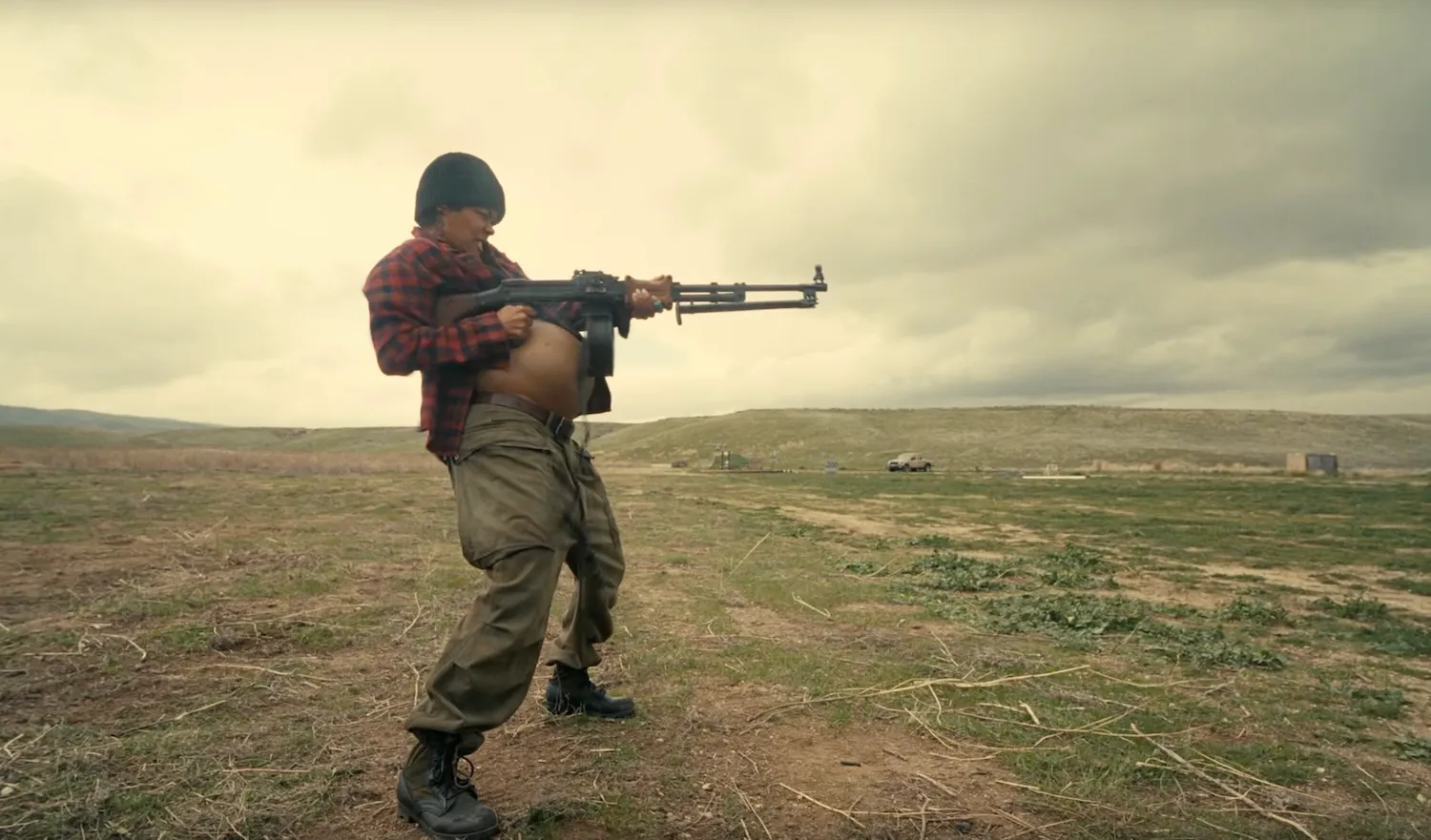
People with wireframe glasses like mine seem to have a lot riding on this movie being really good. I think that it’s pretty good for what it is—a sweet, funny, well-crafted action movie about parenthood—but I want to pause for a moment on the emotional investment itself. Contained within it are really two investments, each informing the other: a hope about the movies and a hope about radical left politics.
First, there’s a hope that this means “the movies are back,” a glibly general celebration that disguises a more specific idea of what movies are and what makes them good. Once upon a time in the ’70s, there was New Hollywood. A crisis of the old studio system meant young upstarts could come in and make dark, risky masterpieces with mid-to-large budgets for wide audiences, sometimes confounding popular taste but often hailed by a new set of critics and later accepted as classics. Easy Rider, The Godfather, etc. These films were neither golden age musicals nor Passion of Joan of Arc. They filled an edgy new upper-middle-brow niche that served as an aesthetic vanguard, reshaping the whole industry in a dynamic that lasted until sometime between the fall of the USSR and the dot-com bubble.
I’d like to emphasize, at the risk of stating the obvious, that New Hollywood formed the foundation of what we might today, begrudgingly, call our “cinephile” subculture. The subculture might be broader, encompassing the original revolution’s contradictory source material (international and art cinema demarcating one boundary, genre and schlock connoisseurship the other), but it’s grounded in the New Hollywood dream of overcoming the contradiction, or of not having to choose. This is, of course, the prehistory of Paul Thomas Anderson himself, dropping out of film school in the ’90s to make a movie about the groovy ’70s, with an arty iconoclasm mingling with fantasies of making his own Terminator 2. It’s also the prehistory of all us Letterboxd users, literal or figurative.
The New Hollywood moment has definitively ended. The kind of movie that begat that cinephile niche and still serves as its center of gravity has been in clear decline for almost two of the five decades since its birth. We have the A24s of the world—carrying forward the middlebrow banner to increasingly diminishing results—and an anomalous, semi-risky recent run from Warner Brothers (e.g. Sinners), but a Robert Eggers picture in 2024 will never have the same place in culture as a Scorsese in 1990. And a Scorsese in 2024, no matter how good, feels a bit like a reunion tour. Where’s it all headed? As Simon Reynolds lamented of popular music (and Mark Fisher lamented of all pop culture) a decade ago, the sense of forward motion is gone.
One Battle After Another arrives heralded as a real contender to overcome this malaise, to return a sense of dynamism to a stagnant industry. There’s a couple reasons why this might be plausible—because PTA is one of the youngest of the old masters of the Long New Hollywood (c. 1965-1999), or because the film seems to hit the upper-middle-brow sweet spot just right (Pynchon plus DiCaprio, action comedy with a Johnny Greenwood score). But whatever’s driving the hope about OBAA, it seems to be less about having good movies to watch and more about the cinephile subculture still having somewhere to go. The cinephile’s dream for the movies—art and entertainment, authenticity and mass relevance—still has legs. The middlebrow vanguard is still viable, with both a rarified integrity worth preserving and a wider public receptive to it in some form.
Beyond the movies, the cinephile’s dream expresses a much deeper cultural tension. When, in 1979, Frederic Jameson issued his famous call in “Reification and Utopia in Mass Culture” to “read high and mass culture as objectively related and dialectically interdependent phenomena, as twin and inseparable forms of the fission of aesthetic production under capitalism” he focused on formal qualities linking the two. Taking repetition as his key example (cutting across pop singles and genre fiction to Gertrude Stein and Robbe-Grillet), he argued that high and mass art couldn’t help but share such qualities because each was a parallel, “antithetical” response to the same structurally-determined “dilemmas of form and audience.”
The argument was sophisticated, but the intervention was simple: neither high nor low culture is “the good one” for a Marxist critic. Both are implicated in the same contradictory totality for better and for worse. Both promise to solve problems that they can’t solve. This observation set the stage for Jameson to advocate what was, at the time, a surprisingly redemptive reading of works of mass culture, arguing that they “cannot be ideological without at one and the same time being implicitly or explicitly Utopian as well: they cannot manipulate unless they offer some genuine shred of content as a fantasy bribe to the public about to be so manipulated.”
Jameson’s thesis looks particularly plausible applied to the commercial cinema of the 1970s which seems to have directly inspired it; it’s appropriate that he ends the essay with case-studies of Jaws and The Godfather. And the thesis might, therefore, appear to fit well with the cinephile sensibility sketched above too. But while some cinephiles might seize on Jameson’s identification of utopian kernels in Hollywood to defend it, today we’d do well to focus on the other half of his formulation. That hope is bait in a trap.
In Jameson’s usage, ideology is all about promising resolution, in fantasy, of objective social contradictions. All culture, then, is ideological in this strict sense, but I would suggest that the cinephile dream itself is too, insofar as it articulates a fantasy of resolving the objective contradiction between cinema as high art and cinema as mass culture. Whatever other objective social tensions the films of New Hollywood expressed and assuaged for their audiences, they also expressed and assuaged this one.
Then again, by the time of Jameson’s writing, the merger of high and low had itself become increasingly “objective” and overt. In the same essay, anticipating his magnum opus on post-modernism by two decades, Jameson noted a growing “interpenetration” of high and mass culture. Citing developments across the arts (notably Pynchon in literature), he observed how this aesthetic intermingling revealed the much older inter-dependence in which he was interested, but also suggested that it was a new development. While the distance between the high and low had always been somewhat illusory, now it seemed to be disappearing entirely. Writing in 2014, long after after this tendency had already hit its limits, Mark Fisher eulogized it as a “popular modernism”—encompassing everything from post-punk and brutalist architecture to Penguin paperbacks and the BBC Radiophonic Workshop—wherein “the elitist project of modernism was retrospectively vindicated” while “popular culture definitively established that it did not have to be populist.”
The conceptual boundaries and periodization here are slippery, and the themes are familiar enough that even the terms coined to describe them feel tired and dated. This isn’t the place to rehash them. But the cinephile niche played no small part in the interpenetration they describe, and has shared all its ambiguities and rapidly accumulating “hauntological” dead-ends. With a few decades of hindsight, we can safely say that, like all capitalist resolutions to capitalist contradictions, post- and popular-modernist fixes turned out to be both short-lived and ambiguous. The same is true of their cinematic subsidiaries. I’d be the last to deny that, at its best, Long New Hollywood produced works of enduring value. Much of the canon remains close to my heart. But at its worst, it contributed to a perverse, hollow parody of the merging of high art and mass culture we might hope for in communism, and this dimension only got worse over time.
Nevertheless, a bad fix still has its appeal, and OBAA seems to authorize us to believe there’s still some gas in the tank on this whole thing—if not for popular modernism in general, then at least for the movies. This reading would go a long way towards explaining the pre-release hype around formats, the repeat viewings (“this is history right here!”), and especially the more breathless initial reviews. Many of the first assessments, like that of NPR’s Bob Mondello, also hailed OBAA as the film for our political moment; and politics—radical left politics—seems essential to the hope for popular cinematic renaissance. This makes sense. The post-New Hollywood canon closely tracked, with a few years’ delay, the afterlives of the amorphous New Left-aligned counterculture from which it was born and on which it relied for much of its edge and urgency.
This is where the second hope comes in, the political hope. It’s more straightforward. Things are really bad right now. People want clarity about what’s happening, what to do about it, where to draw the battle lines. They want not just a movement, but the Movement (as the kids used to call it), either to join or to critique or just to orbit. But right now all we have are these desires and the absence at their core. There are current or threatened catastrophes, atrocities, and there are campaigns and occupations and occasional riots, brave and noble individual and small-group efforts, even movements in the plural. But it would be tough to claim that these threads and tendencies and events currently add up to more than the sum of their parts, and even tougher to say where they’re headed. A decade and a half after its Occupy-era revival, the US left is fragmented, disorganized and, on the whole, demoralized.
That’s how it was in the late ’80s too, when Pynchon was writing Vineland, on which OBAA is loosely based. The book is mostly a bitter rumination on that state of affairs, clearly drawn from close attention to actually-existing ’60s veterans’ efforts to weather the Reagan era. OBAA, on the other hand—transposing the story roughly to the present—might center our own era’s emergencies, but its picture of the left is unrecognizable, even as idealization or parody.
Take the French 75, the revolutionary organization at the center of the film. I’d assumed that this was a plot point taken from Vineland. Urban guerilla cells were an iconic feature of the New Left in the US and globally, and many lasted well into the ’80s (operationally and in pop culture). In OBAA, the French 75 participates in armed robberies and a raid on an ersatz ICE facility; in Vineland, the ex-revolutionaries had only ever been involved in a radical film collective and a university occupation. The US has had some of those in recent years, but no urban guerrilla units to speak of. Why lean into the anachronistic fantasy?
Well, it serves the kind of feel-good story PTA wants to tell. Which is to say, it plays it safe. You get the romance of armed New Left communists, but amputated from the baggage of historical defeat or presently credible threat. You get the sheen of relevant issues (e.g. immigrant-centered fascism), without any reference to our present lack of clarity or unity on what to do.
Comparing the movie to forerunners and inspirations to New Hollywood like La Chinoise and Zabriskie Point, New Yorker film critic Richard Brody notes the latter films’ “documentary-like contact with real life activists” in contrast to Anderson’s “old-fashioned movie about the world of today… a vision of hopeful possibilities that remains unmoored from realities.” An unmooring from present realities, however, may be the movie’s biggest selling point: an escapism that, however well-crafted, fits all too comfortably within the usual kitsch. Another anxiety assuaged. To admit that OBAA’s political content is silly but to insist the shallowness is secondary to the movie’s real virtues as a solid adventure story is to miss the eminently political worries the fun and sentimentality are working to soothe. If all art, following Jameson, promises to resolve tensions like these, it’s no crime (even if it can never quite deliver). But there are better and worse resolutions, even in fantasy, and maybe some anxieties are better left unsoothed.
The hype and hope around OBAA is about the twin torches lit by New Hollywood and the New Left. With each, a process was started, a collective project with forward momentum. But before long, the torches started to dim. The process stalled, turning from progress to pastiche and from tactical retreat to co-optation. While OBAA has a right to do its own thing, Vineland is sharp on exactly the point that the film studiously avoids; so is, for example, Network (1976), an even earlier and bleaker New Hollywood take on mass media, conspiracy, and foquismo in the metropole. In OBAA, the battle lines remain clear, even as Perfidia crosses them. In the book and in real life, they got pretty blurry. As the revolution stalled, it became harder to remember what “sell-out” or “traitor” ever meant in the first place. How can you abandon a cause that may no longer exist? How long can you march through the institutions without being absorbed by them? Are you holding the line or just living in the past? Pop culture (or the Culture Industry, or the Spectacle) was central to the growing confusion, as Pynchon and Network screenwriter Paddy Chayefsky were painfully aware. Now we’re decades away from even their grim diagnoses and the room’s just about starved of oxygen, smothered in Marvel Cinematic Universes cosigned by the Department of Defense and Instagram reels of pregnant AI cats shuffled in with emaciated children in Gaza. Instead of worrying about the direction of the revolution, we’re worried, with good reason, that the lights are about to go out entirely.
In our presently degraded state, OBAA has become a vehicle for the wish that we can keep the torches lit by ignoring both historical defeat and contemporary fragmentation, by simultaneously fleeing from the present to the past and from the past to the present. But that’s where we already are; “yesterday, but today” is just today.
The end of the movie underscores the double meaning of the title, not just nonstop combat but each generation picking up a new battle where the last generation’s left off. Willa dispatches the white-supremacist assassin pursuing her before Bob even catches up to them, deflating the rescue mission anchoring the film’s latter half. As the optimistic end-credits music starts to roll, Willa heeds the call of a HAM radio dispatch and rushes off to a protest while Bob, stoned on the couch, fumbles with his phone camera, telling her to be careful. For Anderson, we can pass the fight on to our kids despite our failures and weaknesses. Bob isn’t equipped to save Willa, but the training he gave her enables her to save herself. Those to come can follow our example and learn from our mistakes, can finish what we started. It’s a deeply hopeful and humane assertion, and, I think, true. The film also, however, seems to have helped stoke a sort of manic denial of our current impasses, undermining exactly the generational learning on which its optimism is based.
The auteurs of New Hollywood were opportunists, seizing the means of film production in a brief window where such a thing seemed possible. It worked out well, too well, for everyone. The movies were reinvented and a senescent Hollywood was saved through creative destruction and hip restructuring meted out by new entrants teaming up with the savvier execs of the old guard. Film scholar Jeff Menne’s label for the era, “Post-Fordist Cinema,” sums it up well. Just as in the transition from Fordism to post-Fordism, revolution was folded into renovation. Is it any surprise that, as the sun sets on the autumnal post-Fordist phase of the long American Century, the movies would have to change again? OBAA, however, is not a change of any kind. It’s a last hurrah for a model of film that’s well past its expiration date. Whatever was true, good, or beautiful in New Hollywood and its afterlives might be better pursued under very different conditions still to come. They’re coming either way.
Yet somehow, we still find ourselves clinging to the artifacts of defeat. Learning from experiences that involve loss requires an ability to mourn, to let go. The clinging of melancholia suspends this possibility. A variety of what we’d now call depression, Freud focused on melancholia’s trademark “painful dejection, cessation of interest in the outside world . . . inhibition of all activity” and incessant “self-reproaches and self-revilings, [culminating] in a delusional expectation of punishment.” Anyone who’s spent much time in Signal group chats in the past decade or so will recognize these feelings well. Freud speculated further that “the content of mania is no different from that of melancholia, that both disorders are wrestling with the same ‘complex’, but that probably in melancholia the ego has succumbed to the complex whereas in mania it has mastered it or pushed it aside,” resulting in opposite symptoms. Later analysts would develop the co-constitution of depression and mania, of mania as a defense against depression. Anderson’s film provides an excellent illustration of such a manic defense. The dejected, inward, inactive ex-revolutionaries are thrust into twitchy, frantic action. The punishment that the first half leads us to expect, maybe even want, never comes. The heroes win, somehow, with the vast network of para-state fascists around antagonist Lockjaw seeming to evaporate with his defeat. Nothing has changed, but everything is now fine.
In 1999, Wendy Brown resurrected an epithet from Walter Benjamin to excoriate the “left wing melancholy” of the turn of the millennium, a “mournful, conservative, backward-looking attachment to a feeling, analysis, or relationship that has been rendered thinglike and frozen in the heart of the putative leftist.” More recently, Enzo Traverso reminds us the left has had such a perennial, politically ambiguous melancholic streak since at least 1848. OBAA illustrates left-wing melancholia’s manic counterpoint.
The day before OBAA was released, Assata Shakur, Black Liberation Army militant, died free in Cuba, where she had lived since being broken out of federal prison by a small team of comrades in 1979. While she’s become something of a household name among several generations of US radicals, much of the details of her own generation’s fight—including the organizational sophistication and wider networks of support that allowed her escape to succeed—have faded into myth or obscurity. But Assata was mourned by comrades who knew her personally, people who are still around and have hard-earned wisdom to offer those able to listen.
I don’t know whether we can keep living in the comfortable, Fukuyaman museum-husks of New Hollywood and the New Left a little longer, but I’m not sure we should want to. It makes sense that we might, since we don’t know what comes next, and all signs point to catastrophe. But both New Hollywood and the New Left were, at their best, just stepping stones anyway. Maybe they were useful ways of posing problems that have long since atrophied into false solutions, and maybe part of our present disorientation stems from having settled for them. Maybe we should worry less about keeping the torches lit and worry more about using them to light something bigger. That requires not less attention to history, but more. But if this is vague, it’s because I don’t know what comes next either. I saw the movie twice too. ♦
