

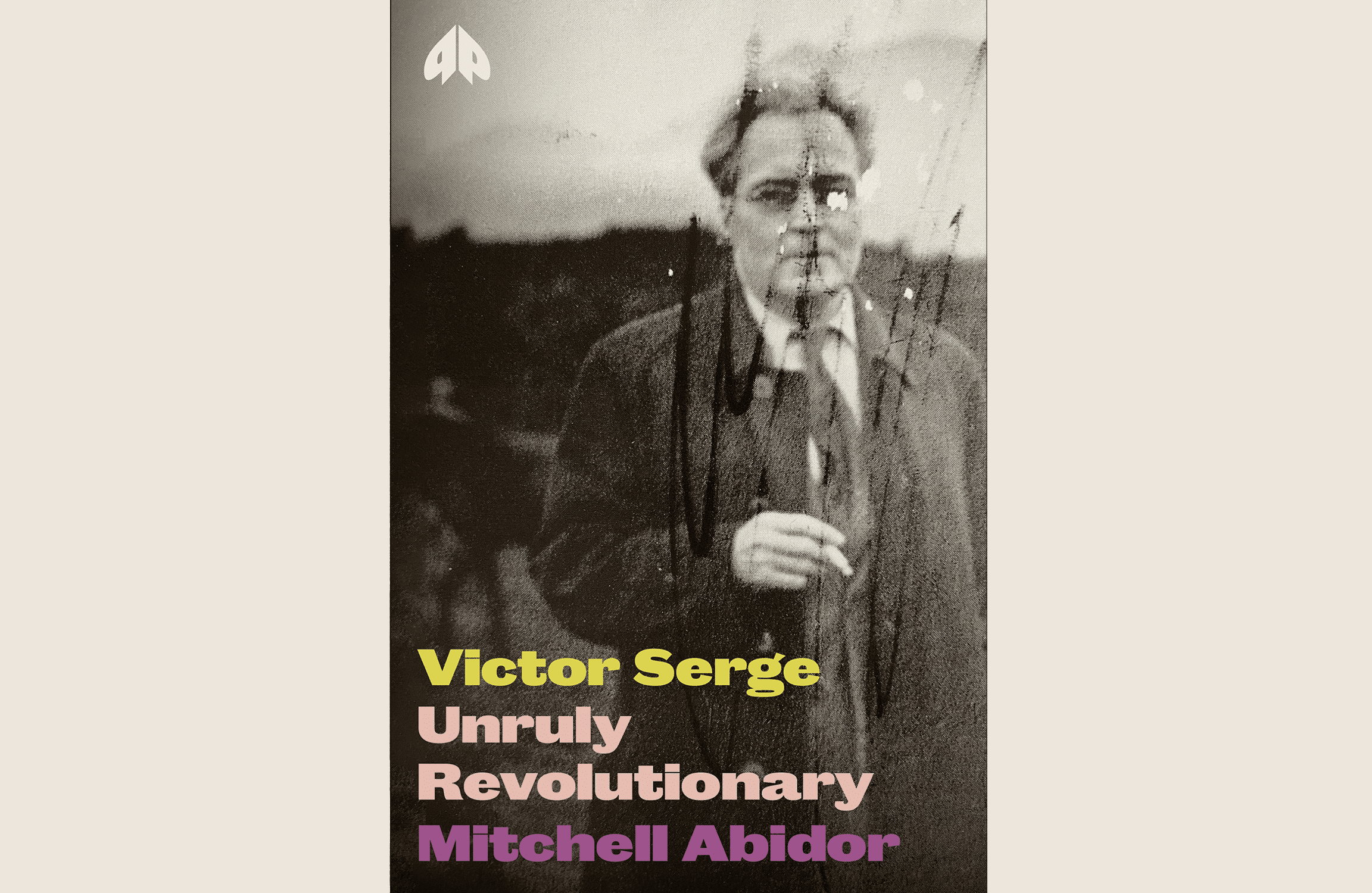
The revolutionary writer Victor Serge spent his life harried by the predicament of “a world without any possible escape,” he wrote, “in which there was nothing for it but to fight for an impossible escape.”
These may sound like the words of someone doomed to a life of revolutionary struggle as much as committed to one. Serge (1890-1947) exemplified the line of the writer Romain Rolland, productively appropriated by Antonio Gramsci, about the need for “pessimism of the intellect, optimism of the will.” Unlike Gramsci, who knew and admired him, Serge lived long enough for this temperament to put lines on his face.
Serge was literally born into the fight. His parents had run in radical circles in Russia and fled to Belgium after the assassination of Tsar Alexander II by the premature revolutionaries of Narodnaya Volna (“People’s Will”), in 1881. He spent the morning of his political life as an anarchist of the individualist bent, sneeringly contemptuous of the masses. When he was 22, in 1913, a French court convicted him and his then-wife, Rirette Maitrejean, of abetting the band of heavily armed, bank-robbing “illegalists” known as the Bonnot Gang—comrades with whom he disagreed profoundly, he would claim, and who exasperated him personally. But the paper trail of Serge’s rhetoric as the editor of l’anarchie (always stylized in egalitarian lowercase) incriminated him in the eyes of the bourgeois court. He spent four years in prison, the first of about 10 that he would pass in some form of captivity before he died.
In the afternoon of his lifetime, Serge was a communist revolutionary. A season in Barcelona during the general strike of 1917 convinced him of the efficacy of mass action; the People were Okay, after all. Following another, brief internment in France, he allowed himself to be deported to the new Soviet Union in a prisoner exchange. At last he arrived in the country of his kin, where it was all hands on deck. Through the 1920s he worked for the Bolsheviks as a propagandist with alternating hesitation and resolve, positioning himself as a broker with the anarchists until that became untenable, and tried when he could (he would say) to assert the ideals of democracy, humanism, and internationalism against the currents of bureaucracy, leader-worship, and chauvinism. As a functionary of the Comintern and a writer with literary ambitions, he acted as a kind of ambassador between the fledgling communist state and European intellectuals. It was this cosmopolitan footing that ultimately saved him. When Serge became a political outlaw under Stalin, like most of the best minds of that first Bolshevik generation, an international campaign of support succeeded in its appeal to free him from internal exile. He left Russia, never to return.
So Serge spent the evening of his life in exile, where in a sense he had never really left. He escaped France on the eve of the Nazi conquest and crossed the Atlantic aboard a steamer in the company of André Breton, Claude Lévi-Strauss, and Simone Weil. In Mexico City he was an eminence among political nonentities. What had gone wrong in Russia? What was to be done? Serge pondered these questions beneath the purple boughs of jacarandas, one eye peeled all the while for the next Ramón Mercader holding an ice pick. In the end it was a heart attack that killed him in the backseat of a taxi. Not an assassination, but an occupational fatality nonetheless, perhaps, like a coal miner dying of silicosis in retirement. From cradle to grave he had borne the pressure of whole governments, great empires.
This is a coarse précis of Serge’s life, one of the more dramatic of the 20th century. A fuller, coherent account can be found in a new biography by Mitchell Abidor, Victor Serge: Unruly Revolutionary, out now from Pluto Press. Enriched by the use of the files of the translator and scholar Richard Greeman, Unruly Revolutionary pays Serge the compliment of deep archival scrutiny. Abidor does not take Serge’s remarkable Memoirs of a Revolutionary at face value, for one thing, and he is forensic in his attention to the two questions from which all debate over Serge’s legacy stems: why Serge continued to defend the Soviet Union for as long as he did, and where, exactly, he ended up in his thinking about the future of socialism. Abidor’s answers are compelling and sobering. There’s no question that Unruly Revolutionary throws some cold water on the myth of Serge l’incorruptible, a figure of Olympian probity to the end. The extent to which Abidor’s findings diminish Serge’s example will be debated, but in any case the book has returned him to us as a more instructive and useful figure than ever before.
Those familiar with Serge will know Abidor as the editor of Anarchists Never Surrender, a collection of Serge’s early writings published by PM Press, and as the translator, with Richard Greeman, of the New York Review Books edition of the Notebooks, 1936-1947. Besides his many books on French radical history, over a thousand of Abidor’s translations from French, Spanish, Italian, Portuguese, and Esperanto are available on the Marxists Internet Archive. His journalism has appeared in publications including Jewish Currents and The New York Review of Books. He was born and raised in Brooklyn, where he still lives.
As we were scheduling this conversation, Abidor wrote to me that we would have to talk a few days earlier than I had initially proposed because he was off to work as a “protective presence” volunteer in the West Bank, standing sentry against the incursions of Israeli settlers on Palestinian land.
“I’m old, legally blind, and hate discomfort of any kind, but sometimes you just need to do something,” he said.
[Ed. note: This interview has been edited for length and clarity.]
♦♦♦
Andrew Holter: Let’s get right down to the really significant intervention of this book, which I expect will surprise and even alarm some readers. You make what seems to me a pretty bulletproof case that in his last years, Serge was not just an “anti-Stalinist” but a full-on, paranoid anti-communist, open to making common cause with the right. Which sources led you to this, first, and could you describe what sort of anti-communist Serge became?
Mitchell Abidor: When I was writing the book, I didn’t want to use secondary sources. Just like how there was never any argument from authority in any of Serge’s writings, I wasn’t going to use anybody else’s stuff. Also, and it’s not incidental, I’m legally blind, so reading books is not easy for me. I have to use a whole fancy setup, whereas letters, I can just blow them up scanned. So I’m just reading everything.
The most important [source] in this regard was his correspondence with Saul Levitas, who edited The New Leader. It was just brimming with the most basic, garden-variety, Cold War anti-communist stuff. You know how Robert Caro talks about how you have to turn every page? I remember when I turned the page on one of the letters and he rats out the leaders of the Spanish Communist Party to Levitas. He says that [Enrique] Lister and whoever else is in the south of France. Nobody who’s not an anti-communist is going to do that.
But you can go back earlier to the FOIA file, which is all documents the FBI found in his baggage when he was on the ship that would ultimately take him to Mexico [in 1941]. The FBI photographed and copied everything that was in there. There are letters where he talks about how the State Department is full of communists, and he didn’t only say it once. Later on he talks about how he can’t get into America because there are so many communists in the State Department.
AH: I was shocked to read that.
MA: He even at one point talks in correspondence about how the administration—I think it would have been Truman’s—was full of communists. There’s really nothing else you could call it [but anti-communism].
Then there’s the importance of Personalism in his writings, and it’s totally unexpected—nobody can argue it, because he writes it in his own words and it’s in the Memoirs. Nobody picked up on it because nobody knows what it is anymore. His correspondence with Emmanuel Mounier, the great philosopher of Personalism, is just insanely anti-communist. Mounier would say in his obituary for Serge that, just paraphrasing, everything about him was twisted in his final years by his anti-communism. It was also something Dwight Macdonald said about him. He called it anti-Stalinism, but we would know it as anti-communism.
So the correspondence is full of it, and even his published writings. I could have taken from a million different sources, but there was one that was just so typical of everything that was really the worst in him in those years, the pamphlet called The New Russian Imperialism. It was a very late pamphlet published by this small left-wing publishing house, very loyal to Serge, where he says things in it that just—my jaw dropped. He says, y’know, I think I know America and Americans well enough to know that they’re not interested in having an empire. He defends the French and British imperialists because they’re giving up their colonies. He was not interested in anti-imperialism at all.
It’s [anti-communism] in the Notebooks. I don’t think it even struck me at the time, but retrospectively I said, Wait a second, he mocks something that his fellow exiles have written because of its anti-imperialism. His claim that the only threat to humanity, and this was in published work, was the Soviet Union, and his belief that if there’s going to be any kind of international movement of the left, communists have to be excluded. I found one instance, but it’s more than enough, when he refers to “commies.” If it walks like a duck and it quacks like a duck, then it’s a duck… Trotsky never went so far as to say the Soviet Union was like, the enemy of mankind. I think that right there is it, you don’t need any more than that. Everything else is just additional information.
Now, yes, he was still writing at the end of his life in praise of Lenin. I do cover my ass on this one. He’s not one of those anti-communists who said that the Bolshevik revolution should have never taken place. But that doesn’t mean that he thinks that what’s happening now has anything to do with it, and he dismisses the communist parties all over the world.
I don’t think I quoted it in the book, but he wrote this snotty letter to [Palmiro] Togliatti. There’s nobody in the world but me who’s going to care that he wrote this snotty letter to Togliatti, but he wrote this snotty letter to Togliatti and it’s full of all kinds of anti-communist stuff. If you don’t read these letters, and if you don’t really read what he wrote… People can dismiss correspondence all they want. In this case I think they were pretty probative.
He thinks that communists have this power over everything. At the end of his life, he’s complaining that his novels aren’t selling because the communists have issued orders or whatever, because they control the press and they control publishing. Well, then why was Darkness at Noon a big bestseller?
AH: I learned recently that the actor Richard Burton was absorbed in Serge’s Memoirs of a Revolutionary while preparing for his starring role in The Assassination of Trotsky, the not very good movie from 1972. In his diaries, Burton calls the book “a depressing picture of man’s inhumanity to man and nobody in my eyes, capitalist, monarchist, Fascist or Communist comes out of it with any virtue.” What do you make of that assessment?
MA: It’s not bad, except the one who comes out of the Memoirs OK—and now I’m going to be really dickish—is Serge! This is the real paradox about Serge: He’s always right. He’s the star of his own life. But even though he’s always right, he’s willing to change his views when he believes that they no longer hold.
I’m sure that people are going to come out of reading this book and think it’s either a hatchet job or an indictment. It’s not, because I admire him for changing his stances. The Serge that I love is the individualist anarchist. That, I think, was the best Serge. The syndicalist Serge, I’m not sure he existed, but once he sees that individualism is a dead-end—the word he uses—he moves on. And when he thinks that the Russian Revolution is fulfilling the dream of the syndicalist he wasn’t, he goes to Soviet Russia. When he doesn’t like the way Bolshevism is turning, he goes to oppositionism. Then he starts modifying everything about Marxism, because none of it that he sees applies anymore. He ends up being totally isolated at the end.
Throughout his life, he was part of the intellectual elite. When you’re an individualist, you believe you have the right answer, I don’t care what anybody else says. When you’re in the Bolshevik Party, well, we’re the Bolshevik Party, so we’re right because that’s who we are. Then it takes an unquestionably positive turn for the rest of life, when he’s going to follow his own star wherever it goes. That’s what I find positive and admirable and worthy of being imitated. But I don’t think people take that away.
AH: I was struck by your chapter on the break between Serge and the French anarchist movement during the 1920s, while he was working as a Bolshevik functionary in service of a state that was rounding up anarchists. It was a far more dramatic and painful ordeal than he recounts in the Memoirs. Are anarchists right to remember him as a turncoat?
MA: They’ve never forgiven him, never. In one version of this book that fell by the wayside, I said that the red thread through his life is individual freedom, all of which comes from his anarchist years. In fact, a book just came out in French almost simultaneously with mine, a biography of Serge [Le Jeune Victor Serge] by somebody who’s been working on him for decades and decades and decades, Claudio Albertani, who assembled the full Notebooks and has published all kinds of collections of Serge’s writings, in which he connects everything to Serge’s anarchism, and it’s absolutely true. That’s why everybody who has downplayed anarchism has missed the point.
AH: He shed his anarchist commitments, but certain instincts remained all the way through.
MA: The only thing that changes is that it takes the form of Personalism, with its defense of the human person. I’m not going to say he gloms on to Personalism, but he finds in Personalism a much more profound intellectual justification for the anarchist sentiments, because his anarchism was all about defense of the individual human person. Marxism has not shined in its ethics of the human person. And so he instinctively finds his way to Personalism, because he’s still got all those anarchist ideas. He discovers Mounier because he was such a voracious reader. Mournier published him when he was in the isolator… His anti-communism grew out of his Personalism.
AH: Let’s go back to imperialism. You cite Serge’s writings from the 1940s to illustrate how oblivious he was in his thinking about decolonization, with assumptions that were pretty flattering to the colonial powers, to put it mildly. He had no idea what the hell he was talking about. That’s not so surprising—we’re dealing with a figure of the early 20th-century European left here. The irony is that one of Serge’s earliest legible political decisions, made when he was still a teenager, was to abandon the Belgian socialist party after its leadership advocated the annexation of the Congo. It was one of the definitive moves of his political life, made on anti-imperialist grounds. So how did it happen that Serge kept himself so blinkered where the non-Western world was concerned, even by the standards of his European contemporaries?
MA: A number of things play into that. He never mentions the massacres in Sétif, he doesn’t talk about Indochina—but if you think about it, he’s not going to talk about Indochina because [the anticolonial resistance] was led by a communist. I don’t know if I made the point strongly enough, but I think Europe is what matters [for Serge].
His final interview is all about Europe. He never talks about socialism. All he talks about is European unity. And this was published the day he died. He so missed Europe, and that’s why he missed the boat on everything. He romanticized Europe. He doesn’t really care about Mexico except as exotic scenery and insofar as the Mexican Communist Party is trying to kill him. He was so totally out of touch with Europe that he didn’t know what he was talking about. He so completely lost his political compass that he’s like, gazing off in the distance at Europe and Europe isn’t living up to his standards.
He wanted to be a New York Intellectual. At the end of his life, if he could have been anything in the world, he would have been a New York Jewish intellectual. He missed his calling. He married a Jew, it didn’t turn him into one. So many of his ideas are the same kind of disabused Trotskyism and anti-communism. Alan Wald’s article about Serge and the New York intellectuals is absolutely spot-on.
AH: On this point about his Europhilia, though, isn’t it true that one way to read Serge’s life is as a story about the historical relationship between Russia and Europe? There’s something very poignant about his affinity with Russia as the child of exiles. He believes he’s the distant relative of a great revolutionary, but the truth is unclear. He wears a Russian peasant blouse in the courtroom during the Bonnot Gang trial in France. But there’s enormous tension in his identity, his sense of himself is in flux.
MA: He carries around this mythological Russia in his youth, this myth of his relative [Nikolai Kibalchich] having been in on the assassination of the tsar, and he models himself on [those radicals] and he dresses like them. Then he goes to Russia and it’s not at all that country anymore, but he still finds a group of people who are going to maintain their purity, and that’s in the opposition.
So when he’s in Europe, he’s missing Russia, and then when he’s in Russia, he’s missing Europe. When he’s at the end of his life, all he’s got is the myth of Europe in front of him, and he actually takes it seriously, just like he took seriously the myth of Nikolai Kibalchich being his relative. And in that sense, he’s just like everybody—we all have myths that sustain us. He would have loved to go back to Europe. I think he would have liked to go to America more.
AH: I never knew what a real possibility it was that he might have settled in the United States instead of Mexico.
MA: It was a hope—it was never really a possibility, because [sarcastic] communists ran the State Department!
Hanns Eisler, Bertolt Brecht, Vladimir Pozner, I could list all the communists that were allowed into America. I mean, for God’s sake, Hanns Eisler went on to write the national anthem of the German Democratic Republic. It’s a lot of paranoid ideation [on Serge’s part]. Why they didn’t let him in, God knows why.
AH: Counterfactuals are supposed to be pointless, but I do wonder whether living in the U.S. instead of Mexico might have softened the harder edges of Serge’s anticommunism later in life. Maybe I’m looking for an escape hatch here, but is it possible that being in the belly of the beast might have led him back to revolutionary commitments, to refocus on capitalism as the big problem?
MA: No… In the book, I specifically say that we don’t know where he would have gone. We know where he was. Whether he would have gone like the route of [Boris] Souvarine and supported the U.S. in Vietnam we can’t know.
—[sotto voce] He would have.
He was already ignoring the anti-imperialist struggles. But what was also coming was the Slánský trial, and the Rajk trial, and all the show trials that were to take place in all of the socialist states. It would have completely pushed him over the edge. That’s not idle conjecture. You just know that [for] the man who wrote obsessively and correctly for years about the Moscow trials, to see them return, he would have waved that in the face of every communist. “You guys have learned nothing. You’ve ignored the gulags,” because they did, “you treat Stalin like a god,” because they did.
There’s no way he would have ever walked it back. He was mocking existentialism in his writings, so Sartre never would have attracted him. They were too open to the communists, the existentialists. I can’t say for sure where he was going, but I’ll say for sure that he was not headed in a good direction.
AH: I haven’t asked you about the fiction. Serge turned to writing novels at the end of the Twenties, and his literary stature was ultimately what enabled him to leave the Soviet Union in the 1930s. What were Serge’s ambitions as a novelist?
MA: The epiphany he had in 1928 that led him to dedicate himself to writing first allowed him to carry out experiments in autobiography, to borrow from H.G. Wells. He didn’t get around to writing his actual memoirs until near the end of his life, so the novels are kind of a sketch of a sketch for the memoirs. Everything he wrote corresponded to a phase in his political life. We’re only missing his anarchist days, but that’s the manuscript that got lost. [Author’s note: The manuscript of Serge’s novel about the Bonnot Gang, Les hommes perdu (The Lost Men), was evidently seized by Soviet authorities in and has never been found.]
[The novels] are a form of autobiography in many voices, with there always being a character who’s Serge, or Serge-like, while the other characters are how he sees and imagines the lives and thoughts of people who weren’t him. This is most successful in The Case of Comrade Tulayev [1948], where he becomes Stalin and gives us a rounded portrait of him, which is a truly remarkable feat.
Of course this also has its ugly side, like in Birth of Our Power [1931], where his portrait of the individualists is ugly and simplistic, a clear act of vengeance. Rirette [Maitrejean, Serge’s ex-wife] was right when she reviewed the book in an anarchist review and lambasted Serge for it. His defense of himself doesn’t hold water. Finding this exchange between the former lovers and comrades was one of my favorite discoveries while I was researching the book. It made me admire Rirette even more than I had.
AH: Speaking of Rirette, you don’t ignore Serge’s desire for companionship and a family, and you render some overdue justice to each of his three wives, all of whom suffered by their connection to him. Rirette Maitrejean was charged together with him in the Bonnot Gang case, and though she avoided prison, he didn’t and the marriage didn’t survive his sentence. Liuba Russakova, his second wife and the mother of his two children, suffered from mental illness exacerbated by the family’s harassment by Soviet authorities, and Serge chose eventually to abandon her in an institution. And then his relationship with Laurette Séjourné, who eventually joined him in exile in Mexico, began as a torrid affair and turned bitter. None of these relationships was very happy for very long. Is it enough to say that Serge’s longing for a family was at odds, in a predictably gendered way, with his idea of what political commitment entailed for himself, and that was that? Was there an element of self-sabotage?
MA: With Rirette, he had everything. She was an anarchist like him, of the same school, and she had a family. She had two daughters who, by all accounts, Serge adored. She was the one, but—and this is something that really gripes me—those who love Serge hate her, which I think is the height of hypocrisy. She was an anarchist, and when [she and Serge began their relationship], she was married to somebody else who was in jail for illegalism. Counterfeiting. He was an anarchist. That didn’t stop her from being in love with Serge, because she’s a free woman. She’s an anarchist, for God’s sake.
When Serge goes to jail and they have to get married so she can visit, he writes hundreds and hundreds and hundreds of letters. I only quote from a couple of them, but they were typical. Head over heels in love, very affectionate. But he’s in jail for five years, she’s a young woman. Shit happens. And she’s an anarchist—why should we fault her? She lived her ideal, and as a woman she could do whatever she wants just the same way a man can. She was the one.
With Liuba, again he gets a family. He marries her because he meets her on the boat [that first took him to the Soviet Union, in 1919], along with her whole family. They’re intellectuals, they’re anarchists, they’re Jews, they’re a united family, they’re moving back [to Russia], they’re doing just what he was calling for—anarchists moving to the Soviet Union. And they paid much worse than Serge did, much worse. His sisters-in-law get sent to the gulag for being his sisters-in-law.
But now he has his family. He’s got his son, Vlady, this adoring son who accompanies him everywhere. There’s a time when it looks like Liuba is going to be the one, but he doesn’t want her to have the second kid. She does it behind his back, insofar as you can have a kid behind someone’s back, and he made her have abortions. Maybe he knew it wasn’t going to last.
Then he completely gets it wrong. He falls in love with Laurette, much younger… That was a huge mistake. She didn’t give a shit about him. [Author’s note: The relationship between Serge and Séjourné, which may not have been an official marriage, was acrimonious. She joined the Mexican Communist Party not long after his death, leading some, including Serge’s son Vlady, to suspect that she may have played a role in his death on orders from Moscow. Serge’s autopsy did not reveal evidence of murder—but, Abidor notes, “Serge probably would have said the Soviets fixed the autopsy.” Séjourné died in 2003.]
He hunted for family everywhere. He called his Belgian friends his “brothers.” He was 12 and a half when he [emancipated himself]. This sounds like total bullshit—how’s somebody living on their own at 12 and a half? Except there it was in all the documents I had, the police document, the residency records, showing him living alone at 12 and a half.
AH: In reviewing the reasons why Serge chose to remain a Bolshevik for so long, past the Kronstadt rebellion, past the persecution of the anarchists, you advise us not to discount the desire to win, finally, after so many years of failure. There is an incredible amount of failure in Serge’s story, compounded by your new information about how much he came to alienate his comrades-in-exile in Mexico. Is there any point in his life that looks like victory to you? Is it just that he survived as long as he did?
MA: Actually, he didn’t stay alive all that long, since he died at 57. Maybe we can consider his ability—except for the awful early years in Soviet Russia, when he lied like a rug—to follow his own path, even if it led to isolation and frustration at the end, as a success. When he died he was broke, on the outs with his wife and son, in bad odor with his fellow exiles, and yet he remained faithful to what he believed. And he continued to evolve, since, as I wrote in the biography, in his final period it was European unity and not socialism that was his lodestar. This stubborn fidelity isn’t nothing. Few people can say that they were as strong as that. ♦
