

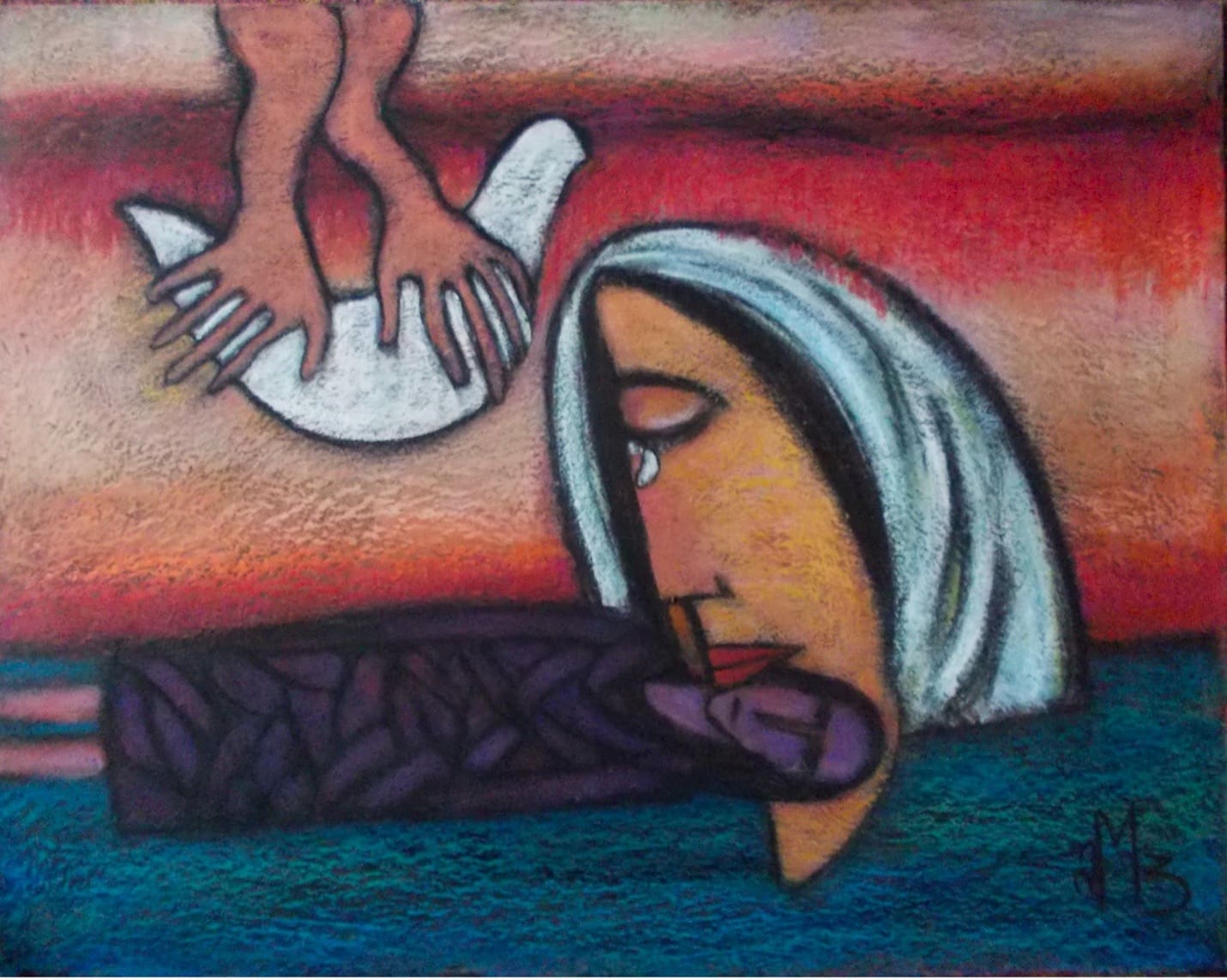
This article will appear in our forthcoming print edition, Protean Issue VI.
♦♦♦
The usual story of education assumes a degree of continuity. You teach students, you learn from each other, and some of them become your peers. Years later, you may run into them, perhaps on a bad hair or hijab day. You exchange smiles and quick life updates, and you walk away with pride in how far they have come, and unease at how much time has passed. This educational experience assumes time, safety, and the luxury of growth. It assumes that both teacher and student will have a future in which to meet.
However, that is not how it goes here, in Palestine. Under occupation, another kind of educational experience exists: one of constant disruption, erasure, and impatience, taught by the machine of the colonial project. Reflecting on the writing of Shirin Vossoughi, I’ve come to conceptualize these counterposed methodologies in a particular way. The life and death of my student, Oudeh Hathaleen, is the ultimate manifestation of this violent clash between two pedagogies: one dedicated to the accumulative and assiduous work of world-building, and the other committed to the frantic, machine-operated work of world-shattering.
In the spring of 2017, as an adjunct lecturer at Hebron University, I taught Oudeh in an English literature course. I remember where he used to sit, and the openness of his smile. Years later, we became friends on Facebook. Seeing his tireless efforts to support his community in Masafer Yatta, I sent him a message: “I am proud of you and the important work you do.” A teacher, a community activist, and a father of three, Oudeh, who had documented and written about the colonial violence of Israeli settlers and authorities, including in a piece for +972 Magazine, would also serve as a consultant for the production of the Oscar-winning documentary No Other Land.
He lived and worked in Umm al-Khair, which means “The Benevolent Mother.” This hamlet was established by Bedouin refugee families expelled from ‘Arad in the Naqab during the 1948 Nakba. Umm al-Khair is one of 19 Palestinian communities comprising Masafer Yatta, a windswept cluster of villages in the South Hebron Hills, within Area C of the occupied West Bank, administered and policed under full Israeli control. Here, life unfolds under the shadow of erasure, encircled by Israeli settlements. Given the dehumanizing moniker of “Firing Zone 918” by Israel in the 1980s, the area has become a site of what residents experience as slow-motion ethnic cleansing: a dual assault of systemic state violence and the daily, intimate violence of settlers who are backed and emboldened by soldiers. Thus, to live in Masafer Yatta, as Oudeh did, is to practice resistance in its most ordinary, everyday form, against a system designed for elimination.
The news arrived on a Monday night, in the same way that it so often does here: a sudden WhatsApp message. It was from my friend, Issa Amro. Oudeh had been murdered, he wrote, shot by a settler. The message was both a world-shattering moment and a further, brutal confirmation that we are all living in the crosshairs. By now, the mind is acclimated to a constant feed of heartbreaking news, but the body knows better. I found myself sitting down, the only physical response I could muster against a gushing river of grief. I let tears flow. A part of me felt that as his teacher I had failed to protect him.
A month later, I finally managed to visit Masafer Yatta as part of a group. I had to accompany international and Israeli activists, for, as a Palestinian, I would likely be deterred if I went alone. I had the honor of sitting with Oudeh’s family. They spoke of him as a loving son and husband, a terrific friend, and the backbone of his community, confirming what I already sensed. In their grief, they entrusted me with their stories. Many of the details in this piece are theirs, relayed to me in a shared act of remembrance and witness.
Oudeh’s name means awdah, “return.” His life was a refusal of the notion that a return is a singular event in a distant future. For him, returning was lived out in quotidian, life-enabling actions rooted in the present tense: teaching English, painting school walls, buying vegetables for families in need, convening with the youth at the community center, playing football with the kids, welcoming visitors, and capturing stories with his camera. He was practicing a way of life that demanded he carry out the actions of verbs with the prefix “re-”, day after day, again and again: return to the land, rebuild demolished structures, replenish the needs and the spirits of his three kids and his community. As a father, he seemed to feel how short and precarious life here is; his photos often show him holding his children, waving to the camera.
He was, in other words, an embodiment of the empathy and imagination that is necessary to build and sustain communal practices of love and care—characteristics, I think, of a true student of literature, among other things. In a conversation with Green Olive Solidarity Network, Oudeh said to international supporters, “Sometimes you’re in a position that you feel alone. And it’s really the hardest feeling ever.” But he was not: his ethical relationality, informed by his connection to land and community, made him welcome everyone, refusing the divisions imposed by the occupation. And he could see beyond his own struggle. “We the people here,” he once said, “are not against anyone. We are not against colors or nationalities or religions… We look to the people as humans and we want the same from them”—an openness and a compassion that was characteristic of Oudeh, and which led to his regular hosting of activists and visitors from all over the world. It also meant he tried to make his community feel less lonely.
Oudeh knew the unspoken rule of advocacy work: be just Palestinian enough to be heard, but not so much as to unsettle a world that demands perfect victims. The ideal victim must maintain this absurd balancing act. Moreover, Oudeh also knew that the very act of documenting his existence made him more vulnerable. He was trapped in what writer and clinician Lara Sheehi calls “coerced documentation,” a condition in which Palestinians are compelled to record their own dispossession—not by choice, but by necessity. In Masafer Yatta, this meant Oudeh had to regularly take the risk of holding up a camera to bulldozers and soldiers, knowing that, to the colonizer and to much of the world, if there is no footage, the violence effectively never happened. The tenet is clear: if you cannot produce evidence that they cannot refute, you do not exist in their world.
However, Oudeh refused to be a passive archivist of his own erasure. Though Sheehi’s argument centers on “pressurizing” words, spoken and written language as “methodological tool[s],” the principles she articulates also extend to visual documentation that resists settler-colonial narrative control. Oudeh’s filming exhibited what one of Sheehi’s patients calls an “urgency to pressurize” the testimony. He transformed the coercion into a methodological tool for reality testing. In a system committed to ideological distortion, or “reality bending,” and to denying that Palestinians exist or that the land is theirs, Oudeh’s camera did not just beg for recognition; it antagonized the lie. It insisted that the olive tree was there, the house was there, the life was there.
He lived the cruel paradox of the “promise of a later utility,” the hope that this testimony might one day serve justice. Yet, he did not wait for that distant day. By adding these pressures to the narrative frame, he made his documentation, as one of Sheehi’s patients put it, an act of “assuredness of the life” he lived, right then and there. Oudeh seemed to fully understand this. In one interview, he said, “You should not give up. The results may take years and years and years. So you should be patient.” To live in Umm al-Khair, he stated, one needs to be both patient and hopeful: “You cannot live without hope,” he concluded.
His relentless hope manifested even in moments of defeat. Not long before his murder, he was blocked from entering the U.S. At the invitation of a synagogue, he had planned a speaking tour. Despite their valid visas, he and his cousin were held for hours in Los Angeles before an officer told them they were not welcome. His first act was to call his wife, Hanadi, not just with the bad news, but with an insistence on buying her a gift from the airport. Upon returning to Palestine, he immediately renewed his passport, recommitting himself to having his people’s voice heard, no matter the bureaucratic humiliation. That new passport, a fragile document signaling a precarious existence, was never used.
On Monday, July 28th, an Israeli settler driving a bulldozer used it to tear at the village’s land, destroying olive trees. This time, when confronted by the community, who threw stones at his machine, the settler used its blade to strike a man named Ahmed Hathaleen, rendering him unconscious. The situation intensified with the arrival of another settler, a notorious man named Yinon Levi, who runs a demolition business. Brandishing a firearm, Levi threatened another man filming. In the video of the attack, one can hear the cries of the villagers in Arabic; one Palestinian man repeatedly tells the others to “Go back,” while telling the settler, “shoot me.” He is single; if someone had to be shot, he wanted to sacrifice himself in place of the parents.
This is the language of a people forced to live on the edge, so anxious about what might happen that they almost prefer the certainty of the act itself. Yinon had continued waving his gun and making cavalier threats to families. Then, he opened fire. He aimed toward the center of the village. Among those in the line of fire were four young children, according to an account by Jasper Nathaniel. One of Yinon Levi’s bullets struck Oudeh Hathaleen in the chest. He was not even part of the immediate confrontation; he had been filming the incident while positioned near the same community center where he conducted his educational work. He collapsed on the playground at the school of the community he served.
In another video, filmed by Oudeh himself—just before the footage went blank, just as the witness (shahed) became a martyr (shaheed)—one can hear the small, clear voice of Oudeh’s three-year-old son, Hammoudeh. Through the chaos, the boy, before he breaks into tears, can be heard repeating feverishly, “Ya Rub” (يا رب)—“Oh, Lord.” Though we cannot see him, it is clear he is looking at his father bleeding out. It is a desperate, primal appeal to a higher power.
Yet for the settlers, their belief in the primacy of their self-declared rights to the land constituted a higher power in itself, one that superseded the value of his and his father’s lives. The settlement enterprise is animated in part by Kookist ideology, based on the thinking of Zionist leader Rabbi Abraham Isaac Kook, further radicalized by his son Zvi Yehuda and followers. To Kookists, holiness is understood through a triad of Land of Israel (Eretz Yisrael), People of Israel (Am Yisrael), and Torah (Torat Yisrael). The three are seen as inseparable; the land is sanctified only by the Jewish people living according to Torah, and redemption requires the land’s full possession. This marks a departure from the earlier theological triad of God–Torah–People. The effect is to conflate territorial possession with divine will, or even collapse the distinction entirely. The settler is not waiting for God’s command; he is pursuing what he wants to believe to be his divine right to the earth.
In that moment, Hammoudeh’s plea to heaven is swallowed up, drowned out by the violence of a man determined to claim his own kingdom. Yinon Levi was seen shortly afterwards laughing with other settlers and soldiers as Oudeh’s lungs were collapsing.
An American medical student rushed over to try and save Oudeh. He remained conscious in his final moments. His voice grew weaker as the scene grew increasingly grotesque: as more Israeli settlers and soldiers gathered, their laughter and chatter could be heard. Even as Oudeh lay dying, collective punishment had begun. Israeli forces came to the village, avoiding Palestinian witnesses who attempted to explain what happened and corralling villagers in a fenced area like cattle. The soldiers listened as Yinon Levi identified the alleged stone-throwers by pointing at them; they were arrested on his word, on the spot.
Oudeh’s body was eventually taken by an Israeli ambulance to Soroka Medical Center in Beersheba. He was alone; no family member was allowed to accompany him. Initially, news reported that he was still alive—a fleeting sense of hope, which served to anesthetize people—and only later that day was his death confirmed.
That night, the people of Umm al-Khair, heartbroken and tired, were still not left to mourn in peace. Soldiers stormed the village, their flashlights glaring on grieving faces, including that of Oudeh’s wife, Hanadi, who found soldiers ransacking her bedroom. They left after terrorizing the villagers and abducting more men under the pretext of interrogation. When the community attempted to hold a memorial service the following day—still unable to bury their son, whose body remained in Israeli custody—soldiers stormed this space of grief too.
They waited until people gathered before raiding the place, commanding via loudspeaker that everyone who did not live in Umm al-Khair must leave. They also stormed the women-only space. Little girls looked scared, one holding her ear, another screaming, “I saw a soldier with a bomb,” and a mother holding her baby tightly as masked soldiers frantically searched the space. “I keep telling my kids there are no monsters. Then they see the soldiers. How can I convince them now?” one mother said to me helplessly.
Writer Abdaljawad Omar describes how this continuous violence creates a “temporal chasm”where the necessary time for mourning is “arrogated and denied.” As Omar explains, mourning requires a specific temporality, a “durée,” to process grief. But Palestinians live under constant, recurrent bereavement that makes genuine mourning nearly impossible. “I was thinking to myself, even in Greek tragedies, nothing like this has happened,” an activist once told me.
The violence did not end with the bullet; it continued to be inflicted in the following days by the architecture of systematic impunity. Yinon Levi was soon released to house arrest while Palestinians remained in custody. The military’s campaign of frantic terror could not tolerate even the lingering presence of the dead, for the power of the martyr is that he continues to teach after death. To counter this, the pedagogy of terror did not stop. In death, Oudeh continued to build worlds, and the occupation continued shattering them. The very next day, the bulldozer was back on the land, resuming its vindictive mission. Oudeh’s mother, Khadra—whose name means “verdant,” signaling her relationship to the land—asked in a broken voice, her tears streaming, something to the effect of, “Then why did my son lose his life? Only for the machine to come back?”
Multiple members of Oudeh’s family were abducted in the week following his murder and interrogated for days without a lawyer, their phones confiscated. During this time, an interrogator showed a young relative the incident video, repeatedly asking, “Don’t you see that Yinon was afraid?” The subtext was clear. He was scared, so he was within his rights to shoot at unarmed families. This is the core of the struggle: the colonizer is entitled to his fear; the colonized must bear its burden, even unto death. This is what the scholar Ahmad Kabel calls “epistemic gaslighting,” where the aggressor’s interpretation of reality is violently imposed upon the witnessed event, making the victim question their own truth.
Even as Israel seeks to colonize their grief, the people of Umm al-Khair have persistently upheld their own standards of dignity. Oudeh’s body was held in an act of necroviolence, a mechanism that extends state dominion over Palestinians beyond death. This withholding of martyrs’ bodies is a calculated attempt to dismantle the communal spaces of defiance that funerals often foster. [Ed. note: Holding Palestinian bodies is a grotesque and systematic practice of Israeli authorities. Palestinian bodies, hundreds at minimum, are known to be held in so-called “cemeteries of numbers.”]
In protest, Oudeh’s mother and 60 women of the village initiated a hunger strike, demanding his return. After 10 days, under mounting pressure, the authorities relented, though they imposed severe restrictions to stifle collective mourning. They sealed the village entrances, permitting only the residents of Umm al-Khair to attend. Furthermore, they denied his family the right to bury him in their ancestral cemetery. Instead, the family was forced to lay him to rest in a separate cemetery, its location dictated by the occupation.
After a brief procession from his brother’s home to the school where he taught, people of Umm al-Khair carried him, draped in the Palestinian flag, through the hills. Their full-voiced defiance illustrates what Abdaljawad Omar describes as “betraying grief and building grievance”: the necessity for Palestinians to celebrate at funerals, denying their oppressors the satisfaction of witnessing their defeat. “To grieve,” he writes, for Palestinians can be “to engage in a betrayal of sorts—a betrayal that bespeaks a collective consciousness cognizant of the impossibility of genuine mourning under the yoke of asymmetric power.” Instead, they must “transfor[m] grief into a claim or a grievance.”
Khadra, her hand bruised from a confrontation with a soldier but her spirit unbroken, buried her son.
Mahmoud Darwish’s words give further testimony to the power of the martyr’s death:
Friends of the faraway traveler,
don’t ask, “When will he return?”
Don’t ask too much,
but ask: when
will our men wake up!
The poem reframes return not as a question of time, but as a challenge of political awakening. Oudeh, as a martyr, has an unending return that the machine cannot control.
Oudeh’s murder was a grim echo. His own uncle, Haj Suleiman al-Hathaleen, a celebrated nonviolent activist, was killed in January 2022 when an Israeli police truck ran him over and dragged his body for several meters. The parallels between their deaths reveal the systematic targeting of Palestinian leadership in Masafer Yatta: the price of exercising community ethics and political agency. Haj Suleiman was killed while trying to stop a confiscation raid. Oudeh was shot while documenting the confiscation of land.
In both cases, the calculated cruelty was identical. Their murders demonstrated that for the occupying force, any Palestinian presence, any resistance at all, no matter how minor, constitutes a threat that must be eliminated. The settler movement abhors the fullness of flourishing lives; its acolytes need to flatten and obscure the realities of the communities they invade, all their humanity and joy, to steal even the sparkle in their eyes. It is a strategy that targets both the roots and the branches of the community. In killing Haj Suleiman, the elder, the killing machine severed a connection to historical memory. In killing Oudeh, the youth, it sought to assassinate the future. This is the chilling logic of the colonial project, which understands it must crush hope in all its forms.
At the time, Oudeh had eulogized his uncle, writing that Umm al-Khair felt orphaned without his wisdom. Now, we eulogize him in turn. Both men faced up to the machine, and both were left to bleed on their land.
Hammoudeh keeps going to the spot of his father’s murder. He tells other kids, “Dad fell down, but he will get up.” For him, his Dad will return, resurrected. Meanwhile, Oudeh’s eldest son, Watan, whose name means “homeland,” tries to make sense of the senseless. He asked his mother, “Why didn’t father just enter the house and close the door?” Watan’s question is the logic of a child trying to understand an event driven by the violent irrationality of the settler mythos. As Darwish wrote in State of Siege, “When myths are needed they simply knock on our doors”—or just break them down. Darwish once described the struggle in historic Palestine as a battle between two memories: “an historical memory and a negative mythical memory.” In the latter, he says elsewhere, “we are forced to return to the inhospitable myths where we have no place.”
At its heart, the machine’s frantic violence and impatience is born of its own insecurity. Colonizers, haunted by the fragility of their claim, require a mythologized past to justify their project. This is the collision Mahmoud Darwish names: Palestinian “historical memory” confronting the settlers’ “negative mythical memory” that blocks access to true history. Myths that “refuse to adjust their plots” and instead “‘adjust’ reality with bulldozers.” Here, the bulldozer is not just a tool of construction, but the myth’s chosen instrument for historical revision. The project of conquest and settlement by definition requires destruction and violence. The bulldozer and the bullet erase historical memory and impose negative myth.
The machine’s pedagogy of terror is not an aberration; it is a daily lesson—one I was taught on the very day the world was celebrating a film that Oudeh helped create. On the day that No Other Land won the Oscar back in March, my cousin and I were driving from Hebron to Ramallah. I now lecture at Birzeit University, while he works in insurance. As we neared the Beit El settlement, we found the checkpoint gate closed. We parked and opened our phones, scrolling through the multiple WhatsApp groups for any updates about road conditions.
Almost immediately, soldiers approached and demanded our car keys. They asked us to hold up our IDs and took photos of our faces next to them, while my cousin repeatedly asked in Hebrew if we had done anything wrong. “No,” the male soldier repeated impatiently. I asked in English why we were being held. He said he could not tell us. This is the pedagogy of the arbitrary detention and the checkpoint: it teaches through unpredictability, creating a temporal suspension where Palestinian life always exists in the conditional tense. This is the systematic colonization of Palestinian time itself—what Jasbir Puar has called a form of “temporal debilitation” where our time is made fragmented and slow, while settler time remains continuous and fast. The machine teaches us that our time, our future, our life does not matter.
The wait stretched on. After nearly two hours, the soldier demanded our phones. My cousin pushed back, but the soldier replied in the coldest tone that if we argued, we would be held there all day. He ordered us to follow his Jeep to a new, open spot. I later asked a soldier to allow me to leave the vehicle to pee. With no bathroom, I had to find a spot in the open, accompanied by a female soldier. By that time, I had already missed my first class.
Once back in the car and upon seeing my silent tears, I was told by the soldier, “You won’t be held for the whole day.” “What does it matter?” I said. “You don’t see me as a human being, do you?” This was my first time engaging in rhetoric with a rifle. The moment I let the question hang, I remembered a student of mine who was held in administrative detention. She told me she had to use a fork to comb her hair, and she once asked for sanitary pads, citing the Third Geneva Convention, only to be met with the soldiers’ laughter. This soldier did not laugh. She just answered impatiently, “Listen, listen, I’m only following orders.”
You know who else was just following orders? Before I could say it aloud, my cousin, sensing the rising tension, cut in. In perfect Hebrew, he said, “We only want peace.” She answered, “Me too.” This conversation, with probably a completely different understanding of the same concept, is the language of the machine at its most generous. No matter that the machine’s image of peace relies on the destruction of ours.
We were held for another half an hour while the soldiers, acting like teenagers, teased one another. Finally, perhaps after receiving orders, one of them gave a nod. They tossed us the car keys and let us go.
Theirs is a system that requires Palestinian despair to sustain itself. This relentless theft of life results in what Victor Shammas calls ontocide: the destruction of a people’s meaning and their will to care for the world. I remember a colleague once telling me, “So long as students complain, it is a good sign. It means that they care, that there is something that needs to be changed, that they think of a future here. I fear for a day they simply will not.” Indeed, under the grinding weight of an ongoing genocidal structure, with the entire world failing to stop the horror, has driven many people, especially in Gaza, to withdraw from the world and from the ordinary pursuits of life, including education. This deliberate dulling of care, this killing of potential, of dreams, of belonging, is the work of a colonizer going unchecked, abetted and supported with complete impunity.
What, then, is the pedagogy of the colonizer? Its curriculum is not clearly described in textbooks, but in actions. It is instead on display in the destruction of nearly all school buildings and the destruction of every university in Gaza, alongside the frequent attacks on West Bank campuses, patrols inside Hebron University, the use of the Kadoorie campus as a military base, constant raids on Birzeit, student spaces stormed, people beaten. It is evident in the murder of the brightest students and lecturers. It is evident in the depredations of Zionism, so numerous and multiple that they form a “cidal swarm,” in Abaher El-Sakka’s term, which is cited in Ahmad Kabel’s essay on pedagogy and witnessing. It is not just genocide, but also ontocide, and scholasticide, spaciocide, epistemicide, memoricide.
The curriculum of the colonizer has been well-learned by the settlers, who have taught themselves Arabic phrases just so they can insult and deride Palestinians. They shout at Khadra, Oudeh’s mother, from across the fence: “He is now dead!” It is evident in the way that Watan, Oudeh’s son, draws a police car and an ambulance instead of a house and a sun. It is evident when Israelis post videos pranking their parents by claiming that they are raising money for Gaza, and are amused by the infuriated reactions and casual dehumanization. It is evident when soldiers break into schools and beat teachers in front of their students. It is evident when students and teachers from Umm al-Khair school are robbed of their favorite teacher and dear colleague.

Watan’s drawing.
This brings us back to the different pedagogies and the temporalities they inhabit. The colonial machine operates in a frantic, linear time. It is the time of the instant reaction, the quick escalation, the fatal bullet. It is impatient because it is insecure, convinced that its existence can only be secured by shattering the worlds of others. Its goal is to create a perpetual present of crisis, in which the past is a myth that it invented and the future is a possibility it has foreclosed. Its manic violence reveals its fragility.
Oudeh’s pedagogy, the pedagogy of return, exists in a different time. It is the cyclical, accumulative time of the indigenous, the farmer, the ancestor. It is the time of planting an olive tree that one’s grandchildren will harvest. It is in Oudeh (“return”) hoping that his son, Watan, whose name means “homeland,” will name his own son Oudeh, so that his name would be “the return of homeland.” It is the patience Oudeh spoke of, rooted in the knowledge that healing is renewal and that hope, like a season, returns. This pedagogy understands that true power is not in the frantic speed of the machine, but in the steadfast, patient work of building a world worthy of human and more-than-human life. It is a lesson that is slow, difficult, and, as Oudeh’s unending return proves, impossible to erase.
As educators, this clash of pedagogies presents us with a task to choose which we will adopt and nurture. To teach in a world of profound inequality is to navigate a landscape where “pedagogy doesn’t travel evenly,” as the educator Hanan Habashi writes. The restriction of basic safety actively, she reminds us, hinders imagination, the ability to conceive of different possibilities, more so than it diminishes a person’s intelligence. Our task, therefore, is not merely to deliver a curriculum, but to “confront the systems that constrict imagination.” Otherwise, as she warns, “every lesson plan is a record of an inequality that no rubric can grade.”
To write this, to teach Oudeh’s story, is to refuse that inequality. It is to insist that his world-building matters. In Palestine, the word “martyr” (shaheed) is not a glorification of death, but rather a recognition that those killed by the machine continue to bear witness, unsettling the living with their ineradicable presence. Oudeh’s own words demand this of us, pleading with the world to “not only be in solidarity with the Palestinians, but also act for their justice. Do something for them. Let us do everything we can to stop all of the attacks.” This is an unambiguous call to action. For, as Ahmad Kabel concludes, “witness is an educational imperative that brings to bear the moral and practical burden of sense-ability, response-ability, and action.” It is ethical witnessing as a public pedagogy—a pedagogy that allows the student and the teacher to be unsettled, to unlearn, and to “refuse the hierarchical ordering of life,” so that one day, learning, truth, justice, and peace might travel, evenly and freely, throughout the world. ♦
Cover image by Mahmoud Zayed. Used with the artist’s permission.
