

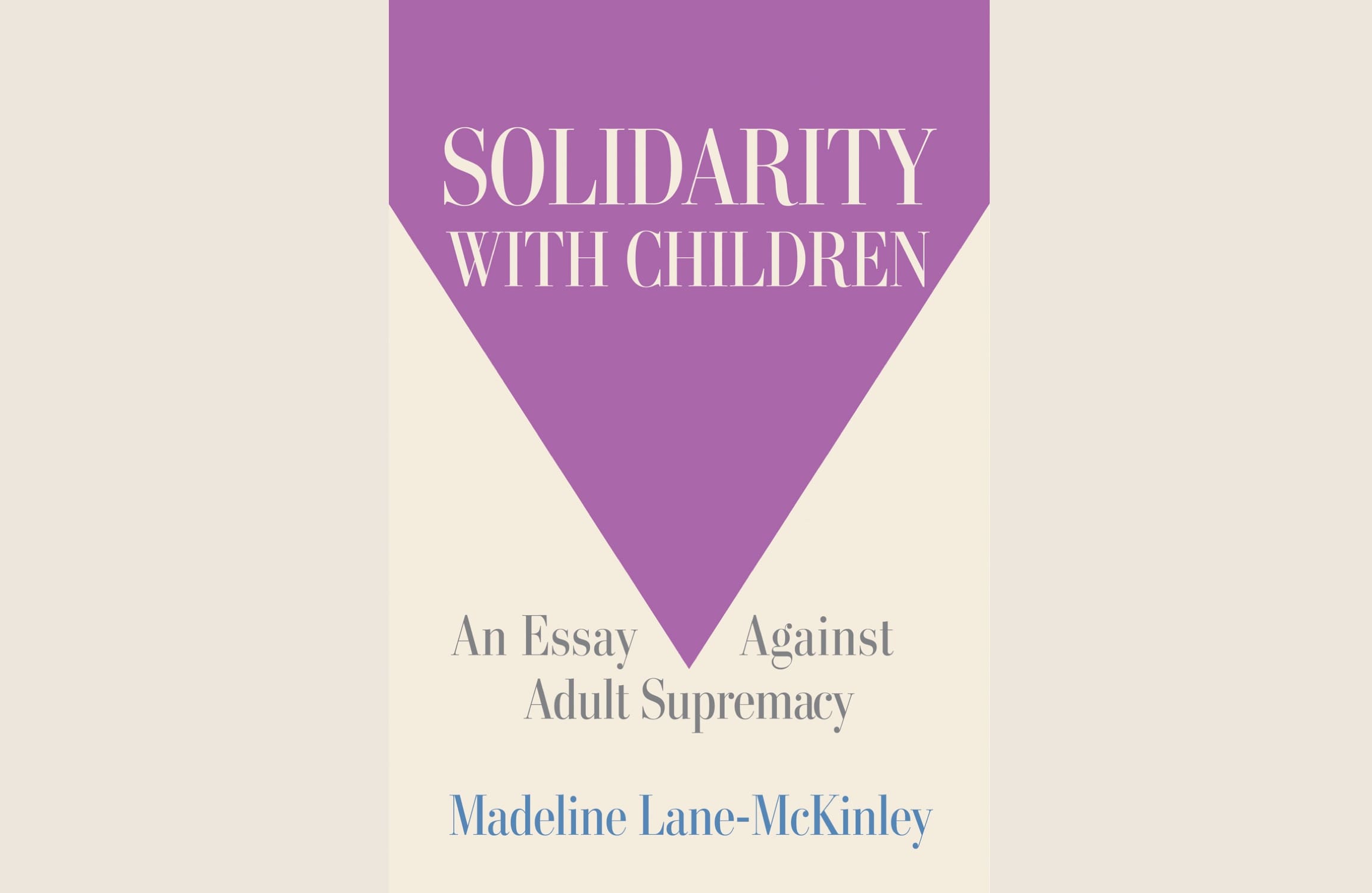
The latest book from writer, feminist, and radical theorist Madeline Lane-McKinley, Solidarity with Children: An Essay Against Adult Supremacy, was published this month by Haymarket. It arrives at an apt moment in our cultural miasma: born in the midst of new revelations in infamous child abuse scandals that involve the very top echelons of society, reactionaries’ stoking of phantom fears around trans children in school and sports (and trans people in general), and the incessant manufactured panics around education and the university.
Conservative parents in Canada and the U.S. are advocating for parental rights to control what happens at school, seeking to restrict teaching about slavery and settler colonialism, capitalism and climate, and gender and sexuality. Children—and the fevered imaginings that curdle in right-wing minds around their upbringing, their future, their innocence, their corruption, and the purported threats to their safety—are a major ideological pivot point, a fulcrum for political projects that defend a hierarchical status quo.
The grounding notions of these phantasias tap into and fortify what Lane-McKinley describes as “adult supremacy.” This names a real culture of systematic, naturalized domination over children, and a repertoire of ideas about why their subordination is justified. Such a regime keeps children confined to education in carceral, punitive, and unstimulating schools, trapped in circumstances of abuse both parental and institutional, and, worse still, subjected in many places (including U.S. agriculture and certain workplaces) to a subservient early life of exploitation.
Most grievously, as in Gaza, children are deemed disposable and targeted for execution: Palestinian children represent futures that their oppressors would prefer to see stamped out. Adult supremacy, argues Lane-McKinley, is an extant ideology that cuts across other systems of domination in complex ways. It is time to dismantle it, and to exchange it for modes of living with, engaging, and educating children that establish new prevailing notions about what it is to parent—notions founded in solidarity and collective care.
Of course, uninformed critics are keen to scorn a loony-leftist notion like “adult supremacy” or “child liberation” based on a thoughtless, kneejerk response to their own assumptions. Based upon little more than the terms themselves; such ridicule occurs in the absence of their comprehending even a tiny bit of the social and theoretical contexts from which these ideas emerge. Lane-McKinley has already been the recipient of serious threats, for this text and her past work. The right is always eager to dismiss as nonsensical so many ideas of which they have little knowledge and even less understanding. Critics of the idea of child liberation will reflexively defer to fictional and psychic imaginaries of dystopia, insisting that children are dangerous lunatics who would destroy civilization if afforded more leeway and independence.
The inevitable example is William Golding’s Lord of the Flies (1954)—the premier fictitious indictment of children’s ostensibly vicious and uncivilized consciousness, and part of standard high school curricula across the U.S. and where I live in Ontario. It depicts, readers will know, the raucous violence of youth left to their own devices, set against the civilizing force of a few mature souls who sagely wait for the adults to save them and return them to an ordered world.
The book is not only fiction but irrelevant fiction: Lane-McKinley’s vision is not one of children suddenly abandoned, unleashed from every kind of aid and guidance. This is the reactionary’s projected idea of child liberation, a world apart from the actual proposition. It is self-evident that children will always need forms of adult oversight, teaching, and assistance. Her point instead is that, within those constraints, we can better respect children for who they are.
We can, if we choose, meet their needs by alleviating their poverty and suffering; we can ascribe to them a full interiority, a consciousness that while still burgeoning nevertheless comprises a coherent identity, complete in itself. We can develop systems and institutions that can help them flourish in their natural abilities, rather than conditioning and stamping out a subject-template to fill the workforce and the military, or diverting young people to incarceration via the school-to-prison pipeline. And we can serve their interests in ways that actually protect them from predatory adults and their sheltering organizations, rather than from manufactured fears of gender non-conformity and other paranoias. Adult supremacy, as Lane-McKinley formulates it, serves today as “the ultimate anti-utopianism,” forcing people (many of whom live in conditions of precarity and uncertainty) to retreat to the comfort of tradition and the status quo—at a time when pursuing radically new ways of organizing society is acutely urgent.
Youth movements are at the forefront of many political struggles today, including over climate change, gender-affirming care, and freedom for Palestine. (Indeed, this is a non-trivial force, and accounting for it can help us unravel why the right is so eager to circumscribe children’s freedoms and independence.) While Lane-McKinley includes useful suggestions about how parents can help support children in these commitments and solidarities, she has not written a guidebook. Instead, Solidarity’s four chapters engage capaciously with the association between utopianism and childhood. Pulling that thread, she disentangles these complex affinities by interpreting representations of children’s development, drawing on thinkers of family abolition and practices of collective mothering, and identifying school as a site of ongoing struggle.
Solidarity contains analysis of the dire contemporary situation for children, the author’s reflections on raising a non-binary child in circumstances of real fear and threat, interpretation of cultural figures of childhood and adolescence—reflecting the author’s background in literary studies—and careful conversations with a range of key interlocutors, including Jules Gill-Peterson, Max Fox, carla joy bergman, Mariarosa Dalla Costa, Kathi Weeks, M.E. O’Brien, Sophie Lewis, Tiqqun, and Freud. A major contribution of the book is Lane-McKinley’s elucidation of how conservatives weaponize the idea of the child in the name of parental rights. They institute book bans and curricular censorship as a way of protecting a revanchist storybook notion of nationalist ideology, gender normativity, and childhood innocence in general, while ignoring (or more often, vindictively dismissing) the implications for non-white and queer children, and any others whose histories and realities are being silenced or disparaged in the process.
Indeed, right-wing lobbying and misinformation campaigns are contributing to an upsurge in “harassing, abusing, and endangering trans and nonbinary children and their caretakers, including parents and educators,” she notes, and catalyzing a resurgent culture of bullying and severe mental health struggles, some of which have ended in suicide. Public school educators, who want to help their students by preserving their access to care and information not dictated by their parents, are charged with “government overreach.”
This is happening even as the Christian right promotes control of bodily autonomy that amounts to, Lane-McKinley puts it, “state authoritarianism when it comes to all matters of reproductive health.” It is adolescents who are most affected by barriers to legal abortion—not least because of state requirements that they provide evidence of parental consent. Lane-McKinley mentions a 10-year-old incest victim who had to travel out of state to get an abortion, and a 13-year-old who birthed a child after being raped and then denied an abortion in her home state. This is violence against children in the name of children, she observes.
As befits a study written against weaponized ideas of the child, Lane-McKinley interprets classic narratives of childhood that legitimate adult supremacy and fetishize children as innocent and naïve—and ultimately, as our charges and possessions. She highlights the pedagogical work that these texts come to perform: instructing children in the value of maturity, reconciling adults to their childhoods being gone forever, and representing adolescence as a terrifying in-between state that threatens adult authority and should be closely monitored, worried over, and interfered with. Lane-McKinley’s point is not that these texts somehow automatically make people into adult supremacists, or that they were written with these precise ideological goals in mind.
Rather, whether because of or despite any intentions of the author, many canonical texts have come to backfill a certain structural function of supporting reigning ideas. She recommends engaging in critical cultural analysis of this sort alongside children, encouraging them to think about how any story can be read against the grain. Her rich readings of these works are directed not at rendering a conclusive judgment, but at exploring the contours of a pervasive cultural imaginary. Young readers would benefit from learning to think about texts in this flexible, multivalent way—which is to say, they would benefit from literature and the humanities, currently under such severe budgetary and political assault in lower and higher education alike.
Learning to grasp the ways that fiction like Lord of the Flies and other popular stories can evince or distort cultural ideas matters a great deal; these notions come to make up the amalgamated “fantasy structures about children that stand in the way of making solidarity thinkable, and that legitimate forms of domination,” as Lane-McKinley puts it. A key example is “the myth of the eternal child,” which is shot through the many tellings of the Peter Pan story. It exemplifies the idea that childhood is a state that must be scrutinized only from a position of adult authority. A child is “that which we have simply ceased to be,” she writes, if we are good moral citizens alert to our responsibilities. As is often the case in children’s literature (which is, after all, written by adults “for” children), in the Peter Pan universe the figure of the child is envisioned through envy and nostalgia, accompanied by a sure sense that those without adult guidance risk being lost forever in a tragic neverland.
This is the fantasy that conservative advice guru and weird substitute father-figure Jordan Peterson taps into when he describes a “Peter Pan syndrome” that is reputedly afflicting young people today. A consummate adult supremacist, Peterson’s fame first began to rise when he spoke out against Canada’s Bill C-16, which added gender identity and gender expression as prohibited grounds for discrimination under the Canadian Human Rights Act and Criminal Code. Peterson objected that, if passed, university professors would be penalized for using the wrong pronouns or for misgendering their students. He refused to grant them such consideration.
Of course, we should exercise some caution about equating children with young adults. Advocates for parents’ rights are worried about schoolchildren; Peterson is concerned (though not exclusively) with the dynamics of the university classroom. Yet this is a conflation that his work plays into quite deliberately. Students, child or young adult, who refuse parental authority are condemned to the perpetual “Peter Pan” state; they are unwell, trapped, unable to grow up.
Lane-McKinley argues, in a marked and compelling contestation, that we should reclaim these sorts of “pathologized” and “monstered” understandings of adolescence as imaginative conduits to living against the inevitable “disciplinary horizon of adulthood.” People cohabiting with adolescents may be familiar with their unique way of making you aware that some part of your former centrality in the household has dissolved. This doesn’t have to be grasped as the clichéd “crisis” of the teenager, who “wreaks havoc on the child/adult dyad” and provokes “the struggle to reign over the rebel without a cause,” in Lane-McKinley’s phrase. It can instead be an experience of “shared transformation” rather than a felt loss of status.
I can speak to this experience myself. My son, Ben, lives with OCD and neurodivergent learning needs. During COVID, the school system barely functioned for him, as circumstances inhibited the administration from providing indispensable accommodations for his needs. It has been hard not to fall prey to the temptation to conceptualize that period as “wasted years” or, in Lane-McKinley’s phrasing, “lost time—a time when nothing seemed to have happened, with the denial that anything else could have been learned.” Her chapter on schooling sets out to trouble the idea that any diversion from a sort of educational teleology (a stifling march towards normative achievement, status, and implicitly, financial gain) is a failure. She points out the pernicious developmentalist logic in this language: the idea that brains are to be shaped to grow in one direction, the same for everyone, and only certain settled on measures of achievement are valuable.
Ben’s elementary school principal, Mr. Paré, had a good way of objecting to this imputation. “The path doesn’t go one way,” he told us once. “There is no one in front and no one behind.” Still, it’s hard for a child to feel that way when he sees his peers excelling, and when he knows that demonstrating such excellence in the classroom is the supposed raison d’être of schooling: the ideal of what you are supposed to be doing, and certainly what you will be praised for.
When schools reopened, it caused Ben overwhelming anxiety to have to go every day to a place where he felt himself judged and lacking, and where none of his own strengths and proclivities seemed to be valued. But I wanted him to go. I insisted. I couldn’t break with the idea that school is where a child, my child, should be, and that he must listen to me—that, as his parent, I had a mandate to define and control his life. He tried one school for children with special needs, then this year another one. He spent the last two weeks of the summer of 2025 ruminating over his impending first day back in torment and misery. And yet I insisted he go, that he “give it a try.” Through anger and frustration and fights. I didn’t relent; I ordered him to go: to get out of the car and walk into that building. Despite all of his tears, and what I knew of how badly he struggled there.
I had my reasons, like all parents: I was worried about him. I wanted him to be around other kids, not isolated in his room. But he persisted in underscoring how he was suffering, and how this environment was not challenging or formative, merely painful. It was painful to have his strengths and his value ignored. And so eventually I listened to his feelings and how he asserted his needs, and I changed my mind. He now takes virtual classes. He works on them when he feels like it and spends much of the rest of the day pursuing his own interests in history, sports, and politics. In the months since then, a rare measure of calm has descended over our home.
I am ashamed of how I acted before. I was afraid. I couldn’t listen to him; I couldn’t stop wanting him to be “normal.” I am glad to have learned from his stubborn refusal: that, while compassionate and informed parental guidance can and should always be a shaping force in children’s lives, it can be equally true that sometimes, they really do know what’s best for themselves, in ways that we cannot. We assume that because their adult self is still inchoate, their present, developing self is not as viable as ours, that their self-understanding is less salient and less worthwhile than the opinions of the adults around them, first and foremost ourselves.
I spoke to Ben about the treatment of schooling in Lane-McKinley’s book, which he read alongside me. She writes about the co-development of capitalism and mandatory schooling, as children gradually came to be sent off to a place where a new developmental stage unfolded outside of traditional family homes. “Yes, and other times and in other places, kids were working alongside their parents,” Ben said, “and they were learning things on the fly, like in the house or farm. And then there came a time when universal public schooling was set up as, like the goal that everybody should have, and mandatory schooling becomes normal.”
Lane-McKinley invokes Emma Goldman, who wrote that “school is what the prison is for the convict and the barracks for the soldier,” where “everything is being used to break the will of the child, and then to pound, knead, shape it into a being utterly foreign to itself.” Ben shared his own gloss on this idea:
“School really does change the way you see the world—like, it tells you that, ‘We need to teach you how to learn.’ You can’t teach yourself how to learn. It’s almost as though the child is incapable of learning until they come to the school and are told how. They can’t do it without help. Like it’s not possible for you to do yourself. This is how you learn, and there’s only one way. If a child doesn’t fit into that one-way mentality, then they’re essentially cast out. I mean, they keep trying to teach you the same way, and they think that if you can’t learn that, then you are the problem.”
Still, Lane-McKinley reminds us that experimentation with different ways of doing schooling, “various forms of social justice and radical pedagogy,” are not wholly sufficient to “take on the trouble with school in its totality.” If alternative social forms were collectivized and organized around continuous education, what my son and I experienced would not have felt so isolating and fraught. This is where the politics of family abolition become key.
Solidarity with Children is thoroughly a work of family abolition; I think, in fact, that it should be considered immediately canonical—requisite reading for any theorist writing in the field. It vividly articulates the precept that the bourgeois family is a privative force that limits collective possibilities for caring for one another. Family abolitionists are those concerned with asserting, Lane-McKinley writes, “the demand to collectivize and de-privatize care and create alternatives to the family as a regime of private property, scarcity, and domination.”
Yet it is hard not to dwell on the difficulty of realizing this vision, the immensity of what would have to change to make it concrete and available in the world: “It’s at the precipice of this thought that I find myself in despair,” she admits, because of the distance between what most people experience now of life in the world and the “shared dream” of more communal horizons.
My son and I talked about this part of the book as well.
Ben: Yes. One of the things that this could mean is that if your parents happen to be jerks, you could go and live with someone else for a while.
Sarah Brouillette: Or even just to try it for something different. It wouldn’t feel so constrained, like that if you left home, you would starve because you would not have any other people to rely on without your parents.
B: You could just go off sometimes without anyone being bothered about it.
SB: Yes, I mean it is already like this in some places in some ways. But it could be more common and general. A more communal kind of model for family.
B: I mean, that that does make some sense.
SB: Imagine you could just wander down the street to Julian’s and live there for a few days. I mean you probably could now, actually; he’s cool.
B: That might be nice. I think that that could work if it was set up like in a correct way, where everyone understood and was behind it.
The idea didn’t trouble him at all. Accepting such a reality might be a lot harder on me.
In an account of motherhood that is moving and richly textured, Lane-McKinley, as a parent herself, readily admits how difficult it is not to revert to being aggressively protective—privative and enclosed—when faced with the threats to children today, and with the venom directed at you if you try to do things differently. (Leftists too have been known to mock certain revolutionary demands as “childish,” especially those concerned with identity, as with questions around gender and disability.)
The charge of “childish” dreaming (so often applied to leftists, with liberals and the right fond of diminishing any call for a better society as issuing from the fantasy land of “pink ponies” and “free ice cream”) helps inoculate us against the possibility of real transformation, and the upheavals that would accompany it. In response, Lane-McKinley takes inspiration from the history of feminist thought about the necessity of fundamentally reforming what motherhood looks like.
At its worst, motherhood is something that is done to you—you are rendered mother, sometimes via coercion and against your will. This comes along with expectations of performing non-reciprocal care within and beyond the family. Feminist calls to eradicate motherhood are an embattled response to the way it has been made into something you are “initiated into,” Lane-McKinley writes. In a more just society, it could, to the contrary, function as a crucial locus of solidarity and collective care—one that is, in Audre Lorde’s words, a “common human battle” for “all our children together,” as a “joint responsibility and our joint hope.”
Marxist-abolitionist thinkers often employ the German term aufhebung, which means both to abolish and to overcome; it carries the implication of doing so in a conscious way, so as to preserve what was good and can be used in the creation of something better. This is part of the impetus behind Sophie Lewis’s demand for “Full Surrogacy Now,” Lane-McKinley writes. Lewis notoriously asks what would happen if we enabled “fully collaborative gestation.” Like child liberation itself, this is a thought experiment that serves as a real provocation, spurring the development of new dispositions toward what it means to have and raise children. Delinking motherhood from the labor of gestation undermines its status as a property relation, bringing us closer to the more revolutionary horizon of the “care commune.” Long ago, my son asked me where babies come from. I said you need a warm place to grow a fertilized egg.
“The driving force of Lewis’s demand is a transformational break,” Lane-McKinley writes, away from “the fantasy of the creator figure, whose life making is mistaken for proprietorship.” Working toward this break, cultivating what others have dismissed as mere dreaming, entails what Lane-McKinley describes beautifully as “insurgent mothering.” Insurgent mothers work as they can against the restrictive couple form and the nuclear family that grows up around it. Again, this is not about the wholesale rejection of maternal care. Instead, she describes her position as one of anti-anti-maternalism: an aufhebung if ever there was one. This insists that responsibility for life in the world is something everyone can share in, and learn from, but that this does not mean we own and control those we parent—nor that the work of care makes people beholden to us.
Children can’t do everything on their own. None of us can. We grow old and need their help. Children make mistakes and need our guidance. We mess up and need their support. The path doesn’t go one way, as Mr. Paré said. “And solidarity is how we reckon with this,” Lane-McKinley writes. It not a matter of “whether or not we intervene when we are needed”; it’s a matter of how we include and treat all of those for whom we care—and a matter of how we determine exactly who is counted among them. Anti-anti-maternalism emphasizes that the dependency of children on adults does not need to reinforce domination. Being dependent is not about being subsumed beneath or being rendered less-than.
Solidarity with Children opens with a stark enumeration of what children face today:
“It is the reality of Palestinian and Israeli children, whose violent deaths are weighed against each other; the reality of children as young as five years old working with bare hands in the cobalt mines of the Democratic Republic of Congo; the reality that over 330 million children live in extreme poverty worldwide; the reality of the immigrant children caged at borders, of the trans children targeted by the state, of the one in three Black and Latinx households with children in the U.S. facing food insecurity, and of the roughly one billion children worldwide who experience physical, sexual, or emotional violence each year.”
We are harming all children by delivering them to an apocalyptic future—and teaching them that this terror is inevitable and unavoidable. But some are harmed more than others, and in different contexts; it is crucial to understand how the circulation of images of suffering is politically determined, and how its impact is alternately instrumentalized and constrained. Media outlets decide which children’s pain should be made perceivable and how it should be framed. “Which children get to be innocent—and which children are merely human animals?” Lane-McKinley asks. The appeal to innocence is a double-edged sword that demarcates who can be killed with relative impunity. In the U.S., Black children are six times more likely than white children to be shot by police. Tamir Rice was killed at age 12, holding a toy gun. He was not accorded the child’s requisite innocence. Migrant families trying to enter the country have had their children taken from them and put in cages; ICE agents have torn children from their parents’ arms.
And in Gaza, one of the very youngest populations in the world—nearly half of its people are children—the unverified and later debunked claims that Hamas had beheaded 40 Israeli children helped justify the wholesale massacre of Palestinian children (killing, in the lowest estimates, not a few dozen but tens of thousands) and more broadly legitimize the genocide of children and adults alike by the Israeli state. Two years ago, at a press conference outside the Al-Shifa Hospital in Gaza (before Israel knowingly and intentionally obliterated it), a group of Palestinian children pleaded for their lives. “We face extermination,” their 10-year-old spokesperson said. “Stop the death. We want life. We want peace. We want medicine. We want food. We want education.”
The video circulated around the world, across media platforms, and was viewed innumerable of times. However affecting it was, whatever sway it may have exerted on the public mind, it was ultimately just another piece of online content. Any impetus to action that it may have stirred was either dashed against the walls of undemocratic systems and state repression, or simply dissipated into our wider conditions of apathy. Such an apathy renders us not only complacent but complicit.
To understand how so many in the world are able to tolerate such a disgraceful moral abomination, which should weigh on the consciences all of us in the Western collaborator nations, Lane-McKinley draws on Susan Sontag’s On Photography, which analyzes the distance from suffering others that is fundamentally encoded in visual media. In the modern experience of “scrolling through genocide,” in Steven Salaita’s phrase, the content stream of images of traumatized children anesthetizes the viewer, allowing us to believe that what we are looking at exists well beyond our sphere of responsibility and action.
Of course, this is a comforting and noxious lie that we tell ourselves; in truth, our sphere of moral responsibility is coeval with the globe. So why do so many refuse the pleading of those Palestinian children, and other children worldwide, failing to take any action to provide what they have so urgently cried out for—and why do so many others deny that their suffering is real, or, worse still, that it is real but does not matter? Let us take seriously the individual realities of not only our own children, but of all. The world’s children—despite how they are denied humanity, written off as “collateral damage” or “military-age males” or as cynically co-opted props with “pre-existing conditions”—are just as real and conscious and capable of suffering as our own. It is as important that we comprehend just what it is that could have made them appear any less so. Lane-McKinley’s Solidarity with Children is concerned with naming, and dissolving, this mystification.
“We are all born into a world that we never asked for,” Lane-McKinley writes. Realizing this is the foundation of a bond between all people, which can be the foundation of collaboration and collectivity. To call for solidarity with children is not to evoke a wispy vision that we can defer to “someday.” It is a moral cry of the greatest urgency—not despite the fact that it entails remaking the world, but precisely because it does.
If Solidarity with Children has a unifying message, it is that we need to embrace, rather than mock, the ambition to radical and utopian reversals of injustice and suffering. “What is lost when we limit our political horizons?” it asks. Moreover, no child is safe today from the threat posed by the crises that are amassing at a planetary level—from the cruelties of everyday life to the unraveling of the global climate. At this scale, only the most sweeping demands rise to the occasion of the threat. The only realism is utopianism. This is exactly what Lane-McKinley articulates so well. “The utopian demand asks the question of what we perceive as feasible, against the reality of what we know to be urgent,” she writes. To refuse it is to surrender the future. ♦
