

The Vietnam War, or at least some memory of it, continues to loom large in the American cultural consciousness. Still, there remain a few holes left relatively unexplored. The largest of these lacunae probably concerns the Phoenix Program: a “counterinsurgency” plan led by the Central Intelligence Agency (CIA) between 1968-1972—effectively a mass murder operation that killed tens of thousands of Vietnamese in the countryside, prefiguring the “night raids” and drone strikes of the later “War on Terror.”
The second-least scoured piece of the Boomers’ war has to do with the drug trade. While the image of the drug-addicted GI may be a familiar one, less familiar is the role that the military itself played in transmitting that drug addiction to the U.S. and elsewhere. By 1972, 70% of the world’s heroin supply was coming from Southeast Asia, sourced primarily from countries in the so-called Golden Triangle next to U.S.-occupied Vietnam: Laos, Thailand and Myanmar.
Production was facilitated by locals and often directly abetted by the U.S. government in some fashion. Chinese Nationalist guerrillas loyal to the late Chiang Kai-Shek who remained either on the CIA payroll or in the Agency’s Rolodex, for instance, proved adept at building narco-economies out of the Laotian or Myanmar countrysides. Distribution was a more global effort. Traditionally, the drugs would have traveled westerly routes to Europe. But the Vietnam War’s countless flights and nautical journeys between bases in Southeast Asia and the United States created new Pacific conduits to the world’s largest market of narcotics purchasers.
To meet demand, forces in the U.S. Army built their own heroin smuggling operations in the late 1960s, a story memorably told in the Ridley Scott film, American Gangster. That 2007 movie depicted the most notorious of these outfits, Harlem kingpin Frank Lucas’s Thailand connection to a Master Sergeant in the 82nd Airborne, Ike “Sergeant Smack” Atkinson.
For six years, prosecutors claimed, Atkinson’s ring was responsible for annually hauling 1,000 tons of heroin into the United States. The sergeant was a self-described Army brat, who used family and hometown friends from Goldsboro, North Carolina to accept packages originating from Bangkok, delivered through the Army postal service. After his arrest in 1976, Atkinson was tried, convicted and sentenced to 31 years in jail.
The stuff that finally got Atkinson caught was delivered to a town an hour away from Goldsboro called Fayetteville, home of the now infamous Fort Bragg. Today, Fort Bragg is the largest military installation in the country. And, thanks to the reporting of investigative journalist Seth Harp, we can also say with confidence that Sergeant Smack’s legacy lives on.
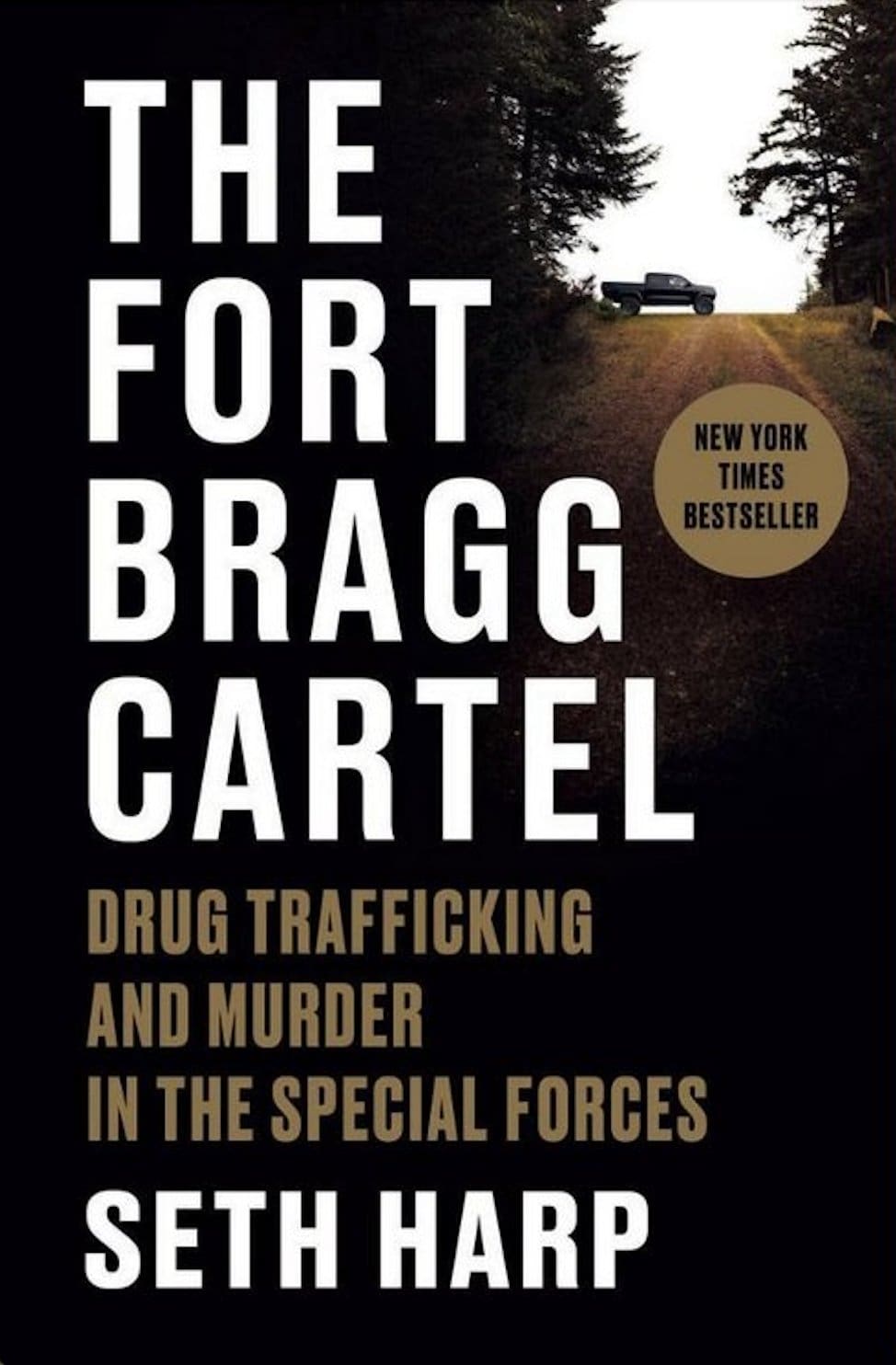
The Fort Bragg Cartel: Drug Trafficking and Murder in the Special Forces is the culmination of over half a decade of Harp’s masterful magazine reporting for Rolling Stone on the string of murders and organized crime activities among the Special Forces soldiers based out of the Fayetteville-Fort Bragg area. (Full disclosure: I consider Harp a friend). The book is a tightly written and comprehensive fusion of Harp’s earlier journalism; after reading it, I felt like I had descended into a Hell hidden in plain sight. Home to the Joint Special Operations Command (JSOC), it wouldn’t be off-base to think of Fort Bragg as something akin to the military’s New York City: not the nerve center (that’s Pentagon City) but its most culturally vital and creative place. And within this “cultural scene,” JSOC is the avant-garde.
The term “special forces” broadly refers to the troops under the command of JSOC, which was formally organized in 1980. While there had been high-fitness special training commando units before, there was, beginning in the mid-1970s, a new operational environment that placed a premium on special operations requiring soldiers who could, to a man, out-kill the general infantry, and deploy abroad with a significantly lighter footprint.
During this time, the peak of the global Cold War had given way to detente. In addition to its battlefield losses, popular resistance to the draft and revolts within its own ranks also contributed to the U.S. military’s defeat in the Vietnam War. Due to both fallout from the Watergate scandal and residual antagonism to the Vietnam War, the CIA was cut off from forming secret armies and carrying out covert military operations. On multiple fronts, Congress threatened to reassert authority over the government’s war-making powers.
While the popular narrative of JSOC’s birth is that it was created as a direct response to the cataclysmic failed 1980 rescue of U.S. hostages in Iran, it would be more accurate to consider it an imperial adaptation to domestic political circumstances.
“The Senate Select Committee on Intelligence formed in May 1976. Its counterpart in the House of Representatives formed in July 1977,” writes Harp. “The Intelligence Oversight Act, which mandates CIA reporting to a group of eight Republican and Democratic legislators, passed in June 1980. Six months later, JSOC came into existence.” Paired with a new lust for Third World war via proxy under the Reagan Doctrine, “the administration leaned heavily on Delta Force and other undercover soldiers.” The increasing use of undercover soldiers was not only a tactical but also a legal and political decision—the wars, if not the operations themselves, were often illegal.
Far above the Navy SEALs and the Green Berets, Harp convincingly argues that it is Delta Force—an ultra-selective group of a few hundred all-male, all–white operators—that forms the dark heart of JSOC. Shielded from any direct oversight outside of the army, Delta’s activity has been traced to theaters as diverse as Pakistan (1986), Iraq (1991), Somalia (1993), Waco, Texas (1993), Afghanistan (2001-2020), Iraq again (2003 – present), Syria (2015–present), Mexico (2016), Ukraine (2022-present) and far, far beyond.
Technically ensconced within the Army and subject to martial regulation, Delta Force soldiers are in actuality given free rein to do more or less whatever they choose—both on the battlefield and at home. When Delta Force members shoot their friends in the company of young children? It gets swept under the rug. If their bullet-riddled corpses turn up in the woods along with those of known drug traffickers? The investigation gets buried. When they rape their female colleagues? His career gets set back a bit, hers is over.
The anchor crime of The Fort Bragg Cartel is the March 2018 killing of Green Beret Mark Leshikar by his supposed best friend, Master Sergeant Billy Lavigne, a Delta Force operator. While returning from a trip to Disney World with their children, Leshikar enters into a Henry Hill-on-cocaine-like paranoia fugue state brought on by heavy drinking and even heavier narcotics use. The two men were still drunk from the night before, and both were also still high on a cocktail of drugs that included, among other things, bath salts. When they returned to Lavigne’s house in Fayetteville, Leshikar reportedly took a screwdriver to check the car for listening devices as Lavigne locked him outside and ushered the girls upstairs.
Not long after, Leshikar’s young daughter let her father back in the house (he was bare-handed now). Accounts differ on what came next, but the facts are that Lavigne shot Leshikar three times and then, according to Harp, “stood over his best friend and finished him off with a kill shot to the rib cage at nearly point-blank range.” Lavigne was taken into custody but never officially arrested. “He was not booked, photographed, fingerprinted, or taken before a magistrate for a bond hearing.”
Lavigne was also not thrown out of Delta Force for killing Leshikar, who was, after all, a member of a different, less prestigious Special Forces tribe. (A theme of Harp’s book is that loyalty to teammates and in-house command structures trump all.) It was only five months after the killing, when Lavigne was arrested on a range of felony offenses that included possession of cocaine, that he would face any kind of disciplinary sanction: a reassignment to a do-nothing job elsewhere in the Army.
Two years later, in December 2020, an off-duty soldier was roaming Fort Bragg’s forested outer reaches with a hunting permit when he encountered a Chevrolet Colorado stuck on a trail at a weird angle. On the ground near the pickup truck was a Black man lying face down—later identified as Army Veteran Tim Dumas—while inside the truck bed lay Billy Lavigne, “wrapped in a blood-soaked painter’s tarp.” Investigators reasoned that Lavigne’s killing had been contracted to Dumas, who had carried out the job with a third party who then, in turn, executed Dumas as well. Text messages found on the victims’ phones led to further suspicions that the homicides were related to the drug trade.
As of this writing, Lavigne’s and Dumas’s murders have not been solved. In 2023, a man with no connections to the military, but with an extensive drug trafficking rap sheet, was arrested for the double murder (the FBI has not disclosed what evidence it has to substantiate the charge). But given that Lavigne used to kill people for a living, and was by all accounts very good at it, people close to the case whom Harp interviewed posit that the government is trying to “pin” the mess on “this skinny little motherfucker.” Seth Harp, however, had an idea of where to look for more answers.
Too much weird shit has happened at Fort Bragg in the past decade-plus to allow for more prosaic explanations of all the mayhem at the base. Harp, a veteran of Iraq himself who has spent substantial time reporting on the Special Forces in the U.S., Europe, and Middle East, points the finger, chronologically, to the start of the Obama administration.
An assassination program tipped by the spear of Predator drone strikes, which fell under the purview of the CIA, had been active since the 1990s. It was supercharged, however, in the late 2000s with the arrival of the Obama administration, which found itself shopping for a new Afghanistan strategy. Paired with Langley’s death machines from above, JSOC insinuated itself into the conversation through the leadership of Gen. Stanley MacChrystal.
McChrystal, with JSOC as his medium, had perfected an assassination program during the 2007 “surge” in the Iraq War, using one simple trick: 1) collect “intel” on suspected terrorists, 2) kill them during “night raids,” 3) search their bodies for more “intel” on others in their “network” 4) repeat. McChrystal had both a goofy Pentagon title for this process (“F3AD”) as well as a name with a more chilling management consultant sheen (“continuous targeting cycle”), but, fused with the CIA’s Predator death machines, the policy was something like a high-tech version of the Phoenix program.
“From about ten a month at the start of the war,” writes Harp, “the number of night raids that JSOC carried out increased to ten per day at the height of the surge.” And under Obama, it was exported from the “bad” Iraq war to the “good” Afghanistan War—and scaled up, dramatically.
Billy Lavigne first deployed to Afghanistan in 2011, which coincided with the importation of McChrystal’s strategy to the JSOC annex at the massive Bagram air base near Kabul. According to family and friends of Lavigne with whom Harp spoke, Lavigne’s job was endless killing. In the past, raids in Afghanistan had happened less frequently, due to a lack of targets—so McChrystal loosened the parameters of what qualified as a “target.”
“The pace of night raids increased dramatically as teams of Delta Force soldiers, Navy SEALs, and Army Rangers carried out one surprise attack after another under cover of darkness, killing up to a hundred Afghans at a time and leaving whole villages in smoking ruins,” Harp writes. “The error rate was around 50 percent.”
Only one unit (the Navy’s SEAL Team Six) attracted any real negative attention for its activities during this period, though this heightened scrutiny was perhaps only a consequence of the media fanfare around Team Six’s assassination of Osama Bin Laden in 2011. Delta operators, on the other hand, lingered in the shadows. The complete picture of their misbehavior—apart from a vague outline of the systematic murder carried out as a matter of official policy—has remained murky.
The darkest quadrant of Special Forces activity in Afghanistan relates to narcotics. During the time of the war in Afghanistan, Harp correctly notes, “in the English-language press, total silence descended over the topic of heroin production in the Helmand, Kandahar, Nangarhar, and other Afghan provinces, where U.S. soldiers were not infrequently photographed patrolling vast fields of poppy.”
During the American occupation of Afghanistan, the Central Asian country reclaimed its historical role (briefly thwarted by the Taliban) as a major heroin supplier to the world market. In fact, Afghanistan became the largest illicit opiate source in the world, increasing production by more than 7,500% from 2003 to 2005. Disallowed from calculating the true impact of Afghan heroin on the U.S. market, the Drug Enforcement Agency (DEA) simply fudged the numbers.
No one wanted to acknowledge the truth: that the biggest heroin traffickers were clients and friends of the American occupation. Most damaging of all was the preeminence of Ahmed Wali Karzai, brother of the U.S.-backed Afghan president Hamid Karzai and a paid CIA asset. Historically, the U.S. has permitted, if not encouraged, drug dealing by its clients, recognizing it as a lucrative source for funding that doesn’t have to be Congressionally approved. While direct links between the American military and Afghan cartels have been difficult, but not impossible, to come by, in the deathly forest of North Carolina, Harp has found a mature milieu of criminality, and even some evidence leading back to senior American officers.
Although Delta Force may be the wind beneath JSOC’s wings, its few hundred soldiers are bit players, in terms of head count, in the 50,000-person world of Fort Bragg. Harp broadens the scope of his book to include killings and crimes that do not seem to concern Delta Force directly, but reflect a culture of violent and at times organized misconduct that has overtaken the military at Fort Bragg, what in other countries the U.S. government and media would not hesitate to label as a “drug cartel.”
Tim Dumas, the veteran whose body was found with Lavigne’s, bears a close resemblance to the spirit of the 1970s’ Fayetteville legend, Ike Atkinson. Both Atkinson and Dumas had served in the conventional Army, from which the latter was kicked out in March 2016 for drug offenses and major errors at work.
Dumas’s job had been to serve as quartermaster for a battalion that provided logistical support to JSOC operations during the height of Afghanistan’s night raids, a period for which Dumas and his unit (the 95th Civil Affairs Brigade of the Green Berets) kept records that were later “found to be missing in their entirety,” per Harp. Dumas bore a grudge—a motif with military men who break bad—which seemed to fuel his post-Army career as a drug trafficker of local renown.
“They don’t seem to have been especially close friends,” writes Harp, “but [Dumas] and Billy Lavigne knew each other and were often spotted in the same company.”
Days after Dumas’s murder, one of his associates, an ex-State Trooper named Freddy Wayne Huff, was made the official target of an Immigration and Customs Enforcement (ICE) investigation. Huff, probably the most interesting character in The Fort Bragg Cartel, was fired, as he tells it, for giving a DUI ticket to the wrong North Carolina political bigwig. Working under the theory that the best revenge would be vast criminal success, Huff turned his law enforcement skills into the basis of a trafficking partnership with the Mexico-based Los Zetas cartel, an enterprise for which he was arrested in 2021, about a year after Dumas’s death.
“Tim told me about basically a gang,” Huff explains to Harp, “a drug-trafficking organization within the military [made up of] an unspoken group of soldiers that police themselves.” Huff claims to have been supplying this group via Dumas, writes Harp, “a confederation of semi-independent dealers in and around Fayetteville.”
These men were not only buying drugs to sell themselves or to take with their buddies, but were taking weapons from Fort Bragg—“grenades” and “automatic arms”—for resale on the black market. It had been Dumas’s job to do the cover up in the record-keeping. Talking with Harp, Huff claimed that Dumas had grown increasingly paranoid as time went on, going so far as to compose a “blackmail” letter, a so-called “insurance policy,” which he gave to Huff on a thumb drive in 2019.
Although four different sources separately confirmed that Dumas had written such a letter, only Huff claims to have actually read it. In Huff’s account, the letter was addressed to a high-ranking general and alleged that soldiers were bringing opiates from Afghanistan into Fort Bragg. “The letter,” writes Harp, “specifically identified the service members who were supposedly transporting commercial quantities of occupied Afghanistan’s marquee national product into the United States.” Huff only remembered one name on the list: Billy Lavigne.
Although Harp has substantial testimony from named and unnamed sources that corroborate Delta Force operator Billy Lavigne’s activities as a drug dealer, he gives considerable narrative berth to Freddie Huff, an admitted criminal now serving a 21-year prison sentence handed down in 2023. The decision is not merely in service of good character work. We suspect that we can trust Huff because Harp did the legwork of actually tracking down the thumb drive.
“In March 2024, Detective Chris Luper of the Winston-Salem Police Department confirmed that their forensics unit was in possession of Huff’s personal computer, three cell phones that had belonged to him, and two thumb drives,” he writes. The first thumb drive contained a colleague’s family photos, while “the other was found right where Huff said he stashed it, in the drawer of a minibar in the basement of his house.”
With Huff’s permission (the drive is his private property), Harp requested that law enforcement turn the USB drive over, as Huff’s case had been concluded. To Harp’s surprise, the Winston-Salem cops agreed.
“A few days later,” Harp narrates, “Detective Luper told me that he had bad news. When he went to effectuate the digital transfer he found the drive empty of any files. There was nothing there. The device was completely blank. The thumb drive, and the forensic information stored on its circuit boards, remain locked away in the Winston-Salem Police Department’s evidence room. No other copy of the letter that Dumas wrote is known to exist.”
Downstream from Delta, the totality of crime at Fort Bragg is dizzying to consider. Simultaneous with their disclosure of the Dumas-Lavigne murders, the military also revealed that authorities had found the headless corpse of support specialist Enrique Roman-Martinez. Roman had been camping with friends at the time of his disappearance before his beheaded body turned up nearby after an apparent nighttime abduction. Another unsolved murder.
Through public records requests and eagle-eyed examination of local news headlines, Harp has determined that death at Fort Bragg—whether by homicide, overdose or suicide—crescendoed in this early 2020s period. He calls it “an unprecedented wave of fatalities, like nothing ever seen before at any other U.S. military base.” Roided out soldiers and those suffering from extreme trauma were dying by suicide, while healthy Special Forces troops, some of the most physically fit people anywhere in the world, were found dead, slumped over a steering well or struck down by a “cardiac arrhythmia.”
This cascade of death seemed unaffected by the lead-up to the publication of The Fort Bragg Cartel. Indeed, Harp notes that, almost surely in response to his reporting, the military no longer discloses how deceased people at the base died at all. With Donald Trump back in the Oval Office, little discipline and even less justice is demanded of the military, which applies doubly to its prized Special Forces units.
If they manage to live through 20 years of service, surviving members of JSOC teams become retirees with sizable pensions and lifelong medical benefits in their late 30s and early 40s. They are free to work or “consult” for private companies, which many of them do. However, an increasing number of special forces alumni—Jocko Willink, Shawn Ryan, Tim Kennedy, to name a few—are trying their hands at the influencer business, making money on the podcast circuit by telling tales, often tall, about their tours of duty.
Ike Atkinson’s story had a somewhat different ending. He was arrested and prosecuted in 1976, successfully made into the scapegoat for a vast, highly complex enterprise that was at least visible to if not outright controlled by more powerful echelons in the military.
But Sergeant Smack didn’t twiddle his thumbs in jail. Witnesses at the time told the Raleigh News & Observer that Atkinson “lived it up in the jail, supplied with women, liquor and special food while he awaited trial.
“His cell was often unlocked. Jailers called him ‘Mister Atkinson’ in a respectful tone… Atkinson had a TV set outside his cell, hooked into the jail’s security cameras.” Despite being prosecuted again for trafficking while in federal prison, Atkinson was released in 2007, the same year as the release of American Gangster, in which his character was given a bit part. He died in 2014, after making ample rounds in the media to play up his role as a Vietnam-era drug “kingpin.”
The essential difference between Sergeant Smack’s era of trafficking and the present one is that Special Forces soldiers enjoy privileges and protections afforded to nearly no one else. They are awarded these privileges for carrying out secret and usually illegal operations which are viewed as mission-critical in the corridors of power. The golden rule of Delta Force et al. is omertà, and the reward for silence is a de facto pension that can support enough jet-skis, deck refinishings and key parties to last several lifetimes’ worth of retirements.
What appears to create problems for Special Forces today—just as in Atkinson’s day— is that many in the ranks bring the war home with them. While killing can exact a mental toll, it can also simply become a way of life. So long as their officially sanctioned work of murder remains protected from on high, however, this criminal recreation will get swept under the rug.
“Mr. Ike was targeted & persucuted [sic] all his life,” wrote a commenter on Atkinson’s obituary in his hometown newspaper. “He was a good man, now he can rest and be free of the ones here on earth that judged him.” In Fort Bragg today, the military seeks to ensure that these “good men” will never face judgement at all. The crimes of JSOC are too numerous and too well hidden for Harp to have covered them all, but if judgment is to come, as it must, The Fort Bragg Cartel is an excellent start. ♦
