

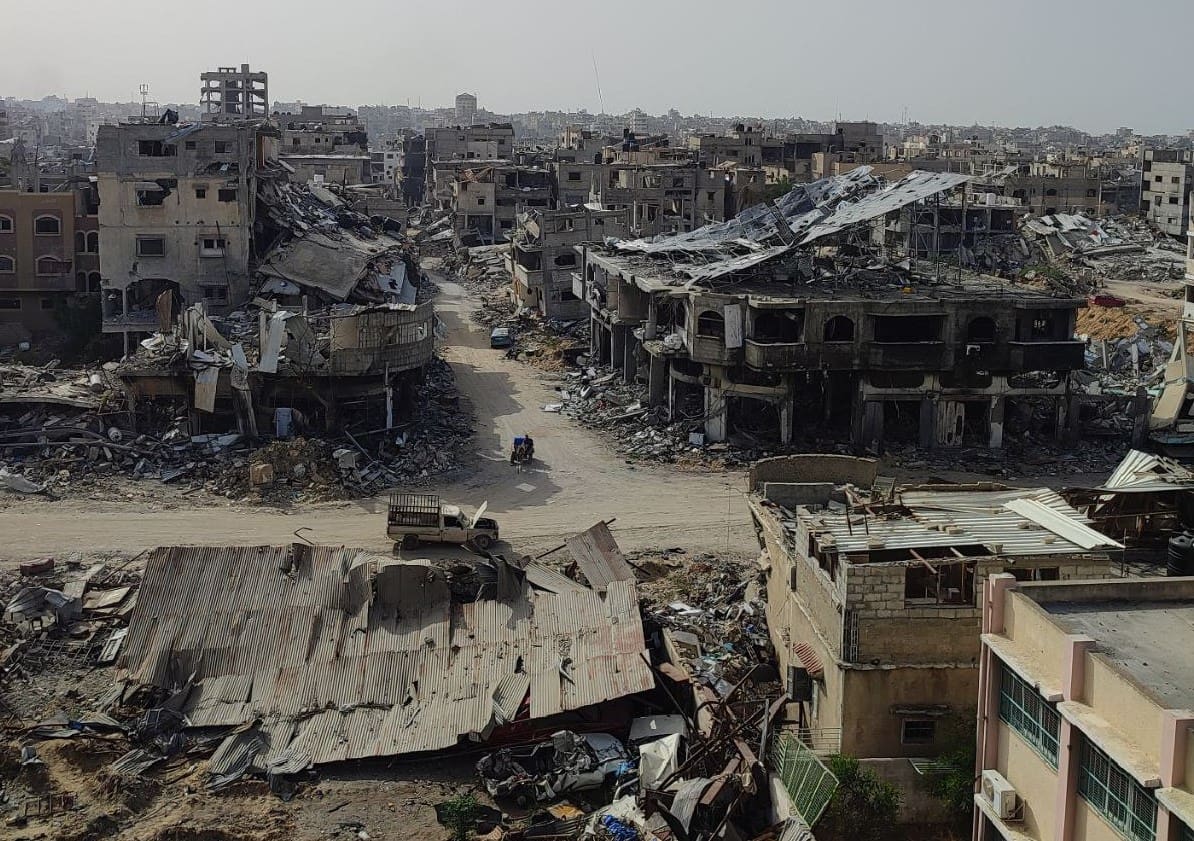
Perhaps someday soon we will find ourselves adding poetry to the list of those killed by the complicity of Western institutions. If Arabic poetry is dying in English, it is because Arabic poetry without Palestine cannot exist. The suppression, erasure, and eradication of “Palestine” and “Palestinian” in the English language, through blatant and nefarious means, is a threat to the very idea of language itself. The most recent assault on the notion of Palestine in English was the Israeli Prime Minister’s desperate attempt to equate the call of “Free Palestine” with “Heil Hitler.”1 Language loses all meaning when it is used to disfigure truth and malign justice. And there is no greater injustice than what has happened, and continues to happen, to Palestine. No greater lie than calling Palestine an unjust cause. How might poetry, then, ever come to rescue language?
“I want to find a language that transforms language itself into steel for the spirit—a language to use against these sparkling silver insects, these jets. I want to sing. I want a language that I can lean on and that can lean on me, that asks me to bear witness and that I can ask to bear witness, to what power there is in us to overcome this cosmic isolation.”2
Pick up a copy of Memory for Forgetfulness, and you will feel as though its renowned author, Palestinian poet Mahmoud Darwish, was with us today, and was speaking of the ongoing genocide in Gaza. While the events to which the extended prose poem testifies are the atrocities of the 1982 Israeli invasion of Lebanon and siege of Beirut, the indictment against the treachery of language is the same. As we helplessly watch the slaughter of thousands, we too must condemn language that fails to bear witness or incite action—or worse, that yields the opposite of its intended effect, concealing truth and chilling those who might act against genocide into submission.
Memory collapses time and place. It creates an oneiric wasteland where Israeli war crimes—such as cutting off Beirut’s water supply and testing horrific weapons like the vacuum bomb on civilian infrastructure—take place alongside prior historical atrocities. On the same pages appear the European Crusades, the siege of Acre, and the U.S. atomic bombing of Hiroshima, which incinerated nearly 140,000 Japanese civilians. Everywhere, the tragedy of poetry is the same. It is the first to respond, yet it always arrives too late. Darwish feared that poetry, as other genres of language have already, will also succumb to the banality of reportage one day.
Darwish’s memoir is at once a historical document and a literary product of trauma. Exiled from Lebanon in 1985 for his association with the PLO, he barricaded himself in his Parisian apartment, only to emerge 90 days later. He sent the finished manuscript to Al Karmel3 for publication and never read it again. Despite its timeliness and urgency, Memory would not be translated into English for another 10 years, until 1995. Among the many lessons Darwish learned from his Beirut phase is that time is no luxury when faced with methodical annihilation. With this lesson in mind, some Palestinian poets and writers have abandoned the torturously slow industry of translation and are now seeking to reach wider audiences through more immediate channels by choosing to write and publish in English.
The recent surge of Palestinians, namely Gazans, writing in English dates to the 2014 Israeli siege of Gaza, in which 2,251 Palestinians were killed.4 The vanguard of this movement was Dr. Refaat Alareer. Best known for his 2011 poem “If I Must Die,” the university professor used every platform at his disposal—from publishing edited anthologies (Gaza Writes Back) to founding websites (Eye On Palestine)—in order to amplify young Gazan voices. Dr. Alareer survived every Israeli siege, blockade, and onslaught since 1979. Shortly after an interview (in which he famously vowed to throw his Expo marker at the occupying soldiers if they ever broke down the door) Israel would assassinate Dr. Alareer, adding his name to the toll of innumerable Palestinians murdered in the course of Israel’s genocidal campaign. On December 6th, 2023, he was killed along with his brother, sister, and her four children in a targeted airstrike on their home in northern Gaza.5
But after his assassination, Dr. Alareer and his message were revived through his poetry. His poem, “If I Must Die,” passed through the lips of thousands (maybe millions!) all over the world at vigils, protests, and encampments, and was further amplified on social media. With each reiteration, his words thrived in their afterlife; they grew stronger with every echo of “Then you must live,” the poem’s final refrain. One of Dr. Alareer’s students, Dr. Yousef Aljamal, says the following:
Refaat thought that speaking to the world in English will help us tell our story and convey the Palestinian side of the story. That is why he invested in English. So, he used English as a tool of resistance. Not because he thought that English was superior [to] Arabic. In fact, it is the opposite. Arabic has more metaphors. To quote Edward Said, it is the language of love and philosophy and politics. It’s because Refaat had a pen to tell the story of Palestine, the story of Gaza, and to reach a wider audience. And I think he was successful in doing that.6
Dr. Alareer worked tirelessly to encourage young Palestinians to write about their experiences in the same language spoken in nations that actively seek their erasure. In 2016, a member of Israel’s Likud party made the astonishingly stupid claim that Palestine could not possibly exist because Arabic has no letter “P.”7 More recently, U.S. ambassador to Israel Mike Huckabee perpetuated the same brand of ignorance, declaring “There’s no such thing as a Palestinian.”8 These two high-profile attempts to erase the linguistic and cultural memory of an entire people is more evidence that the struggle for liberation is also being waged on the frontlines of the English language—a language that has proven to be dangerous territory for Palestine and Palestinians.
The poet Mosab Abu Toha—who, like Dr. Aljamal, was a student at the Islamic University of Gaza, before Israel reduced it to rubble—also responded to Dr. Alareer’s call for Palestinians to write and publish in English. Abu Toha, credited for founding the only two English-language libraries in Gaza, first in 2017 and then in 2019 (both of which have also since been destroyed), went on to publish two collections of poetry in English. His recent ascent to literary fame in the West has given scholars of Arabic literature and literary critics a lot to consider.
Encouraged by an international network of friends, Abu Toha began posting English compositions on social media platforms like Facebook in 2014.9 That support culminated in endorsements from institutions like PEN America’s Writers at Risk and Harvard’s Scholars at Risk. Eventually, Abu Toha would publish his much-lauded debut collection Things You May Find Hidden in My Ear with City Lights Books.
Actually, Abu Toha reached his present visibility when The New Yorker broke the story of his release from Israeli captivity in Gaza. Almost overnight, Abu Toha emerged on the other side of October 7th as the journalist-poet upon whom the West relies to hold a mirror up to a genocide it has so willingly allowed to happen. Since then, he has published three guest essays for The New York Times and several others for The New Yorker, and continues to churn out interviews with numerous media outlets. But his most impressive achievement is arguably the Pulitzer Prize he received for his New Yorker essays “on the physical and emotional carnage in Gaza that combine deep reporting with the intimacy of memoir to convey the Palestinian experience of more than a year and a half of war with Israel.”
Without a doubt, the presence of a Palestinian writer within legacy media contributes to the growing awareness and visibility of the ongoing Nakba. Abu Toha’s voice, as a Palestinian who witnessed genocide and nearly lost his life, is vital. His harrowing accounts, which document the brutality, degradation, and starvation to which his family, his neighbors, and he himself have been subjected, have indeed provided legacy media and their subscribers with a much-needed Palestinian “perspective.” Some would also make the case that the appearance of these kinds of narratives in prominent Western publications represents a contribution to the Palestinian cause. After all, many Palestinians, including Dr. Alareer and Mahmoud Darwish, have appeared in The New York Times in the past, hoping to influence public opinion through guest essays and interviews.
Nevertheless, I’ve been troubled by certain recurring patterns in media and cultural commentary—patterns that I’ve also been seeing reemerge around Palestine and the literary-media establishment. Even before his transformation into a media commentator, Abu Toha’s poetry enjoyed a kind of critical immunity. His work is routinely met with extravagant praise and unexamined assumptions.
After all, Abu Toha’s is a voice that can testify to the horrors of Gaza. If we criticize him or critique his work, are we not impeding the cause by problematizing his efforts to reach institutional recognition? Is Abu Toha not fulfilling Dr. Alareer’s own call to publish in English? Doesn’t more visibility always contribute to the growing collective awareness of Palestine? These arguments have not gone unconsidered. Still, I think a more thoughtful critique is needed—one that questions the West’s sudden and eager embrace of Abu Toha and moves beyond the cheerleading that precludes real critical engagement. Anything less actually disrespects the integrity of the poetic practice and the art of poetry itself, doing both a disservice.
If critics were hesitant to engage honestly with his poetry before, it feels even more fraught now that Abu Toha is enshrined in the circles of media and literary elites. This is not, however, a new phenomenon. In fact, it reflects a broader pattern in the Western journalistic and literary world that I find troubling and increasingly recognizable in the reception of writers and poets in the past like Ocean Vuong and Amanda Gorman. It is a phenomenon I now see repeating itself in the case of Abu Toha and his work.
The Western media—which I understand as the dominant literary and journalistic institutions shaping mass perception—has a persistent habit of tokenizing individuals from marginalized groups or oppressed communities. At best, this treatment stems from convenience; more critically, though, it reflects laziness, genuine disinterest, and a racist impulse to find a single, “digestible” representative. But tokenization is dangerous. It flattens complexity and diversity, turning one person into an unelected spokesperson for an entire people and their struggle.
In the era of livestreamed genocide, the over-promotion of a singular voice inevitably muffles the hundreds of thousands of others who also demand to be heard. This is especially urgent as Gazan journalists are being targeted and slaughtered by the IDF with impunity. Over 226 journalists have been killed, to date. One of the most recent deaths among journalists was that of Anas Al-Sharif, who was killed in a targeted Israeli airstrike on a media workers’ tent outside of Al-Shifa Hospital in Gaza City. Although he too was a Pulitzer Prize winner, Al-Sharif was nevertheless assassinated. The absence of widespread outrage in the wake of his murder is a chilling reminder that Western media still systematically minimizes Israel’s blatant criminality when its military targets journalists for assassination. All too often, the work of Gazan journalists is virtually ignored by the Western media; when they are acknowledged, they either become bigger targets or are baselessly portrayed as terrorists.
As many sources and media critics have documented, The New York Times has been absolutely central, among “respectable” mainstream outlets, in disseminating pro-Israel narratives and imparting a slant to ostensibly neutral coverage. And so there is something disturbing about seeing any advocate for the Palestinian cause associated with The New York Times, especially during the past two years. Which is perhaps why I found the dates of Abu Toha’s publications in The New York Times unsettling. His first piece appeared on October 14th, 2023, in the wake of the 7th. The other two, however, were written a year later. Crucially, it was on Februrary 27th, 2024, that Writers Against the War on Gaza called for a total boycott of the Times for its complicity in legitimizing Israel’s genocide. Still, in defiance of the boycott, Abu Toha persisted in publishing with the very institution that denies the genocide and plays a significant role in shaping U.S. opinion in its resolute backing of any and all actions by Israel.
Abu Toha’s guest essays for the Times appeared in the Opinion section, which claims commitment to publishing diverse perspectives. But the paper as a whole has, by and large, proven to be systemically pro-Israel. On one hand, it shamelessly circulates debunked Israeli propaganda; and on the other, it prohibits the use of the word “genocide” and discourages writers from using terms like “ethnic cleansing” and “occupied territory” when discussing Israeli policies. This produces a palpable dissonance. On one end—the Opinion section—the paper pays lip service to Palestinian experience, while just across the office, the systemic bias of its “respectable journalism” betrays those very people, at the cost of their lives. The token quota is checked, serving only to soothe the guilty conscience of the liberal elite.
In May of this year, Abu Toha participated in an interview with Al Majlla in which he rightly acknowledges the complicity of the broad scope of Western establishments (from military and political, to journalistic, academic, and literary). I do not doubt that Abu Toha is aware of the reprehensible conduct of the Times. In all likelihood, he is even aware of the complexities and problematic nature stemming from his own participation in these structures. However, his remarks in the interview make him sound rather too willing to dismiss the significance of the prohibition on using the word “genocide,” and too eager to thank the censor for the “freedom” to say everything else he wanted. He seems to shrug it off as a minor constraint: “Beyond that,” he responds, “I have been free to articulate everything that goes through my mind and heart.” But censorship is censorship, and calling things by their right names matters.
We know about this prohibition in the Times thanks to memos that were leaked to The Intercept, a revelation which came to light in April of 2024, eight months after Abu Toha’s last two Times articles. It seems he must have been apprised of the ban before it was publicized. If he was ordered to avoid saying “genocide” by his editor, he could have declined on those grounds. Adding further weight to the allegations of a structural bias that pervades many leading publications, a former fact checker at the New Yorker recently published a piece in which he attested to a stiflingly pro-Israel climate in the magazine’s offices—a slant that was explicitly enforced by the editor-in-chief, who stated, among other comments, that he did not believe what was occurring was a genocide.
What happened behind the scenes at these publications, and Abu Toha’s intentions in continuing to publish there despite this precondition, we cannot know. Nevertheless, by allowing him to report on everything hidden in his ear, unless that thing included the word “genocide,” both the Times and The New Yorker placed Abu Toha in a contradictory position, forcing him into a contorted posture of simultaneous affirmation and denial. And ultimately, the result has done a disservice not only to public understanding and critical commentary, but also to his own stature as a poet.
Earlier this year, Abu Toha received the Pulitzer Prize for his New Yorker essays on Gaza. Despite the prestige and recognition a Pulitzer confers, the cruel irony is impossible to miss. Gazan journalists have been reporting on the ground every day, and as of mid-August, at least 226 media workers have been killed by Israel––not to mention those maimed, injured or still living under constant threat of assassination. However, the irony runs even deeper. Abu Toha presents himself as primarily a poet, yet the committee awarded him the prize for “Commentary” and did not bother to recognize him as one. While it is clear he received the major award for his journalistic articles, it raises questions about how Abu Toha understands the relationship between “poetry” and “commentary.” While some might not take issue with this constricting designation, I’m certain that any poet will detect the insult.
In the same Al Majalla interview, even Abu Toha betrays his own anxiety about this issue. When asked about the prize, Abu Toha insists on calling his Pulitzer a “literary honour” and a recognition of his “literary form,” as if to shift attention away from the journalistic label. Still, I’m not sure he sees the Pulitzer for the Trojan horse it is. It suggests a conflation of “poetry” and “commentary” with regard to a poet’s relationship to language. It undercuts the identity of any nascent poet and effectively dilutes the category of poetry itself. When a poet is relegated to mere commentary, regardless of context, language ceases to be an intervention, and the poet is no longer an agitator.
But, as I intend to show in the rest of this piece, the awarding of a Pulitzer for Commentary was perhaps an appropriate decision after all, in that “commentary” accurately describes not just Abu Toha’s journalistic work but also the quality of his didactic poems. Indeed, my argument is that his poetry lacks actual depth beyond its ability to record and report, especially when measured against the ongoing tradition of poetic innovation exhibited by poets from Palestine, whether they are composing in Arabic or English.
The rapid ascent of Abu Toha—in the absence of meaningful discussion and criticism, and in the context of a Western scene that knows nothing about the Arabic poetic tradition—has frustrated and perplexed poets, artists, and scholars alike. Once again, we are all forced to choose between obscurity and mediocrity. This false choice reproduces the same racist politics of tokenization in academia and the publishing world to which we’ve become bitterly accustomed, whether we are designing a course syllabus or drafting a shortlist for a prize. Rarely are we afforded the luxury of rigorous critique that drives real discourse forward. If our poets are only allowed to speak when they are being massacred, then there never really was an interest in their art to begin with.
Real critical engagement, appraisal, or assessment of poetry in the time of genocide has been precluded by the relentless onslaught of Israeli violence. The severity of this crime has generated a pervasive but tacit feeling that literary debates about Palestinian writers should be sidelined—that we, in other words, should pull our critical punches. In writing this, I’m seeking to challenge that feeling, along with the assumptions held by a literary and journalistic apparatus that has emerged through the combined, though uncoordinated, efforts of liberal literary institutions, publishers, writers’ programs, well-intentioned scholars, and media outlets of all sizes.
The efforts of this apparatus has achieved little beyond providing sanction for a handful of U.S. institutions to applaud themselves for charitably giving a Palestinian a platform to describe, in metaphor, the horrors and devastations wrought unto Gaza, approved and funded by Western nations and their governments. The literary establishment seems to have collectively decided that now was the time for a token correspondent to emerge. Once again, this is too little, too late. After all, Abu Toha’s poems in his collection (and Mahmoud Darwish’s, and Refaat Alareer’s, and so many other Palestinian poets) speak to lifetimes of sieges, blockades, airstrikes, and murders. Circumventing the slow process of translation, it seems, still is not enough to wake the West to its own complicity. As the West continues to uncritically celebrate Abu Toha’s poetry, they inflate his poetic currency and, in doing so, expose their ignorance of a long and ongoing tradition of poets from Palestine in both English and Arabic.
In interviews, Abu Toha says revealingly that poetry is a means of processing, reporting, documenting, and spreading awareness.10 Of course, these are all valid definitions. But they are only the early fruits of poetry’s labor. And we have many exemplary poets from Palestine who push the limits of poetry and protect it from banality—the absorption into institutional, aesthetic, and political norms that flatten its critical power. Darwish’s nightmare is now closer to reality than ever before. If poetry must survive this genocide, then we must confront the difference between a poem and a comment.
Perhaps the depiction of life under occupation and genocide is what critics find novel and urgent in Abu Toha’s poetry. Peruse either of his collections and you will find no shortage of death and devastation saturating the soundscape:
“We didn’t hear the F-16s until they finished their strikes. / They descended from the inferno. / Dante hadn’t mentioned them;”11
“The F-16s swallow the light from the sun, casting shadows of their fat bellies on us, dead or alive.”12
“The drone’s buzzing sound, / the roar of an F-16, / the screams of bombs falling on houses, / on fields, and on bodies, / of rockets flying away—/ rid my tiny ear canal of them all.”13
Judged by literary merit, Abu Toha’s poems do not meet, let alone exceed, the standard set by his predecessors or contemporaries. So, what exactly do critics find moving in these poems? Is it the poetry? Or is it merely that gazing at images of Palestinian suffering allows these critics to soothe, however temporarily, their guilt over their own silence and complicity? I suspect it’s less about the poetical force behind Abu Toha’s verses, and more about the fact that, by endorsing such compositions, these institutions perversely exonerate themselves, exposing how shallow their commitments to Palestine and Arabic poetry truly are. Poetry cannot be severed from the language the poet inhabits, or the language that inhabits the poet. Any serious appraisal of poetry must begin there. If language is not at the core of poetry, then what distinguishes it from mere reportage?
A meaningful appraisal, then, must attend to more than content. It must consider how poetry rediscovers the language of its medium, interrogates the foundations of meaning, contends with form and structure. No poem stands completely outside history; each participates, whether consciously or not, in the legacies of its composition, legacies bound inextricably to the poetic traditions of its language.
With Abu Toha, the process of rediscovery is rarely profound. In “To My Visa Interviewer,” Abu Toha writes, “You will ask for my website / I am no spider, and my site is wherever / a rose grows […] wherever a child does not confuse a cloud / for bomb smoke.”14 Awkward and occasionally forced associations like this surface throughout the collections, lurking behind images that solicit our compassion, making it easier to overlook them.
Even stranger is the imagery produced by the muddled language in “My City After What Happened Some Time Ago.” The poem begins with the image of a noose being tied around the neck of a city about to be ravaged by looters, its victims loosely compared to naked trees: “Looters strip the city, sell off its clothing and jewelry to the monsters in the sea. Trees, bare and heads down, blow their yellow leaves, trying to cover the private parts of houses: bathtubs filled with warm water for the new bride and groom.”15 Even if we assume that drawing warm-water baths is a marital ritual, the composite image is opaque, and produces a mixed metaphor. Are the leaves covering the house’s genitals meant to evoke the fig leaves of Adam and Eve, hinting at shame or exile? Or are they a gesture of protection—an attempt by the land itself to shield the intimate spaces of its people? The poem never quite clarifies, yet is already off to the next set of juxtapositions.
Shorter pieces mistake brevity for profundity. In “Rubble Salary,” Abu Toha asks, “Why doesn’t the warplane heave some rubble / overboard after bombing / a house to increase the pilot’s salary? / On the scale, stones and rebars are heavier than souls.”16 The poem seems to weigh rubble and souls against the material spoils of war, but the logic of the metaphor is elusive and underdeveloped. Discussing this poem with Al Majalla, Abu Toha clarifies that he employs “dark humour” to save the victim from becoming a statistic and to restore their humanity. While that may be his intent, the poem’s humor is not entirely discernible, especially when we consider that it is less evocative than it is literal; as Abu Toha surely knows, IDF contractors actually are paid for each home they demolish in Gaza.17
In “Mosab,” the poet teases out the emotional grief provoked by the loss of meaning of his own name outside an Arabic context. “When someone from the life insurance company calls / and pronounces my name in English / I see the angel of death in the mirror / with eyes that watch me / crumbling onto this foreign ground.”18 While the irony of a health insurance representative doubling as a harbinger of death is not lost on an American audience, equating the mispronunciation of one’s name with existential erasure is anything but subtle and, if anything, is a common trope. It not only appears widely in poetry and political commentary, but has long since been refashioned into a rhetorical weapon to wield. Lena Khalaf Tuffaha’s poem “Mountain, Stone” defiantly stands against this trope, instead weaving shame into a tapestry of pride and incitement. (Even Zohran Mamdani recently tapped into the trope on the debate floor to deliver a crushing blow to his opponent Andrew Cuomo.)
Like his interventions in the English language, Abu Toha’s engagement with poetic form and structure often feels arbitrary. For instance, the abecedarian poem with which the collection opens (and which has also been featured in collected anthologies) offers the potential for a powerful structural intervention. Yet, in “Palestine A-Z,” that potential goes largely unrealized. The poem tepidly reproduces the form’s conventions to create a list without much reflection on, or resistance to, English’s structural erasure of Palestine.19 In “Palestinian Sonnet,” there is no attempt to work within iambic pentameter, nor any indication as to why the formal conventions of the sonnet—including its 14-line structure—are rejected. (Abu Toha’s poem contains 17 lines.)20 If there is no intention to engage with the tradition of the form, one is left to wonder: why invoke the sonnet at all?
Any poet tasked with representing Palestine—whether as homeland or as metaphor—must, at some point, reckon with the Arabic poetic tradition. How a poet chooses to engage that legacy shapes their relationship to it, whether through continuity, departure, or critique. This is not a call for conformity, or a defense of a literary canon. It is, rather, a recognition that a poet who speaks for Arabic poetry in English assumes a responsibility: to acknowledge the tradition they inherit—even if only to subvert it! To disregard it altogether, or to invoke it superficially, is not innovation. It is a form of erasure.
Abu Toha’s engagement with the tradition and legacy of Arabic literature goes only as far as superficial references to prominent figures, namely Mahmoud Darwish and Ghassan Kanafani, through elegiac tombeau. Edward Said also appears in the pantheon, although he did not write fiction or compose poetry. In “To Ghassan Kanafani,” Abu Toha evokes the memory of the titular revolutionary and intellectual, by mentioning his assassination and lamenting how, in his exile, he was never able to see Haifa again. (a reference to Kanafani’s short story “Return to Haifa.”)21
Another poem, “Desert and Exile,” abstractly discusses some themes in Kanafani’s novella Men in the Sun, gesturing to an inconsequential rereading of its ending.22 In “To Mahmoud Darwish,” Abu Toha converses with the poet in a dream that seems to hint at some cryptic understanding of the poet’s relationship to poetry and his attitude in life.23 The engagement with these figures lacks depth. Their inclusion seems driven more by their recognizability to a Western audience than by any effort to produce meaningful engagement with their legacy, let alone new readings in relation to Gaza today. When asked about his relationship to Arabic poetry, Abu Toha responds:
“I never tried to master the classical structures of writing poetry. When I think of poetry I don’t think Arabic poetry or English poetry or Spanish poetry. No, I just think of poetry as an idea, not as rigid form that I need to follow. The word for poetry in Arabic, [shiʿr] doesn’t refer to a particular form, it only has to do with feeling. […] When you are a poet, you need to be saying something that cannot be said by other people. Poets don’t necessarily need to be first-rate readers of poetry, because when they start to write poems they already have what they need, they’ve been living it.”24
While centuries of literary criticism and scholarship across language, continents, and cultures would suggest otherwise, Abu Toha expresses no hesitation in severing poetry from its linguistic and historical legacies. This is not the first time he has spoken about Arabic poetics with a confidence that appears, at best, misguided. In an essay published by Arrowsmith Press, he rushes through the history of Arabic poetics—its development and critical reception—only to mistakenly conclude that composing prose poetry somehow precludes recognition and success within contemporary Arabic literary circles. “I was once asked why I write poetry in English. One reason is that most of my poet friends who write in Arabic refuse to call what I write in Arabic ‘poetry.’ And so I go my own way.”25 While prose poetry remains a subject of debate, it in fact inhabits a robust position in modern Arabic literature, with its own poets and audiences. Abu Toha’s remarks misrepresent that history and, in doing so, offer an unconvincing explanation for his turn to English.
It is becoming increasingly clear that Western critics and literary institutions assess Arabic poetry in English within a simplified, flat, and decontextualized framing of its aesthetics and history, reductively basing their judgement on the content of a given poem. And since it’s the bare content that interests them the most, it hardly matters whether it appears in a line of verse or in a paragraph of commentary. What matters is that their conscience is clear and their quota met. They secured their Palestinian representative to report to their subscribers in English the atrocities committed against Gazans—without complication, without inconvenience.
Is this the poet’s fault, though? The ones who should be held responsible are the same exploitative institutions that claim to support the arts while endorsing, through silence and deferral, a genocide. Once again, they’ve carved just enough space for a single voice—a lone poet, a lone commentator—to speak for Palestine. Reading Abu Toha’s poetry within the broader universe of Arabic poetry reveals the fallacy of singular and institutional representation: no single poet can bear the burden of representation, least of all one chosen by institutions complicit in silencing and censorship. If these institutions were serious about opposing occupation and genocide, the would amplify a wider range of Palestinian voices—poetic, journalistic, and otherwise. Instead, they place that responsibility on Abu Toha, asking him to speak not just for all Palestinians, but for all of Arabic poetry. But then again, tokenization and efficiency are signature characteristics of Western media institutions.
By hiding behind Abu Toha, these institutions also neglect poets from Palestine who have been loyal to the endeavor of poetry and a meaningful apprenticeship with Arabic. Fady Joudah elegantly speaks about “a Palestine” in English and Palestine in Arabic, emphasizing the symbiotic entanglement around their shared struggle against erasure and oblivion.26 In his aesthetic meditation on the watermelon as metaphor, Joudah is also keen on explaining to Western readers that Palestine does not depend on the English language in order to survive.27 Its liberation will happen with or without it. Lena Khalaf Tuffaha, Yahya Ashour, and Ahmad Almallah have also mustered the English language to Palestine’s defense without losing sight of its poetic legacies.
Ahmad Almallah, born in Bethlehem, Palestine, emigrated to the United States as an adult and has lived there ever since. If asked, he will tell you he prefers the title “poet from Palestine” over “Palestinian poet,” a modest defense against tokenization. In exile, he learned that poetry cannot be separated from the language the poet inhabits. Relinquishing Arabic, Almallah also turned to English, a tongue which he swore owed him a language, the governing theme of his first collection in 2019, Bitter English.
Since then, he has published two other collections of poetry, Border Wisdom, and more recently, Wrong Winds. Self-reflection and processing also feature in Almallah’s work. Indeed, through melancholic and irreverent verse, Almallah ruminates on his excruciating relationship with the English language and Arabic tradition, his mother’s battle with Alzheimer’s, raising a family as a Palestinian in the United States, and, now, grappling with a genocide on his people sanctioned by his country of residence.
As early as Bitter English, however, I immediately understood Almallah’s sensitivity to poetry’s relationship to translation. I found a new front line in Arabic literature’s struggle to cross over into the world of English. I discovered poems that dig deep roots into the Arabic tradition, and do not stoop to shallow tokenism. You won’t find superficial references to motifs, hollow nods to conventional forms, or a name dropped here and there. What you do find is a conveyance of the emotions that echo deeply in the halls of Arabic poetry—echoes that, if you followed them, would lead you to their source and confront you with something new. Take “Malmoum,” for example:
the stone, standing, brushing again and
Again, against
the accidents of the world and there that
word, and the
sound, its echo that keeps us all together
And very much
lonely.28
The poem is the best “translation” you’ll find today of verse by Tamim Ibn Muqbil, a 7th-century poet who witnessed and lived through his own cataclysmic moment of transition into the Islamic era. And yet, it is a poem that is made anew by its rendering in English. For Almallah, poetry is translation and translation is poetry.
In Wrong Winds, Almallah continues to speak to the present moment without compromising his poetic vision. “A Holy Land, Wasted” is both an indictment and reappraisal of T.S. Eliot’s “The Wasteland” in light of Israel’s apocalyptic obliteration of Gaza, which has rendered the Palestinian homeland, and its cities, uninhabitable. However, the Israeli campaign of annihilation has moved so rapidly that the process of publication has lagged behind every catastrophic development. That is why, unfortunately, Almallah’s more recent poem, “Because You Wished for It,”29 could not be included in his recent collection. Instead, it was published online. It begins:
&because
you
is the object of love
you yes
you my enemy
into whose enmity
I was born
you
are my always and I
am the never you tried
to master
you who knows well
how to feed my world
destruction
The cryptic dance between subject and object recreates the different dialogues of us-versus-them that play out in individual minds, on a political stage, or in the media. However, these categories prove unstable, as “you” is both the object of love and the object of hate. Like in Alareer’s “If I must die / then you must live,” addressing the poem in the second-person “you” draws the listener in as they utter the words that stem from a pool of capricious emotions, mediated by the restrictive ideological binaries that are used to foment violence and unleash destruction in the world. But the relationship the binary actually demarcates, and the motive behind it, materializes at the end of the poem:
You thought it enough to burn me,
dance like a devil over my remains.
In the open, you thought I’d shrivel
and die in the eye of the desert sun.
You thought you have
annihilated me, erased
my identity, my history,
my everything –
But in vain all your efforts,
in vain you will remain,
because
a rebel doesn’t wither,
a rebel doesn’t settle,
a rebel is me – at the end
I say:
I’ll come for you one day.
I’m coming for you one day.
Embedded in the poem is the voice of Maria Hannoun, a four-year-old girl from Gaza and survivor of Israel’s genocide. Upon returning to her home in North Gaza after a “ceasefire” was announced on January 19th, 2025, a video of Maria went viral.30 The video opens on Maria standing in the backseat of her parents’ car, which is crammed with their belongings. With wide eyes and shrill defiance, she recites verses belonging to the Saudi poet Muhadhdhil al-Suqur.
By including Maria, Almallah’s poem becomes more than a space where Arabic poetry lives—it becomes a portal of translation, one that brings both al-Suqur and Maria closer to English-speaking audiences. Most will never have heard of al-Suqur. And even those in the West whose algorithms have tuned in to the livestreamed genocide will likely lack any context beyond the video alone. In fact, even many Arabic-speaking audiences are left baffled: how could a four-year-old child produce such a sophisticated recitation of traditional verse?
Almallah’s poem is not a translation per se, but rather a rewriting of Maria’s recitation of the poem. Responsibly, he attributes it to her in a footnote. One cannot help but wonder if the pronouns, the “you’s” and “I’s,” have the same meaning for Almallah and Maria. What is certain is that Maria’s recitation becomes the key that unlocks the conversation between the poet and himself, himself and Maria, Maria and her defiance against her own annihilation, and the Arabic poetic tradition’s deep roots in resistance.
If “Because You Wished for It” arrived too late, then another poem by Almallah that I find worthwhile to mention uncannily anticipates, if not prophesizes, a moment to come. There is no consensus on the phenomenon of prophetic poetry. In many traditions, not just Arabic, a degree of insight and foresight is attributed to the poet, who operates as a seer or prophet. Pre-Islamic poets attributed this power to the possession of jinn, denizens of the spirit world. The Quran cautions against confusing prophets with sorcerers, soothsayers, and poets.
Modern critics occasionally invoke the phenomenon to elevate poems that they believe predict, or at least anticipate, great political moments. Khalil Hawi’s “Lazarus 1962” is said to have presaged the failure of the United Arab Republic between Egypt and Syria and predicted the Arab defeat in the Six-Day War. More recently, Adunis’s “A Grave for New York” allegedly foresaw the fall of the Twin Towers. But, as in Almallah’s “Wook,” I think a poem taps into the realm of prophecy when it transcends self-centered awareness and reflection by embracing the legacy of its own tradition. I don’t mean the classical tradition of Arabic poetry, or the more recent 20th-century Arabic modernist movement. What I mean is poetry’s materiality: the vessels of tradition, not as an idea, but as physical matter that has been manipulated to preserve language and memory in books and anthologies—matter that makes poetry an official object worthy of accolades and institutional prestige.
From “Wook”:
When the world ends
—as in the now—we’ll
have to turn books to
their source, and use
them as burning wood.
For now: I look at my
stack—of scrap books?
Mostly wood on wood
doesn’t burn on its own.
What will I part with
first to keep warm, or
cook my self something?
Because you can’t eat a
book, not for sustenance
anyway! Or could I make
a structure out of all my
books—what would wood
look like in that form?
Would the words stick
out facing the sky, or
would they be dripping
in, on my head, on my
everything. I don’t know
how to save myself, any
how? Most of the time?
I don’t know mainly how
to save myself from my
words: I would want them
all, alive and well, or at
once, all at once, burning.31
A few months after this poem was written, another apocalyptic scene was broadcast from the wasteland. In this video, we see scholar Fayiz Abu Shamala burning the anthology of poet Nazik al-Malaika.32 With no other way to ignite his stove, Shamala tears the pages of one of the tradition’s greatest modernist poets, as a whirring IDF quadcopter can be heard in the distance. “Wook” presciently stages genocide’s material destruction of Arabic poetry in Gaza, where literature, culture, and tradition revert to their primordial forms for survival: fuel to cook food, lumber to build a roof. During a genocide, literature must sustain the self in more immediate ways.
Like many, I’ve grown increasingly disappointed in legacy media, literary institutions, university administrations, and international political bodies like the United Nations, all of which have either denied, obscured, legitimized, or turned away from this genocide. Even today, leading U.S. literary institutions like the Poetry Foundation and PEN America refuse to recognize the Nakba or denounce the elimination of Gaza’s people and the ethnic cleansing of Palestine as genocide. Even media outlets that have supported Arab and Palestinian representation eventually draw a line. In my own experience, one platform declined to publish this essay, not because they disagreed with its arguments or found it lacking, but because, as they explained it, they feared that criticizing Abu Toha during the rise of his career might harm their reputation. At least in their case, optics and public image outweighed the value of debate and critical thought.
Across this institutional sphere, the reception of Abu Toha has been unanimously positive. Whereas a genuine critique would signal a more sincere investment in him as a poet, these platforms prefer flattery and adulation. They forget the generative tension between poetry and criticism—how they flourish together, and how each will falter in the absence of the other. In short, they deny our poets serious critical engagement in their spaces because, ultimately, these spaces serve to sustain their curated image as a community of allies in solidarity. This version of shallow solidarity culture is premised upon the need to maintain power over the marginalized people that it first rushes to rescue, then mythologizes as victims of tragedy and celebrates as paragons of resilience, as though they are condemned to a lifetime of struggle. World Literature Today (which, while publishing “Gaza Voices,”33 still continues to insist on calling what is happening a “war” rather than systemic extermination with established intent) turns the documentation of Palestinian genocide into an opportunity for the Western world to “recognize our shared humanity.” For anyone paying attention, the senseless contradiction within this gesture should be evident; Gaza has shattered the discourse around a “shared humanity” as a pillar of Western values.
Since the very first alarm sounded, this essay has been aching in my chest. This alarm, which began as an itch in the back of my mind, rang louder as I discovered others taking notice and speaking out. As poet and translator Huda J. Fakhreddine has said:
والشعر، هو كذلك، يقتل في المجازر.
Some of what passes as poetry in the moment of genocide serves those in empire who seek validation and credit for their emotions and guilt. This so-called poetry will return to haunt us all and will be remembered as another form of violence.34
But already, it feels too late. Poetry becomes a target when occupation and genocide reduces literature to raw material for survival. It becomes a target when complicit institutions perpetuate colonial violence by celebrating poets whose image they can manage and control, turning poets into commentators and commentators into poets. It becomes a target when tokenism deteriorates any space left for poetic criticism. While it may seem frivolous to discuss poetics and aesthetics in the time of genocide, the work of literary studies is more urgent than ever before; it is a means of seeing through the extent of institutional violence and complicity. And we would be wise to heed the warnings of those oracles who have spoken when they see the early signs. ♦
The full list of sources cited in this article can be viewed here.
Cover image by Rawan Murad. Licensed under CC BY-SA 4.0.
