

The setting is an adult English class in Belgrade in 2008. As you’ll recall, this was hardly an auspicious year—not for the world as a whole, rocked by the rolling spasms of an international financial crisis, and certainly not for Serbia, which finally saw the formal secession of Kosovo that February.
Inspired by weeks of street protests, the students decided to stage a mock debate about Serbia’s future. On one side of the room were “the Russophiles,” who argued that “only by leaning on the power of their Orthodox brothers could Serbia’s interests be protected in the new Western-dominated global order.” Opposite them were “the Europhiles,” who suggested Serbia should be glad to shed the “medieval baggage” of Kosovo, which was only an obstacle in “the path of European integration and democratization.”
The language-learners went gamely through the motions, but the exercise made them all despondent. It only illustrated “just how powerless the small country was, how dependent on its more powerful neighbors.” An uneasy silence settled in the classroom when the role-playing was over. Finally a voice cut through the quiet: “I think maybe we should make a federation with Venezuela.” And with that the class dissolved into laughter.
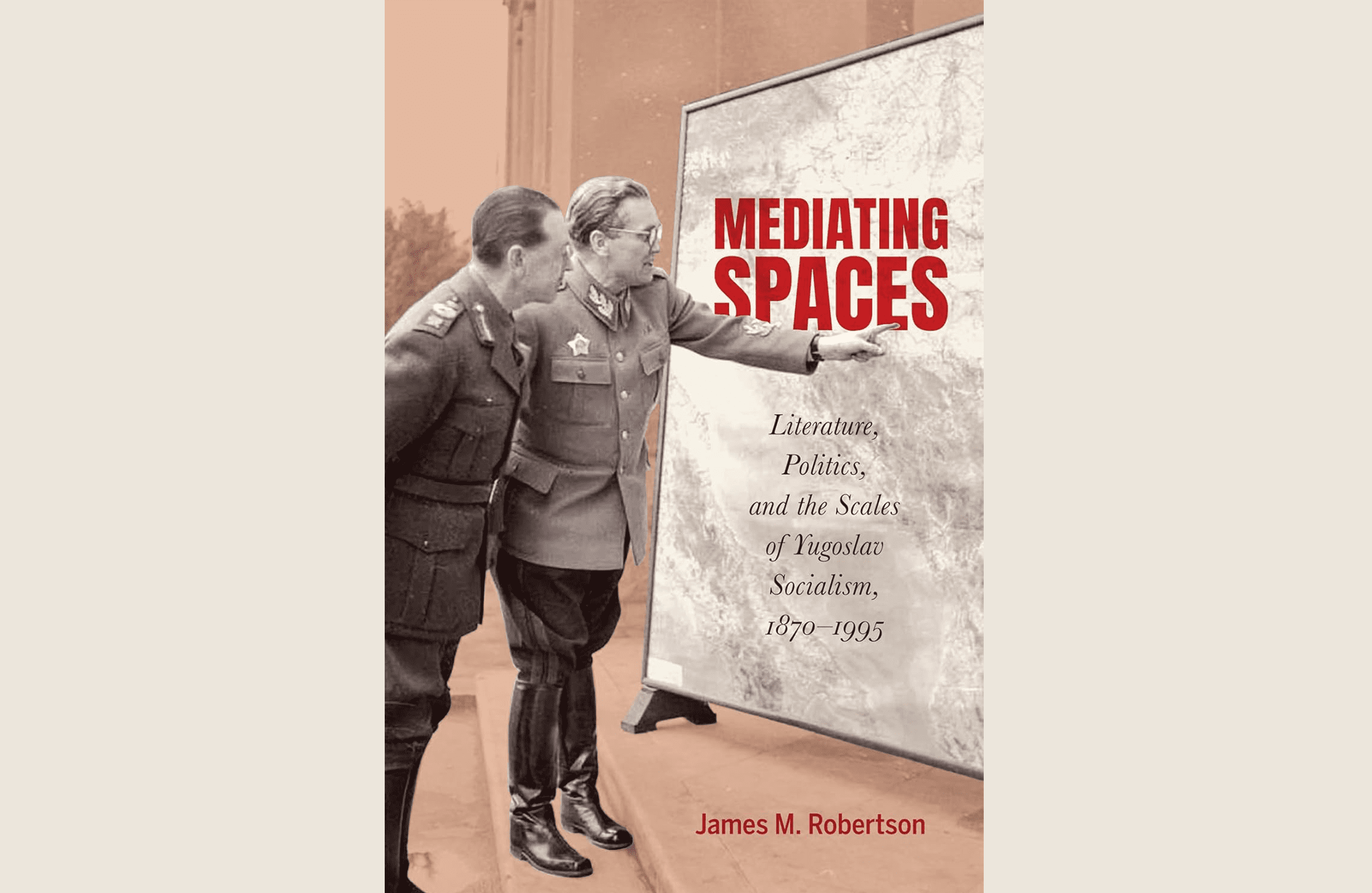
James M. Robertson tells this curious story near the end of his new book, Mediating Spaces: Literature, Politics, and the Scales of Yugoslav Socialism, 1870-1995 (McGill-Queen’s University Press, 2024), a fascinating and occasionally disorienting history of socialist thought and literary output in the Balkans. One measure of the book’s success, I think, is how ably it explains that odd joke about “the unrealized Serbo-Venezuelan federation.” As it turns out, various dreams of federation—sometimes realized, but more often deferred—have conditioned the political cultures of South East Europe for well over a hundred years.
The culturally and ethnically delimited nation-state that had proven so useful for advancing the interests of the wealthy metropolitan powers like England or France would not do for the small, nations of South East Europe, with their intrinsic structural disadvantages. Only a supranational state could shield the Balkans from the destabilizing effects of capitalist modernization. This, at least, was the widely shared perspective of Yugoslav socialists for a century or more.
He was an English teacher when he was invited to observe that mock debate in Belgrade in 2008, but nowadays, Robertson is an intellectual historian. His book is not (primarily) a work of geography, or even a straightforward political history. Instead, Robertson sets out to map the cultural underpinnings of a peculiar orientation towards the geopolitical space of capitalist modernity.
Robertson begins his history in the late 19th century, when a “new experience of global space” presented new perils and possibilities for radicals in the fragmented Balkan territories, which were then sandwiched between the overlapping Habsburg and Ottoman empires. As the world became increasingly networked through capitalist development, Robertson argues, scale itself became a matter of political contestation. Structurally disadvantaged and squeezed between East and West, radicals in the Balkans came to articulate their politics in supranational terms. Their abiding aspiration was to establish a field of action between national and global scales, which might facilitate the favorable incorporation of peripheral polities in the world market of globally networked capitalism. This kind of scalar project is what Robertson aims to capture with his concept of “mediating spaces.”
These “mediating spaces grew out of the tensions that emerged in the late nineteenth century between deepening processes of global integration and nationally articulated sovereignties,” Robertson writes. “Yugoslav socialists sought to resolve problems of modern state-building at an intermediary scale, somewhere between the national and the global.” This project had military, economic, and political dimensions. Through supranationalism, Yugoslavs sought to fortify their defensives against imperial predation, integrate fragile local markets into stable pan-regional economic zones, and to foster a “regional cosmopolitanism” that nonetheless remained “sensitive to the global asymmetries of power and prestige.”
The Socialist Federal Republic of Yugoslavia, a federated entity that in some ways defied the traditional nation-state format, was itself a product of this supranational orientation. But Robertson does not limit himself to the 47 years of that country’s existence (1945-1992). Instead, he traces the supranational ambitions of Yugoslav socialists throughout the full breadth of the 20th century, from the carnivalesque avant-gardes of the 1920s, to the counterpoised projects of Balkan federalism and ethnic Slavism in the 1940s, to Yugoslavia’s participation in the Non-Aligned Movement during the 1960s and beyond.
As Robertson shows, capitalist globalization in the 20th century “overhauled the epistemological frameworks through which radical ideas were formed.” It was in large part through literary production that Yugoslav supranationalism was articulated and advanced. Predictably, then, Robertson’s most important source materials are the literary products of socialist and communist authors in the Balkans during the long 20th century. These include novels, stories, poems, plays, essays, and, of course, the occasional polemic. What’s more, Robertson situates these works of literature in the scalar projects that informed their meaning, displaying a remarkable sensitivity to the dynamic and sometimes slippery ideological currents that shoaled around the Second International and Comintern in South East Europe.
One great pleasure of reading Mediating Spaces is that Robertson curates the understudied literature of the Balkans with the unselfconscious enthusiasm and confident erudition of an aficionado, quoting generously from such authors as Miroslav Krleža, August Cesarec, Dubravka Ugrešić, and many others. Socialist students of literature, especially those of us interested in the neglected literatures of the global periphery, are all the richer for his efforts.
I blush to admit that prior to reading Mediating Spaces my whole concept of Balkan literature consisted of Danilo Kiš. This prejudice—summating a country’s literary output by reference to a very small number of representative figures (especially pro-Western dissenters)—is typically American, which is to say it is parochial by design.
The structure of world literary production during the Cold War ensured that Balkan literature would be encapsulated for the international reading public in one or two translated titles—i.e., that it would never be considered in anything approaching its true sprawling complexity. Chief among those most visible titles (for English-speakers, at least) was Kiš’s A Tomb for Boris Davidovich, which appeared in 1978 as part of the implicitly anti-communist “Writers from the Other Europe” series, edited by Philip Roth for Penguin. The book’s inclusion on this list, which already included the likes of Milan Kundera and Alexandr Solzhenitsyn, transformed the enigmatic Kiš into something of an international literary darling, a global whisperer of the Yugoslav condition.
Conspicuously, Mediating Spaces references Kiš only twice, and only in passing. One reason for this, clearly, is that Robertson’s focus is on authors who self-consciously aligned themselves with left-wing political projects, which Kiš did not. But Robertson’s omission is also a welcome corrective to the critics’ tendency to pluck Kiš free from his context, and by doing so to reproduce South East Europe’s marginality to the “world republic of letters.”
“The world republic of letters” is a concept Robertson borrows from the French literary critic Pascale Casanova, whose 1999 book of the same name laid out a theory of global literary production in the capitalist world-system. World literature is a “field of domination and dependence,” as Robertson writes, in which national literatures are enrolled hierarchically. The literary producers of the metropoles (Paris, London, New York) “control the entrance of peripheral texts into global markets and decide on their consecration into the canon.” This structural advantage expresses itself aesthetically as a presumption of metaphysical authority. Literature written in English or French can claim autonomy from politics, and so may appear to “represent a supposedly universal set of values.” But literature written in, say, Serbo-Croatian, cannot help but be political—and is therefore minor, parochial, sub-universal.
This stifling dynamic is satirized in one of the novelist Miroslav Krleža’s first published works, a short story from 1919. (Krleža was a towering figure in Yugoslav literature for much of the 20th century, and toward the end of his life took on a prominent role in the administration of Josip Broz Tito.) The story’s protagonist, like Krleža, is a bookish émigré from the Balkans who arrives in Paris seeking literary recognition, only to be roundly rejected by the metropolitan literati. Cast onto the street, the émigré seeks shelter in the Louvre—where he becomes a devotee of Hodorlahomor the Great, the reanimated mummy of an Elamite king.
Challenged to explain his origins, the émigré delivers a memorable monologue that inverts the hierarchical structure of the world republic of letters. “The Balkans, if you please, are a peninsula of Europe,” the Croat says to his zombie monarch. “And Europe is, so to speak, an insignificant peninsula of Asia. […] Some sort of appendix, if Your Majesty knows what that is.” Even in this early story, Robertson argues, we see evidence of Krleža’s lifelong conviction that “only through a Balkan federation […] could his people secure a future that lay neither on the cold stone benches of Western Europe nor at the feet of Eastern kings.”
One strength of Robertson’s survey is that he avoids falling into the trap of just-so periodizations; instead, he emphasizes throughlines between apparently disparate literary traditions. Early in the book, he turns his attention to the late 19th-century avant-garde movement known as zenitism. Founded by the poet Ljubomir Micić in 1921, the literary journal Zenit became a major cultural forum during the interwar period, when a Serbian prince, somewhat panicked by the October Revolution in Russia, established “the first Yugoslavia” (the Kingdom of Serbs, Croats, and Slovenes). The avant-garde poetry scenes that spiraled outwards from Zenit and similar magazines—especially Plamen, established slightly later by Krleža and his comrade August Cesarec—“transposed Balkan federalism from a political economic to a political aesthetic register, using new modes of cultural experimentation to reimagine the space of the Balkans.”
This exuberant experimentation contributed to Soviet realism’s less-than-enthusiastic reception in South East Europe. During the Popular Front era, figures like Krleža and Cesarec controversially rejected the realist conventions of the didactic propaganda fiction then emerging from the Soviet bloc. In 1936, for example, when the global proletarian culture of the Comintern was at its height, Krleža published his beguiling The Ballads of Petrica Kerempuh, a series of poems written in the regional Kajkavian dialect that dramatized the religious politics of 16th-century peasant life. Neither the Western European metropoles nor Moscow knew quite what to make of the book. Krleža’s imagination, it turns out, was far weirder than the Soviet literary sensibility could comfortably accommodate.
In the middle decades of the 20th century, travel literature addressing the conditions of formerly colonized nations in Africa and Asia came to prominence in South East Europe. As global decolonization spurred the emergence of the Non-Aligned Movement (in which Yugoslavia played a major role), Yugoslav authors pursued a newfound fascination with “aesthetic primitivism.” Robertson notes that this primitivist mode occasionally brought Yugoslav “one-worldism” into uncomfortable proximity with racialized civilizational discourses. But it more often took the form of a kind of subaltern cosmopolitanism, recasting human history as “a vast reservoir of cultural forms,” all of which offered resources for modern liberationist politics.
In his book’s final sections, Robertson examines the somewhat despairing literature that emerged near the end of the century to lament and account for Yugoslav disintegration. The major figure here is the novelist and essayist Dubravka Ugrešić, who died in 2023, just months before Mediating Spaces was released. The major premise of this literature was that the cosmopolitan aesthetics of Yugoslavia’s earlier avant-gardes had given way to a decidedly tacky aesthetic mode associated with ethnic nationalism. “Nations, Ugrešić suggested, were logos, advertising brands burned onto the backsides of Yugoslavs by their new leaders that they might be better categorized and marketed to a global public.”
In other words, the literary style of ethno-nationalism was kitsch.
A book like Mediating Spaces must inevitably end on a somber note, since, as even the most inattentive observer knows, Yugoslavia collapsed in spectacular fashion at the conclusion of the Cold War. The 1980s and 90s saw a catastrophic dissolution of cultural spaces in the region, paralleling the political disintegration that would culminate in the country’s bloody civil war. NATO’s response, the “humanitarian” bombing campaign of 1999, not only failed to achieve the Clinton administration’s hollow promises of restored peace—it ultimately exacerbated the ethnic expulsions and violent conflict, while also arguably inaugurating the global period of unilateral military intervention that legitimated the War on Terror and persists to this day.
This is the historical context in which that student’s peculiar punchline about Serbo-Venezuela landed in 2008. The joke was “a soft gibe at the legacy of supranational thought.” It poked a finger in the gap between the “grandiose ambitions” of the Balkans’ historic federalist politics and “the now marginal status of their nations on the global stage.” As Robertson writes, with a hint of sorrow, “There was more than a touch of gallows humor here, an implicit acknowledgement that Yugoslav socialism had failed to remap world space according to its own utopian visions.”
Any book that takes the supranational dream of Yugoslav socialism as its starting point, as Mediating Spaces does, must ultimately contend with that dream’s apparent failure. The question posed by history, as Samuel Moyn has written in Dissent, is, “Why did the nation-state model win out, when the alternatives were supposedly so compelling?”
In his final pages, Robertson confronts this prickly question directly. He argues that the supranational project’s failure did not stem from some essential deficit of Yugoslav culture, but rather from a profound shift in the scalar composition of world capitalism at the end of the 20th century. Yugoslav socialism depended on “a relatively stable configuration” of geopolitical power and influence. “When that configuration changed,” Robertson explains, “so too did the salience of the supranational project.” The triumph of U.S.-directed neoliberal development in the 1970s (not to mention the spectacular collapse of Soviet modernity a few decades later) jostled the format of geopolitics and international trade to such an extent that Yugoslav supranationalism was sent into a deep crisis of legitimacy, from which it ultimately would not emerge.
The looming possibility of a pan-European supranational polity conditioned this crisis in powerful ways. One of Robertson’s most provocative arguments is that European integration and Yugoslav disintegrations are “more entangled than we have previously thought.” Far from being some primitive or pre-modern Balkan cultural holdover, Slobodan Milosevic’s “reactionary and intolerant Serbian nationalism” in fact emerged from “within the spatial framework of European integration.” The virulent strain of ethno-supremacist nationalism that cracked the Yugoslav project open in the 1990s was a knock-on effect of the global reconfigurations of the 1970s, which prompted elites throughout South East Europe “to recalibrate the state to a new, more austere, more competitive global environment.”
The nation-state—and its unruly ideological attendant, nationalism—remains something like the reef upon which liberationist politics seem to be inevitably dashed. This has long been the case, from Thermidor 1794 to the 1914 assassination on the Latin Bridge. The nation-state is a perennial frustration for socialists in particular, for whom it represents a major stumbling block in the march of proletarian history.
In fact, the problem of nationalism is so persistent that some internal critics regard it as the Achilles heel of Marxism in general. “Nationalism represents Marxism’s great historical failure,” as Tom Nairn bluntly put it in 1977. Cedric Robinson, in the opening salvo of his Black Marxism, remarked that nationalism “bemused the founders of historical materialism,” even as it came to “overtake both the direction of capitalist development and eventually the formative structures of socialist societies.” Even the conciliatory Benedict Anderson, in his seminal analysis of nationalism, Imagined Communities, found that he had to acknowledge Marxists’ general inability to “grapple with nationalism.” Clearly, while we may occasionally delude ourselves, the storied national question of yesteryear remains far from resolved.
Yet the nation-state is not so preeminent as it may appear. After all, the European Union itself, arguably the most powerful political entity on the contemporary world stage, is supranational in character. The EU is its own “mediating space,” to borrow Robertson’s term—a “supra-state public authority” that, by guaranteeing the disproportionate economic weight of Western Europe as a whole, allows its member states to overcome their structural disadvantages of size and distance, as the Hungarian sociologist József Böröcz has shown.
As Robertson insinuates, today’s architects of world integration ignore the lessons of Yugoslavia at their own peril. The highest lesson of Mediating Spaces, I think, is that the Balkans may yet provide us with some fruitful historical ground from which to imagine a re-scaled version of our politics. “More than anywhere else in the long twentieth century,” writes Robertson, “socialists in Yugoslavia fostered a vibrant supranational imaginary.” With their help, maybe, we might finally be able to envision a future beyond the polluted container of the nation-state, even if any future world system will have to be assembled from the irregular building blocks of individual national polities.
Mediating Spaces begins with an epigraph from Dubravka Ugrešic, who was born in 1949 in federated Yugoslavia. “I grew up in a multi-national, multicultural, and monoideological community that had a future,” she writes. “I was not interested in politics;” indeed, she claims, she could barely comprehend the notion. But as she further describes her childhood, it becomes clear that what Ugrešić found so incomprehensible was sectarian politics, the nationalist credo of “us against them.”
The epigraph ends with a plaintive and enigmatic line that stuck in my mind over the entire course of my encounter with the text of Mediating Spaces, growing ever more haunting as the book’s chronology drew inevitably closer, with each passing page, to the catastrophe of the 1990s. What Ugrešic said was this:
“I only ever wrote one ‘political’ sentence (and I stole that from a child): ‘I love my country because it is small and I feel sorry for it.’”
This is how one should love a country, I think. Ugrešic’s is a protective, condescending love, the kind of love one shows an infant or a pet. It is the opposite of the nationalist’s love, which is like the obsessive devotion one might show an idol or a god.
By recovering a Balkan literary tradition characterized by cosmopolitanism, not ethno-supremacism, Mediating Spaces elaborates the full meaning of Ugrešic’s lesson: Love your country, if you must. But love it to the extent it is something delicately human—to the extent it is synonymous with community, not as it embodies the imagined dominance that is the falsehood of nations. ♦
