

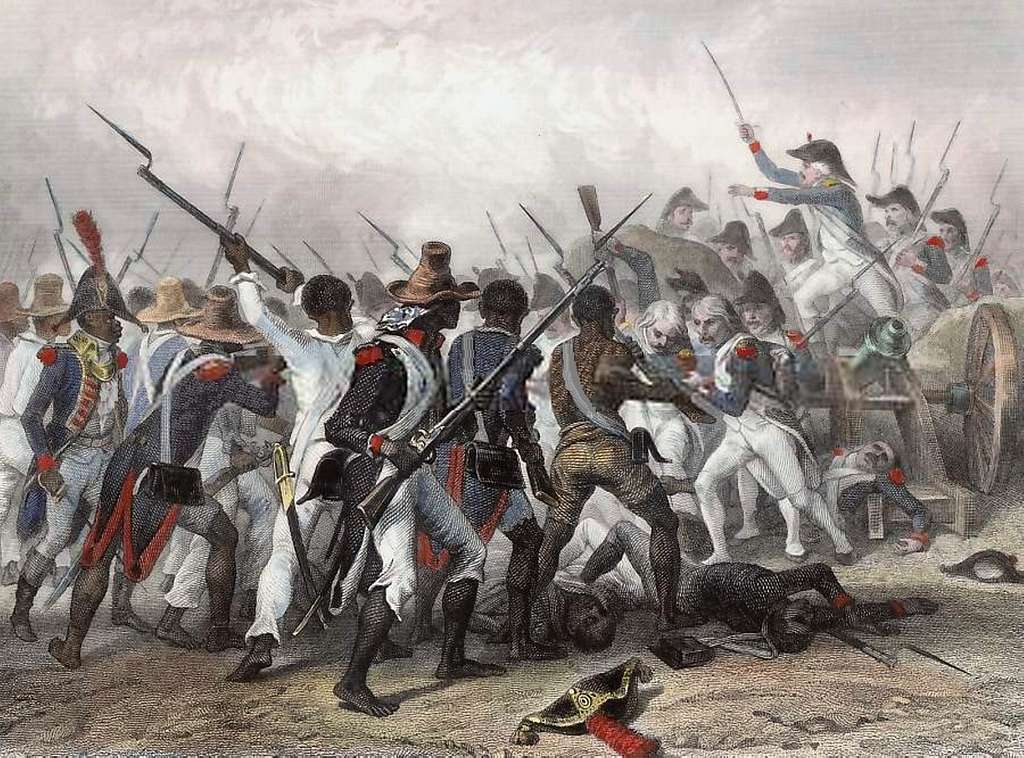
In Haiti, former slaves once honored the Polish people as the “white negroes of Europe”—a brief moment of co-identification that tore through the colonizer’s construct of whiteness. I think about this episode often. In my part of the world, the threshold between “East” and “West” is fluid. As we draw ever-deeper into the world of the colonizer, we are bestowed with a “whiteness” anchored only by our complicity in imperial violence. It is not the river Dnepr that separates the “orcs” from the “freedom fighters,” but the rivers of weapons, debt, and sorrow that bind some of us to the Atlanticist war club.
Few people have been cast further across this threshold than the people of Haiti. We are told that the Haitians “carry disease,” that they are puppeteered by “criminal gangs,” that they “eat cats and dogs.” Here, we see one of the hallmarks of empire: the brutal punishment of a people who have already been punished, the cowardly beating of the downtrodden. But if we look at Haiti beyond the fascist bluster, we will find the cradle of one of humanity’s most precious traditions: internationalism.
Haiti’s story is bound by a million threads with that of capitalism. On December 5th, 1492, Christopher Columbus landed on the northern shores of the island. He came in search of gold. “From gold comes great wealth,” Columbus wrote to Spain’s royals, Ferdinand and Isabella. “And with it whoever possesses it can do whatever in the world that he wishes.” The observation would be true in both the particular sense and the universal. In the newly colonized world, it gave men like Columbus the bestial power of tyrants. He gave name to the island, calling it Hispaniola, or Little Spain. His men terrorized, raped, enslaved, massacred, and infected the island’s native Taíno people. In 15 years, a population of up to a million plummeted to 60,000. Enriched, Columbus and his men did whatever in the world they wished.
In a broader sense, the yellow metal gave the same terrifying power to the European ruling classes. Gold satisfied the rising demand for coins, which fueled the rise of the early capitalist money economies. Between 1493 and 1600, Spanish Conquistadors looted roughly 340,000 kilograms of the metal from the colonies. Europe now did whatever in the world it wished, and with its wealth, it brought genocide on the peoples of the “new world,” destroying entire populations in its path.
Terrified by the erasure of the Indigenous peoples of the Americas, the priest Bartolomé de las Casas pleaded with the Spanish government for a bargain that even he, ensconced in the world of the colonizer, would come to regret: spare the native and bring in the African to bear his burden. King Charles V conceded and, with a 1517 edict, launched one of the most barbarous projects in human history: the trans-Atlantic slave trade.
Here, as Karl Marx later observed, we find the early ingredients of the capitalist project: “the discovery of gold and silver in the Americas, the extirpation, enslavement, and entombment in mines of the indigenous population of those continents, the beginnings of the conquest and plunder of India, and the conversion of Africa into a preserve for the commercial hunting of blackskins.”
By 1785, the French had taken the place of the Spanish, and the city of Cap-Français brimmed with the vulgar decadence of the colonial outpost. In the so-called “Paris of the Antilles,” white-walled churches surrounded broad public squares, cafes and galleries proliferated around the city, houses could cost more than they did in Paris itself. Sewage flowed through the streets, and drunks dallied between brothels and casinos. In the harbor, men and women in chains were unloaded from the slave ships. For months, they had been packed in putrid conditions below deck.
Now, if they had survived the journey, their bodies were picked at, prodded, and pinched. Their skin was branded, and they were marched to work the sugar and indigo fields, cotton, and coffee plantations of Saint-Domingue. For indolence, complaint, or fatigue, some would be brought back to the public squares of the city, their bones crushed on the wheel, their bodies set alight or buried neck-deep in the soil for insects and animals to torment.
“Already my pen is frightened by the number of crimes it must trace,” wrote the Haitian historian Louis Boirond-Tonnerre as he sat to record the story of the Haitian Revolution. Under the French reign of terror, he wrote, “the forests became gallows,” the “ships became gaols,” and “the women, the children became prey for the rapacious soldiers who, with the utmost inhumanity, tore off their ears along with the earrings they wore.”
On Saint Domingue, whiteness separated the two peoples alien to the island: the colonizer and the slave brought to serve him. The most mutinous parson, boatswain, or quartermaster—dreaming of taking out a cruel captain—would never think to join forces with those shackled below deck, only to share the profits from the “cargo” among his fellow sailors. These working white men, lacking in property, had only their whiteness to fall back upon. Their colonial society was stricken.
As Frantz Fanon later observed, any threshold set for dignity and humanity unleashes in society a torrent of indignity and inhumanity, which lingers and festers, generation after generation, swallowing up the worlds both of colonizer and colonized. “A nation that enslaves another forges its own chains,” Karl Marx wrote. Thirty-seven percent of all enslaved human beings shipped across the Atlantic would pass through this small island in the Caribbean, then the wealthiest colony in the Americas. By 1789, some 32,000 white people, 24,000 free Black people, and at least 500,000 enslaved people lived in Saint-Domingue. Inhumanity had engulfed the island.
The leaders of the Haitian revolt, as all revolutionaries, were radicalized by these circumstances of violence. Their humanity was denied by the whip and the baton and in the courts and institutions of the state. They held clandestine assemblies in the forests. They were moving to bring the ideals of liberty, equality and fraternity to the shores of Saint-Domingue. As C.L.R. James showed us, they believed these ideals more powerfully than the French. Toussaint L’Ouverture was prepared to die before surrendering “that sword, those arms, which France confided to me for the defense of its rights and those of humanity, for the triumph of liberty and equality.”
All colonized peoples learn that the ideals that European colonizers claim to uphold—whether of liberty or democracy or human rights—can only be won by the European project’s final defeat. In Haiti, this compelled the enslaved to realize the unfulfilled promises of the French Revolution. In May 1791, after a century of failed leaps towards liberation, the people rose up against their slavemasters.
These decades were pregnant with rumination about the future. In France, the bourgeois revolution drafted up the Declaration of the Rights of Man and the Citizen, tearing through the caste structure of feudal society. But when the French bourgeois declared that all men were born free and equal, they did not mean the Black man, the slave, or the property-owning mulatto of the colony. Their pens did not write the Haitian into their future. It became fashionable to decry the horrors of slavery, less so to strike at its foundation.
The French Revolution was not a workers’ revolt. Its bourgeois architects dared not pull at the gossamer threads that bound their prosperity to the enslavement of human beings. They objected to the word “slavery,” not the thing itself, C.L.R. James wrote in his account of the Haitian Revolution. They debated, bickered, and schemed, but they were not prepared to yield. So the French bourgeoisie eventually proposed a feeble concession: the children of free Mulattoes, numbering in the hundreds, would be given the right to vote. But the slavemasters of Saint-Domingue could not tolerate even paltry concessions to the dignity of Black people. They refused to surrender the privileges of caste that defined their society.
That same month, the contradictions of bourgeois reform doomed the Polish-Lithuanian Commonwealth to collapse—a process that would put its people and the people of Haiti on a collision course. Struggling to hold the nation together, the Polish Sejm adopted the Constitution of 3rd May, the first written constitution in Europe. The Republic of the Two Nations had been governed by a weak king and a parliament controlled by a warring nobility who employed the liberum veto—a mechanism not unlike the filibuster in the United States today—to paralyze political decision-making.
A reformist movement rose. Led by figures like Ignacy Potocki and Adam Czartoryski, they looked to France. They, too, wanted to establish rights for the bourgeoisie against the old nobility. They sought to end the liberum veto, and the constitution they adopted proclaimed that the will of the people is the source of “all authority in human society.” Like in France, these laws did not fundamentally change the position of the masses, and the constitution lacked the power of the people to defend it—just as the Polish state could not defend itself from the schemes of more powerful neighbors. The enemies of the constitution moved quickly against it, inviting foreign powers to support them. The constitution was abolished and, in 1795, the Polish-Lithuanian Commonwealth ceased to exist as Russia, Prussia, and Austria tore it apart. Poland lost a nation as the people of Saint Domingue began to build theirs.
Writing a century later, another internationalist would describe the limits of these reformist currents: the inability of a people mired in class interest to respond to the needs of the masses. His insights teach us why Toussaint L’Ouverture believed in the ideals of the French Revolution more earnestly than its architects and point to what needed to be done in the pursuit of liberation, a truth that had arrived with blinding force in Haiti.
“An imperialist war does not cease to be imperialist when charlatans or phrase-mongers or petty-bourgeois philistines put forward sentimental ‘slogans,’” Vladimir Illych Lenin wrote in 1918, reflecting on the First World War, “but only when the class which is conducting the imperialist war, and is bound to it by millions of economic threads (and even ropes), is really overthrown and is replaced at the helm of state by the really revolutionary class, the proletariat.” Feudalism could not be unwound by appeals to popular sovereignty, and slavery could not end because it became fashionable to condemn it. In Poland, as in France, the revolution was incomplete.
Polish officers, troops, and mercenaries moved south. They went to Italy and France, seeking an alliance with the revolutionary French government. They hoped France would reclaim Poland from its occupiers, a hope so powerful that it is inscribed in our national anthem to this day. The Poles were determined to prove their loyalty. Led by General Jan Henryk Dąbrowski, they fought against the Russian Empire at Trebbia. They withstood an Austrian siege at Mantua, before the French commander betrayed them in exchange for safe passage. They fought the Bavarians at Hohenlinden and policed the annexed territory of Etruria.
In 1799, Napoleon Bonaparte seized power in France. He hurried the Polish legionnaires from battle to battle, front to front. They dutifully complied. “They were seduced,” historian Norman Davies wrote, “by the banners of ‘Liberte, Egalite, Fraternite,’ as surely as the beautiful Maria Walewska was seduced by the Emperor himself.” But with each new battle, the struggle for Poland’s independence drew further away. The legionnaires saw that they were written out of treaties and agreements, pulled from strategic battles against Poland’s occupiers. Morale plummeted, and where it fell furthest, Napoleon found the shock troops for his war to put shackles back on the men and women of France’s wealthiest colony. This meeting of distant contradictions began the episode of the Dąbrowski Legions in Saint-Domingue.
In 1802, 5,280 Poles arrived at the shores of the island—part of an army of Germans, Swiss French, and dishonored legions of the French army. To Napoleon, they were disposable. Four thousand Polish soldiers soon died, their bodies unaccustomed to the tropical climate. Their strategies saw them crushed by boulders or gunned down by guerrillas lurking in the mountains. The cloth of their uniforms was thick. Yellow fever took hold, and killed them by the thousands.
Worn down by a distant war fought to preserve a power not their own, they would learn that they, too, were not allowed to share in the rights of the colonizer. The color of their skin did not create for them these privileges. We are slaves, they thought. “Slaves to the necessity of duress, they go to guard the prisons where the greedy, degenerate European tortures the unhappy Negro,” wrote a Polish officer. When the French general Charles Leclerc ordered the massacre of hundreds of Black men, the Poles refused.
Across battle lines, the people of Saint-Domingue found in the Poles their companions in misfortune. “Unhappy Poles, the French have led you astray, bidding you to seek your lost fatherland under a torrid sky,” Toussaint L’Ouverture’s brother is said to have told the Polish soldiers. The Haitian general Jean-Jacques Dessalines implored them to remain in Saint-Domingue as “children of the island.”
Four hundred remained, and some 140 of them took up the musket in the war for Haitian liberation. We remember them because the facts of their lives compelled them to rise against a common master—to overcome the boundary of whiteness, a threshold that even the lowliest of colonizers dared not cross. Dessalines later designated a brigade of Africans fighting alongside the Haitians as “les Polonais”—the Poles.
Toussaint L’Ouverture led the Haitian people through a struggle that tore through the fabric of time. United by struggle, people are thrust onto the stage of history and the Haitians, as C.L.R. James showed us, “made the history” of their emancipation. The Haitian revolution birthed a Black republic—an idea so inconceivable, so at odds with the foundational principles of the colonizer’s violent civilization, that it opened a new horizon for human dignity everywhere.
The story of the Dąbrowski Legions in Saint-Domingue was a small episode in that history. The Haitian people carried their story forward, beyond the shores of Haiti and across the Atlantic. In the final paragraph of his history, Boirond-Tonnerre appealed to all the enslaved peoples of the world: “And you, slaves of all countries, you will learn from this great man [Dessalines], that man naturally carries liberty in his heart, and that he holds the keys [to freedom] in his hands.” Not content to be free when others remained in shackles, the liberated peoples called out to the enslaved and colonized and promised that they would share in their struggles for liberation.
The victory of the Haitian Revolution brought material force to the process of liberation, birthing an internationalism of deeds. Haiti sent sugar and arms to neighboring Santo Domingo, where rebellions had erupted from the sparks of its revolution. Haitians fought alongside Latin American liberator Simón Bolívar, liberating Gran Colombia from the Spanish and freeing its slaves.
The states of Colombia, Ecuador, Panama, Venezuela, Northwestern Brazil, and Northern Peru were birthed in that struggle. In 1897, Haitian General Benito Sylvain became the aide-de-camp of the Ethiopian emperor who dealt a fatal blow to the occupying Italian forces at the Battle of Adwa. At that time, Ethiopia and Liberia would be the only states in Africa to remain independent from colonial rule.
The people of Haiti continued to build with the downtrodden. In 1900, Sylvain helped organize the First Pan-African Conference in London, representing both Haiti and Ethiopia. Its aim, he later wrote, was for the people of Africa to “coordinate the common efforts and safeguard, by means of methodical and continuous action, the economic interests as well as the political and social rights of their exploited and oppressed brethren.”
Nearly 50 delegates and participants debated the facts of life under colonial occupation. They authored a manifesto to the nations of the world. “Let not the natives of Africa be sacrificed to the greed of gold, their liberties taken away, their family life debauched, their just aspirations repressed, and avenues of advancement and culture taken from them,” it read. It also left a warning that the limits of the French Revolution themselves presaged. The exploitation of Africa would, it said, be fatal to the “high ideals of justice, freedom and culture” which Europe purported to represent.
Decades later, this warning would echo solemnly and furiously in the writings of anti-colonial thinkers about Nazism. “[Before] they were its victims, they were its accomplices,” Aimé Césaire wrote. “[Before] engulfing the whole edifice of Western, Christian civilization in its reddened waters, [Nazism] oozes, seeps, and trickles from every crack.”
Haiti’s internationalism prefigured the forms of solidarity that are demanded of us today. In their time, the Haitian revolutionaries were derided as barbarians—just like Hamas in Palestine, Hezbollah in Lebanon, Ansar Allah in Yemen, and other liberation forces opposing the genocide in Palestine are labelled “terrorist” today. All those who struggle for liberation at one point have to face up to the violence of the system they seek to defeat—a system that inhibits their existence, exterminates those they love, and seeks to crush the very hope for a world free of violence.
But it is not the violence of these struggles that taints them in the eyes of their oppressors. It is the threat they pose to strategies of accumulation, to capitalism. Liberation struggles reveal to us the inseparability of colonialism and capitalism. The enslavement and extermination of peoples—from Haiti to Gaza—are shown as necessary steps to securing the capture of land, the extraction of its wealth, and the new property rights that emerge on the bones of the murdered.
Internationalism has therefore not historically demanded an adherence to a fixed set of political prescriptions. It did not demand that your flag be red or green. It demanded a shared revolt against the structures of accumulation whose violence festers and spreads with time—eventually turning, as Césaire saw, against those who might excuse it today.
We are not asked to support anti-colonial struggles because the specifics of their political commitments mirror our own, but because our collective future hinges on their success, on the defeat of a powerful imperial apparatus that seeks to envelop our world in its violence. Look today to the forces that most unapologetically support Palestine and its right to resist by any means necessary. Pay attention to those who would hedge their support in condemnations or root it in hollow calls for peace. You will learn something about the contours of the global struggle for liberation.
In this way, the torch of revolution is carried forward through time. C.L.R. James saw it pass from Toussaint L’Ouverture to Fidel Castro. The revolutions of 1792 and 1958 were “the product of a peculiar origin and a peculiar history,” he wrote—the conditions of colonial societies in the East Indies, molded in the violence of the colonizer and resistance of the enslaved, birthed them and their leaders. Separated by time, L’Ouverture and Castro shared the conditions of their struggle.
In the story of the Haitian revolution—as in the victory at the Battle of Adwa and the world’s first Congress of African peoples—we find the project of internationalism begin to take concrete form. Between L’Ouverture’s struggle and Yahya Sinwar’s today, the lessons solidified. Historical processes and brave men and women carried the yoke of shared oppression into other projects of revolution. The tools of state power sharpened the mission of internationalism. One act of liberation became tinder to calls for dignity elsewhere—and the fuel to construct new institutions, capacious enough to hold the aspirations of entire continents and powerful enough to realize them.
We find echoes of the Haitian Revolution in all the struggles for liberation that followed its path. We find them in the Third World project and the movement for non-alignment. We find them today, having outlived the tyranny of the counterrevolutions of the 20th century and facing the counterinsurgencies of the 21st. We find these echoes, and we create them. ♦
