
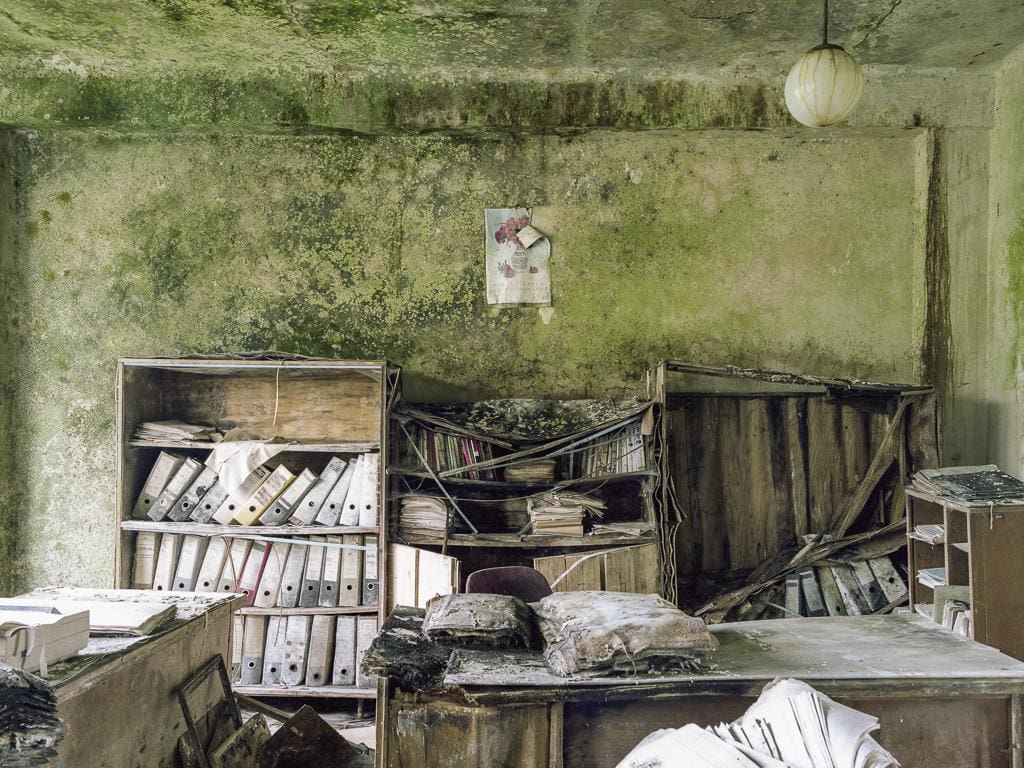
Introduction: I wrote this poem in the office, while working, behind a big desk, and the form of the poem came from the very moment of “birth” of the poem, and this moment of fertility and birth is like a break in the heart of everyday work, which is similar to performing religious rituals. That is why I chose this expression for it. For me, this poem was a kind of disobedience to duty and a break, a break that can be created in the heart of every sacred matter by satirizing a rigid language.
Kaf, Alif, Rā1
By the pen2,
papers will smear at the office,
and everything will soak in the office
even this boss who is looking at us from behind the desk
Someone says hello in the office
And ____Good work!
Goodbye
And some___ gossip in the office
“Help yourself!,” arises a sound by the smell of hot food.
-Surely humankind will eat when he is hungry-
It is an orderly inferno!
Someone bites his nails in the office
And the boss tramps in our unconscious
Quiet we are
By the sound
By sighing
By the rattling of the bones___ that are rotting away in the office,
I hang my head down
The ink from my eyes splashes on the table
The table does not speak
Quiet is the table
The boss is thinking about our unconscious
Quite we are
Clocks talk ___ with two black tongues_____ in the office
By the day
When night falls in the office
They are sucking the ink from my eyes
telling my joints to sit down
But I sit down and stand in the office
I sit down and stand in the office
And I stare and you do not know what it is to stare at the whiteness of a page that
_____doesn’t even spew its ink
By the march of fingers on letters and words,
when they go black on whiteness with a large font,
the tired rigs of finger
do not reach any black oil in the office
The night sticks to the paper of the day like ink
And office clocks do not comprehend time
And office clocks are only two black scorpions on whiteness
And office clocks talk to the boss in our unconscious
And my eyes
leak
black
My hairs spill
black
And something is constantly pumping in the brain
An orderly inferno!
With table, with stapler, with blue, red, and green pens, with scissors, with tapes,
_____with chairs that fill the lordosis
With words
Large words
which are talking in our unconscious with the boss, with clocks, with scissors, in
_____the office
By the morning!
By the rush of dawn runners towards the buses
By the afternoon!
By the three stages of darkness3
By the even and the odd4
Someone will give birth
Someone is pregnant and will give birth in the office
And words
Beloved words
will explode in the air
like ammonia bubbles
And they shall fill the lordosis
And they shall fill the office buses
And they shall fill the unconscious of the boss
And they shall fill the whiteness of the papers
And they sit
on clocks
on clock hands
and on helloes
goodbyes
signatures
good works
and smell of food
And work
with a capital W
and a red tongue
will stick to the palate
and sets one free
Work
sets you free!
♦♦♦
Translator’s notes:
1It is necessary to explain a point to better understand the beginning of this poem: Here, the poet has written the word Kār )the persian word for “work”) in the form of the mysterious letters in the Quran. The mysterious letters (ḥurūf muqaṭṭaʿāt in Arabic) are combinations of between one and five Arabic letters that appear at the beginning of 29 out of the 114 chapters of the Quran. The letters are also known as fawātiḥ (فَوَاتِح) or “openers” as they form the opening verse of their respective chapters (surahs). For instance, the second chapter of Quran (Surah Al-Baqarah) begins with three mysterious letters: “Alif-Lãm-Mĩm”. The general belief of most Muslims is that the meaning of the mysterious letters is known only to God (Allah). The purpose of this literary creativity, from the poet’s point of view, is to emphasize the so-called sacred nature that is imposed on the concept of “work” in the capitalist society; as if “work” is a sacred concept that humans cannot understand its modern nature. It is not possible to translate this part in a way that is fully understandable for the western reader. In fact, one can imagine that the poet has broken the word “work” into its constituent letters: W, O, R, K
2Here the poet once again uses the writing features of the Quran: Many chapters of Quran begin with an oath from Allah. Accordingly, he has the right to swear by any object of His creation (i.e., the sun, the moon, the stars, the dawn, or the angels). The poet uses this literary and formal creativity many times in her poem.
3In the 39th chapter of the Quran (Surah Az-Zumar), it is stated as follows: “He creates you in the wombs of your mothers [in stages], one development after another, in three layers of darkness.” According to the commentators of the Quran, three layers/stages of darkness mean the darkness of the belly, the womb, and the amniotic sac.
4Taken from the beginning of the 89th chapter of the Quran (Surah Al-Fajr): “By the dawn/and the ten nights/ and the even and the odd.”
