

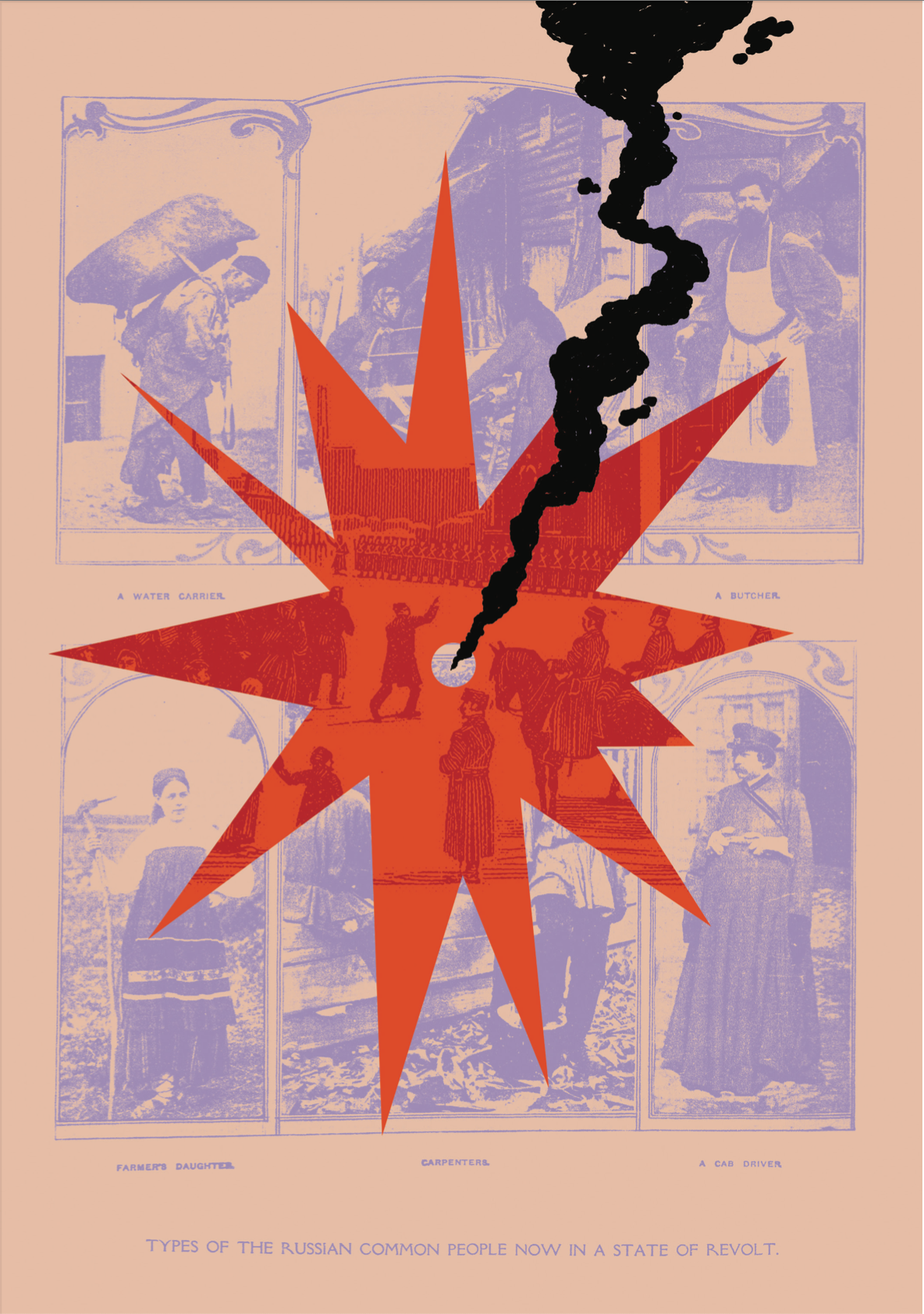
Two years ago I found a tattered, century-old piece of paper in a box in my grandmother’s Moscow apartment. I struggled to read the faded typescript, but when I had puzzled out the contents, I was astonished. It turned out to be a document issued by the Soviet Union’s Archive of the Revolution, certifying that Antonina Vasilievna Fessalonitskaia, my grandmother’s grandmother, was arrested in St. Petersburg in 1901 as part of the Union of Struggle for the Liberation of the Working Class. She was 23 years old at the time.
“Fessalonitskaia,” the document read, “entered into direct contact with workers and, visiting their apartments in St. Petersburg, convinced them to organize secret clubs [kruzhki]. Being present afterwards at clandestine gatherings, she distributed illegal writings to the participants and explained their contents.” She was sentenced to six months in prison, but this did not stop her. After her release, the police reported that she had not abandoned her “past criminal activities.” As a result, she was banned from residing in the vicinity of Moscow and St. Petersburg for five years; later, she would serve another term for helping to run a Bolshevik newspaper in the small town where she was forced to settle.
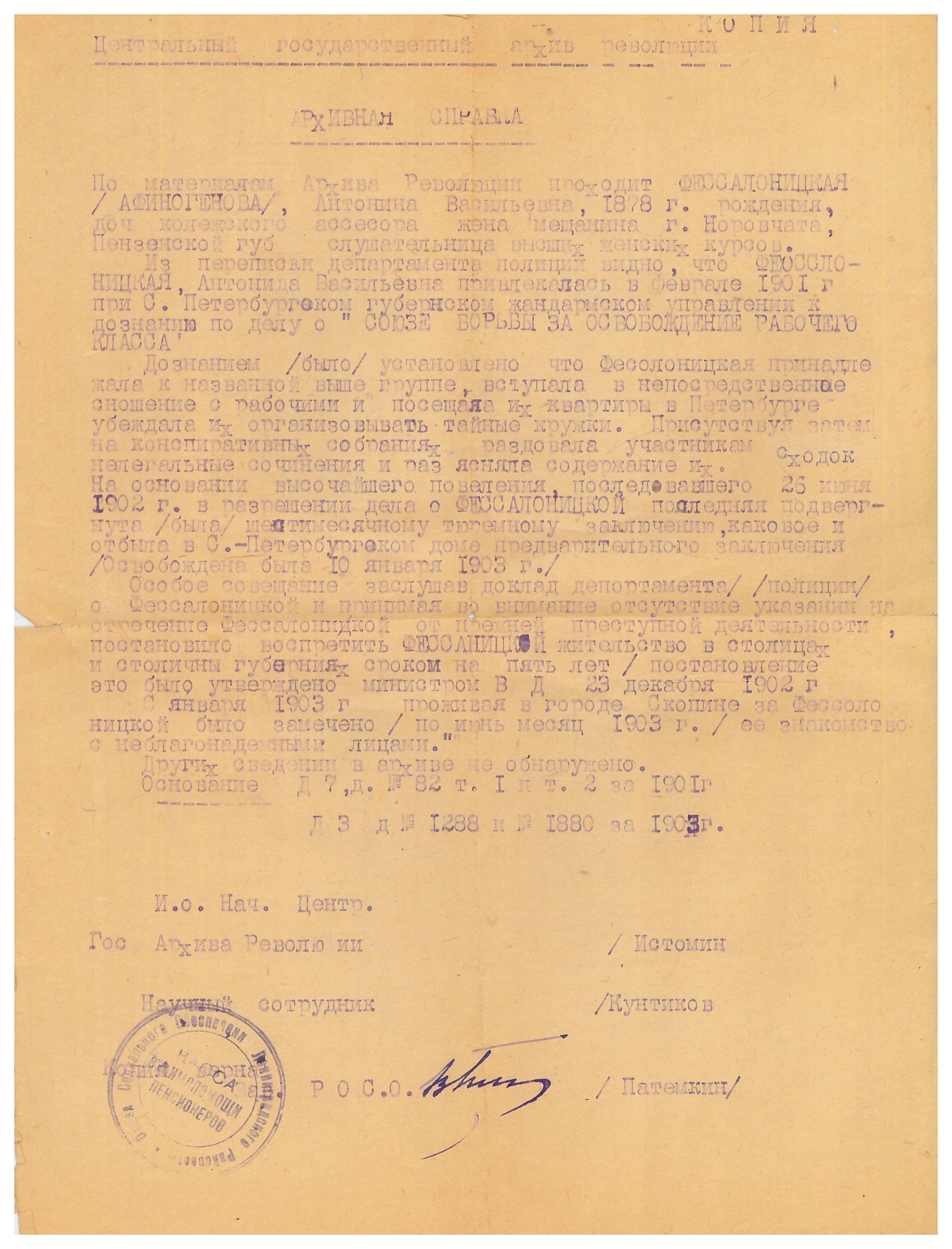
Looking at this document now, I feel admiration for this young woman. Like many activists in the United States, I’ve been arrested—but only once, and my case was speedily dismissed. I’ve never risked more than a fine or a missed day of work for the cause. Organizing is, for me, a moderately time-consuming hobby rather than the existential commitment it was for her, in a police state where employment was only one of many circumstances that demanded a “certificate of political reliability.”
On a deeper level, though, what I feel is a kind of envy. Although I’ve “entered into direct contact with workers,” I can’t imagine convincing someone I’m organizing to do something as risky as joining an underground political organization. Neither has anyone I’ve ever spoken with who wasn’t already a socialist shown any interest in socialist pamphlets (“illegal writings”), even if I’d had any to offer. And I know that Fessalonitskaia’s experience was not unusual. All over fin-de-siècle Russia, underground socialists—then known as social democrats—were meeting radicalized workers and forming small, secret clubs for political education. Their efforts would eventually catalyze the wave of mass political strikes that became the Revolution of 1905.
The social democrats always insisted that organizing the masses would be easier if they could just get rid of the absolutist police state and operate in the open. But here we are in the land of the First Amendment, and the masses are nowhere to be seen. Far from sowing the seeds of a revolution, all we seem to have are sporadic cycles of organic popular upsurge that struggle to achieve any meaningful structural change—before succumbing to demoralization or co-optation (and often repression as well, albeit never as severe as in Russia). Organized socialists seem to be almost entirely irrelevant to this process, regardless of their tactical or strategic orientations.
Maybe we are stupid and lazy, while Fessalonitskaia and her comrades were smart and dedicated. But that doesn’t seem right either. In the years I’ve spent organizing, I’ve met many brilliant, talented people who devote nearly every spare hour they have to the cause. While these are hardly “professional revolutionaries,” there have been other socialist organizations with a permanent paid staff, and they don’t seem to have made much headway either. Instead, they seem to gradually become insular sects interested primarily in their own self-perpetuation.
Or could it be that the social democrats knew how to speak the language of the people, to meet them where they were in ways we had failed to understand? That might be part of the problem—but the differences between us in fact seemed to run the other way. In the 1890s, an abbreviated training course for “less advanced” Russian workers included everything from Marx’s theory of surplus value to the history of the French Revolution.
Is the fault in our social origins? We are primarily white and college-educated, while the masses we dream of reaching are largely not. Yet this issue was equally troublesome for the Russian social democrats, who fretted constantly about the proportions and roles of workers and intelligentsia in their organizations. (“Intelligentsia” is a complex concept, but for the purposes of this essay, we might think of it as the equivalent of what we call the “PMC”—in particular, the radicalized, often downwardly mobile left-wing segment of it that occasions so much handwringing in socialist circles. Fessalonitskaia herself was a member of the intelligentsia.)
In short, try as I might, I cannot squeeze a pat lesson about party structure or organizing strategy out of Fessalonitskaia’s experience. She seemed to have operated in a completely different landscape, one in which the same skills and ideas that appeared to have so little power to change our world had become mighty levers of social transformation.
It was only when I began to look closely at a slightly earlier period that the problem began to stand out more clearly. For the Russian left did not emerge in 1890, and it hadn’t always found purchase with the masses. Here is the revolutionary terrorist Vladimir Debagorii-Mokrievich, reflecting on his early experience trying to organize peasants in the mid-1870s:
Speaking honestly, there was little fertile soil for revolutionary activity among the people. Even then the more dispassionate of us had concluded that our people was very far from being in a revolutionary mood. I myself remembered the passivity of the peasants that struck me as we wandered around Kiev and Podolsk Provinces. We heard everywhere that the peasants desired the redistribution of land, but they were content to await the redistribution peacefully, like a simple boon from the tsar. Trying to win redistribution for themselves didn’t occur to them.
In 1917, those same passive peasants would be putting their landlords’ estates to the torch and claiming land for themselves, both independently and under the authority of the Bolsheviks’ Decree on Land. But that was still decades away. In the meantime, what reigned on the Russian left was a mood of isolation, futility, and defeat.
This generation of Russian socialists (usually known as populists) had emerged in the 1860s, after a time during which radical ideas seemed trapped in circular salon conversations about Hegel. In contrast to the arcane philosophical jargon of their predecessors, these men and women preferred what they saw as the clear, unambiguous language of the natural sciences. More importantly, they saw themselves as people of action. They were tired of their elders’ endless talk about what a post-autocratic Russia might look like; instead, they were determined to bring it into being by any means necessary.
It was a heady time to be young. After a long period of stagnation, a new tsar, Alexander II, had come into power in 1855 and initiated a program of reforms. These whetted Russian society’s appetite for change without satisfying it. For instance, serfdom was abolished in 1861—but by a method that trapped the freed peasants under a heavy burden of redemption payments. Higher education expanded and restrictions on it were loosened, but when students tried to take advantage of their new freedoms, the state moved ruthlessly to shut down the social spaces that attracted radicals. Alexander II had quickly come to represent the limits of the change that was possible under the autocratic regime.
So the populists went underground. They existed within and adjacent to a broader urban bohemian subculture known as the nihilists, many members of which weren’t politically active themselves but were sympathetic to radical socialist ideas. The nihilists wore deliberately shabby clothing, formed communes, and tried to practice gender equality (for instance, by contracting fictive marriages that allowed the women among them legal independence they wouldn’t otherwise have). This environment allowed the populists to experiment with organizing the urban population of St. Petersburg. They established cooperative businesses, educational institutions, and secret revolutionary societies, working relentlessly to bridge the gap between the intelligentsia and the masses.
This approach quickly reached its limits. In the urban environment where the populists were operating, there were still relatively few workers, and the labor movement was still in its infancy. In 1874, populists from around St. Petersburg decided to change course. Rather than appealing to the empire’s small urban population, they resolved to fan out across the empire and establish contact with Russia’s peasants—the overwhelming majority of the population and, the populists believed, the best candidates for a large-scale revolutionary uprising. If the autocracy was to be toppled and replaced with a democratic socialist state, the peasants would have to be the ones to initiate it. This was hardly a naïve or paternalistic approach. Anyone who wanted a revolution in the 1870s had no choice but to start with the peasantry, for no other social forces were available. Yet many of the populists also harbored attitudes that romanticized the wholesomeness of rural life and the supposedly non-capitalist social order of the Russian village commune.
The project, as Debagorii-Mokrievich’s reflections suggest, was a fiasco. Though the populists tried their best to fit in, the peasants generally greeted them with suspicion and incomprehension. Many had no desire for a revolution, blaming their landlords and local authorities for their problems; others were so ground down by tsarist repression that they had no appetite for risky adventures. Worst of all, in some cases, peasants simply turned these strange outsiders over to the police, who hauled them back to St. Petersburg for trial. The few cases of genuinely productive contact soon faded into insignificance beside the general collapse of “going to the people.” (Certain historians have argued that the populist memoirists of the time exaggerated the scope of this failure to cast their later work in a better light, but the overall results speak for themselves.)
Some populists reacted to this failure by concluding that they were too urban, too elite, too culturally alien to achieve mutual understanding; even the radicalized workers in their midst had become too urbanized to fit into the culture of their home villages. They tried to dress in peasant garb and avoid revealing how educated they were. In the end, one populist faction—which included Debagorii-Mokrievich—even decided to trade in the language of revolutionary socialism for the traditional vocabulary of peasant revolt and attempted to rally rebels around a forged imperial decree about overthrowing the nobility. Despite some initial successes, the rebels were quickly isolated and arrested before an uprising could take place.
The skill and dedication of the populists seemed useless without the mass support that would be crucial to any revolution. Most of them returned to St. Petersburg, casting around for a new strategy that could somehow square this circle. Unexpectedly, they found new allies in the liberal public, which rallied behind the revolutionaries as they faced a series of well-publicized court trials. What if they didn’t need the masses after all, at least at this stage? What if the media and the public opinion it represented could substitute for the impossible task of large-scale organizing?
One way to rouse public opinion was through street demonstrations, but the police were able to shut these down too quickly for any substantial effect to register. Soon, an alternative began to emerge. Using the techniques they’d learned as revolutionary pioneers in the shadowy underground of the imperial capital, the populists embarked on a strategy of bombings and assassinations targeting police officials and other unpopular representatives of the regime. They became exceptionally skilled at evading pursuit and arrest, at staging daring stunts right under the noses of the police. For the most part, liberal public opinion remained sympathetic, and it was to this liberal public that the revolutionaries began to orient themselves.
Terror was a complex solution to a complex problem, but fundamentally it was rooted in a sense that organizing would never be enough to bring about a political solution in the populists’ lifetimes. The hope now was that, if the revolutionaries could somehow decapitate the imperial state by dint of their own courage and resourcefulness, it would spark an uprising that would sweep away the remnants of the old regime. They were astonishingly successful at the first part of this plan: in 1881, the terror strategy culminated in the successful assassination of Alexander II. As the historian Chris Ely puts it, “A rough analogy to the contemporary United States would suggest that in the space of three years a terrorist organization had managed to kill the director of the FBI, explode a deadly and destructive bomb inside the White House, assassinate the president and maim or kill many others besides.”
But no uprising ever materialized. As the smoke cleared, the surviving revolutionaries faced the grim dawn of another tsar’s reign, lacking even a peasant revolt to show for their efforts. (Though the post-assassination backlash did produce the first significant wave of anti-Jewish pogroms in centuries—many had come to associate the revolutionary movement with Jews.) Alexander III instituted sweeping new police powers, and within a few months most of the remaining populists were hunted down, then arrested, executed, or driven into exile abroad.
Regardless of whether or not the civilian casualties that inevitably accompanied populist terror could be justified with an appeal to future revolutionary accomplishments, the terror strategy was a practical failure—yet other ways forward were similarly obstructed. Perhaps they could have tried harder to organize the peasants, but there were structural limitations on what this could have accomplished. Over the centuries the tsarist state had become remarkably efficient at putting down peasant discontent, and in a state as vast as Russia, revolutionary efforts were easy to isolate and stamp out. The tragic product of this unwinnable situation was a left that thought it could win socialism by its own efforts, a project that could never be fulfilled.
Yet, deep underground, the tectonic plates of Imperial Russian society were already shifting. As capitalist industrialization led to the growth of large-scale manufacturing enterprises, millions of workers (usually recent peasants themselves) flooded into cities like St. Petersburg, Moscow, and Odessa. Keenly aware of their own exploitation, they began to organize, then to seek out activists in the intelligentsia (whom they usually referred to as “students”) to help them make sense of the new world around them and the means of changing it. Sometimes the activists were veterans of the populist underground—but often, they were young people like Fessalonitskaia, who had been three years old in 1881. Starting with a trickle in the 1890s, by the early 1900s, they built a powerful new mass movement together. These were the masses the revolutionaries had been waiting for.
Growing the new social-democratic labor movement—or, in the classic Kautskyite formula, “the union of socialism and the workers’ movement”—took skills not only in organizing but in exactly the kind of underground tactics the populists had once put to use in their terror campaigns. From smuggling literature across the border to creating false passports and safehouses to adopting codenames and cell structures, the social democrats learned valuable lessons from their predecessors. Before, these had been the desperate expedients of revolutionaries without a mass movement; now they were part of the arsenal of a much larger army. Moreover, unlike the peasants, the workers were strategically located: properly organized strikes in key industries could paralyze the transportation and communication nerve centers of the empire, destroying the state’s ability to respond. This was what happened in 1905.
In collaboration with the social-democratic intelligentsia, the Russian working class demonstrated unprecedented levels of militancy, making both political and economic demands. By conventional metrics, “union density” remained low, for the obvious reason that unions were generally illegal. What really mattered were the workers who organized them. In 1905 there were only about 100,000 union members in the Russian Empire, compared to 14 million in the United States in 2021. Yet in that revolutionary year, there were some 14,000 strikes involving some 3 million workers, of which nearly half were classified by regime authorities as “political.” (By comparison, the 2021 strike wave in the United States involved some 350 strikes and tens of thousands of workers, and virtually none would have been counted as “political” by Russian standards. The Russian Empire had a population of about 125 million, compared to 330 million in the contemporary U.S.)
Whatever other problems socialists would face in the decade after 1905—including the brutal repression that would follow the unsuccessful revolution—the absence of mobilized masses of working people would not be among them. Even when the movement reached a low ebb between 1908 and 1911, hundreds of strikes continued to take place annually. Defeat and isolation still haunted the Russian left, but there was no denying that millions of people stood ready to answer the revolutionary call.
In the years since I discovered that piece of paper from the Archive of the Revolution, I have found myself pulled toward two diametrically opposite conclusions. One is optimistic. In 1875, a demoralized populist like Fessalonitskaia could hardly have predicted how rapidly things would change three decades later. The skills she’d learned, the ideas she’d studied, the contacts she’d made—all of these would come in handy soon, however futile they seemed now. She just needed to survive, to stay patient, and to not lose heart. Above all, she had to have faith in the historical process. What ultimately mattered was not the degree of personal energy the left expended, or on the specific tactics it did or did not use, but the social forces that brought the masses and the intelligentsia together.
Another conclusion is darker. There was something special about the golden age of the Kautskyite strategy—a global process that Fessalonitskaia and her comrades experienced as a personal one. Around the world, vast labor movements merged economic and radical political demands; they pioneered mass political parties that seemed to be driven by an irresistible momentum towards victory, even electoral victory. But this was not to last. The social democrats anticipated that the industrial working class would continue both to grow numerically and to become more militant—yet both processes had their limits. While particular events like the German SPD’s abandonment of revolutionary goals or the suppression of the independent labor movement in the Soviet Union might have sounded the death knell for social-democratic utopianism, ultimately, the same deep-seated social forces that had enabled social democracy to emerge also left victory beyond its grasp.
A few years before the October Revolution, when her prison term ended, Fessalonitskaia abandoned her underground organizing so that she could raise her son in safety. After 1917, she neither rose through the party ranks nor fell victim to Stalinist attacks on the Old Bolsheviks. I once asked my grandmother (who died in January 2022 and may have been the last person in the world who remembered her) if Fessalonitskaia ever discussed her revolutionary past. “She never talked about politics,” she replied. For her, the revolution had ended. As for the rest of us, the jury’s still out. ♦
