

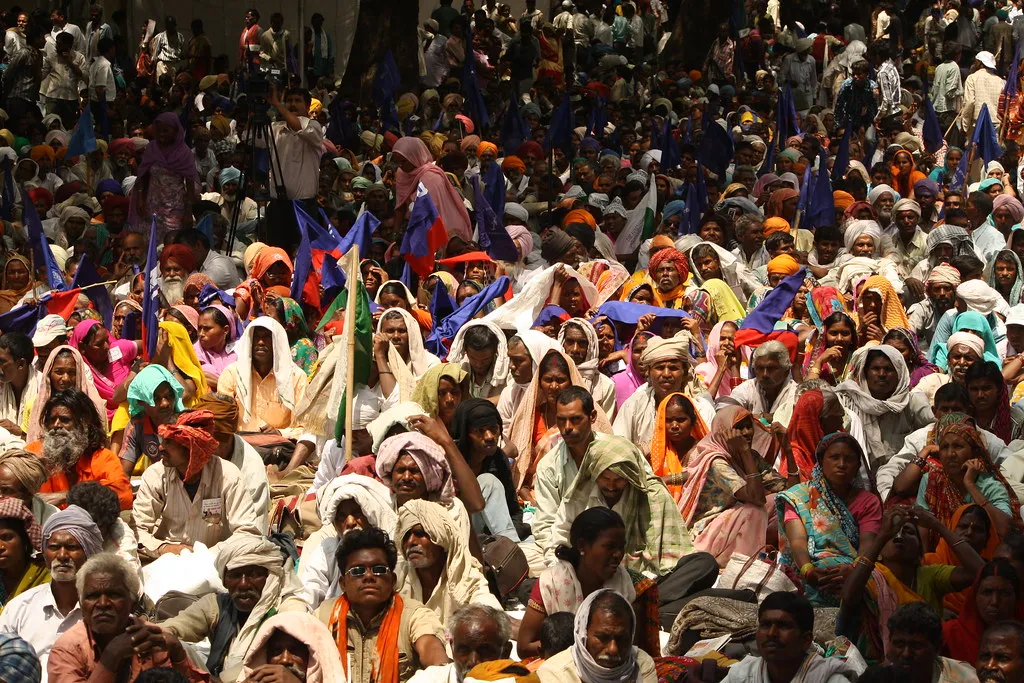
In the ongoing Indian general elections, Narendra Modi, likely to remain Prime Minister, has been busy reacting to and distorting the statements of Rahul Gandhi, the most prominent opposition leader. Rahul Gandhi has promised two related but different sets of measures, should the opposition alliance come to power. First, a caste-based socio-economic census shall be conducted across the country. The government shall then use this census to inform the deployment of corrective measures, which include extending the provisions of reservation (or affirmative action) in public institutions for people belonging to the lower castes, who constitute the vast majority—more than 90 percent—of India’s population. Second, the new government will assess the widespread national inequalities (India is one of the most unequal countries in the world) that are directly related to the caste order and take steps to redistribute wealth.
The only things you will hear about this ambitious reform program in most international media, however, are Modi’s claims that the opposition will seize everything that belongs to the “Hindus” and give it to the Muslims. (The idea of a unified Hindu ethnic-religious group is, in any event, a hoax constructed by the upper caste elites of India with the help of the British colonial administration to suppress the fact that the real majority of India are the lower castes of all religions. A Hindu majority does not exist, except in upper caste media and academia). This pattern of distorting any attack on the oppressive caste order and diverting the conversation to Muslims, a diversion which often leads to pogroms against them, is the strategy of both the so-called “left” and right in India, including some on the academic “left.”
Rahul Gandhi’s campaign speeches constitute a threat to India’s social and economic oligarchs: the country’s upper castes and their global partners. In a way, Rahul Gandhi’s program mirrors what Divya Dwivedi and Shaj Mohan, the most important philosophers in India, have long argued and noted: India’s exploitative crony capitalism is founded on the caste system. In a clear ode to Lenin, the two recently made a creative intervention into the Marxist-Leninist position in Indian politics in a text titled “April Theses”, a significant text for understanding the difference between race and class in the Indian context. In it, they write:
“The caste order itself is the hereditary capital to which we have mistakenly given the modest name of ‘social capital’. In this sense, the savarna [upper caste] capitalist is first the controller of the caste order and only later a manager in the sense of corporate theory.”
There are obvious parallels between the manifestos of the opposition and the revolutionary theses of Dwivedi and Mohan today. In India, the upper caste rulers (who portray themselves as “Hindu” rulers) now fear a double challenge: namely, a threat to their 3000-year rule within a rigid social hierarchy and the related threat to their grip on the economy managed via caste-based crony capitalism.
Recently, an American government official and Jewish scholar named Lily Greenberg Call resigned from the Biden administration over Biden’s support for the genocide in Gaza. In an interview, Greenberg Call explained that the fact that Jews have been made the pretext and face of the American war machine by both Democrats and Republicans is not only a personal affront to Jews of conscience around the world, but makes the Jewish position more precarious both domestically and internationally.
Biden’s use of Jewish people as a shield for his unpopular and genocidal policies finds its mirror image in the Indian mainstream political establishment’s strategy of foregrounding Muslims and Islamophobia to divert attention away from other agendas of domination and oppression. It is the political expendability and execration of Muslim lives in India that has in large part enabled the upper caste to dominate Indian political, cultural, and academic life all these years. This process, however, is beginning to come to an end.
Modi’s distortion of Rahul Gandhi’s socialist and social democratic commitments exposes a key element in Indian politics. The so-called upper caste left and the Indian liberals, in this context, should be understood much the same way as the “left” is understood in other countries of the world, such as the Democratic Party in America and the “Zionist left.” That is, India’s mainstream Left is only the left flank of the upper-caste extremist and supremacist right.
The elections are nearing their close, and in the first week of June we will know the winners. If you read the reports in the Indian mainstream media (controlled by the ruling party), and in the international media (always mediated by India’s upper caste elites), the elections are a mere formality, a cursory ritual that will soon be behind the country. The upper caste media claims that Modi’s far-right Bharatiya Janata Party (BJP, People’s Nationalist Party) will win with a historic majority. The BJP itself has spoken of changing the nature of the Indian Constitution, which ostensibly ensures that India is a secular, socialist and democratic republic committed to equality. A BJP victory, however, may not be so fully assured. Even if the right continues to win the votes of the upper-caste minorities, who constitute less than ten percent of the population, that contingent will not necessarily secure victory.
For international readers: Indian politics is often portrayed as a simple picture of “Hindu majority thinking” against “religious minorities”, especially Muslims. The BJP portrays itself as representing the “Hindu majority” while accusing the opposition of representing only Muslims. This image is deceptive for several reasons. The simple opposition between “Hindu” and “Muslim” has served Western media and academics well in the face of their own political investment in Islamophobia. Islamophobia is not only a domestic strategy—it has also allowed Modi to forge closer ties with Israel and successive U.S. administrations.
While the majority of the Indian population belongs to the lower castes and comes from all religions, the upper caste minority controls the judiciary, the police, the army, the bureaucracy, the media, and the academic institutions. The existence of the upper-caste minority is often treated as a harmless cultural idiosyncrasy by international academics and media. One gets a sense that elite Western voices assume for themselves a default upper-caste identity when they try their hand at interpreting Indian society and politics. There are upper-class solidarities that resonate across international borders—Western journalists and academics mentally transpose themselves from their own elite positions to the upper castes (whether Hindu, Muslim or Sikh) of India. Therefore, as is the case with those domestic Indian elites whose positionality they assume, the international set rarely interacts with or troubles themselves with the concerns of the lower castes of India. As is so often the case across world discourse and media, it is the lives and concerns of the ruling classes that dominate. Consequently, international commentators fail to understand the underlying dynamics of Indian elections.
Indian elections have always been about caste; therefore, they are also about Islamophobia as well as the hatred of other religions, including Christianity and Sikhism. India’s lower castes have never been allowed to form their own public political organizations or protest movements. The bulk of major protest events, excepting the recent farmers’ protests, have been organized and puppeteered by the upper castes to represent their interests. When lower-caste groups retaliate or protest against the atrocities committed against them—up to and including rape, torture, and murder, often as a public spectacle—they are labeled terrorists or Maoists, paving the way for pogroms and extrajudicial executions. In the face of such intense domination and violence, strategic voting in elections remains one of the few responses available to the lower caste organizations.
The BJP has, alas, benefited from this strategy. Under the guise of claiming a “Hindu majority” and “Hindu unity,” the BJP is an upper caste organization controlled by a Nazi-like paramilitary organization called the RSS (National Self Service Corps). In elections since 2013, the BJP has expanded to fielding lower-caste candidates, and thereby won the votes of the majority of the lower castes. This strategy helps to explain the BJP’s continued electoral success—an embarrassment to both the supporters and opponents of the upper-caste elite. Despite this strategy, the lower-caste majority has not been able to wield power or even maintain any real visibility in government, which functions autocratically according to the decisions of Modi, his lieutenant Amit Shah, and the RSS.
One must ask why people from lower castes are participating in elections as candidates for the party of their oppressors. First, India’s main opposition party, the Indian National Congress, and other smaller parties, including communist parties, are headed by members of the upper castes. Often, these parties, again including communist parties, have furthered the cause of upper-caste domination. The BJP understands that the majority of the lower castes have, consequently, turned away from the opposition parties. At the same time, in its two terms in office, the BJP has ensured, through measures both licit and illicit, that the majority of the lower castes cannot form their own political, academic, or intellectual organizations like the old opposition parties.
The upper castes not only shun contact with and the presence of people from lower castes, but also shun conversations about caste itself—a literally “untouchable” subject. That is why caste oppression is rarely debated in mainstream Indian media, even today. In order to secure some modicum of respect and representation, the majority of the lower castes see themselves as having little option but to side with the BJP. Many do so whether or not they are aware that the BJP and RSS are planning to replace the Constitution (which still putatively guarantees the protection of the lower castes) with the old Manusmriti. The Manusmriti, the Book of the Law of Manu, is an ancient text written by Brahmins to codify upper-caste supremacy or Aryan doctrine.
The mistake Modi and his cohorts made in these elections was to reveal their intentions should they be elected to power: their plans for the next term. Modi and the BJP have loudly declared that they will obtain a two-thirds majority in the elections, the figure required to amend the Indian Constitution. The Indian Constitution is precious to the majority of the lower castes. It was drafted under the leadership of the Dalit (formerly known as “untouchables”) constitutional scholar, political philosopher, and economist B. R. Ambedkar. It is the only protective barrier between the supremacist social codes of the upper castes and the majority of the lower castes.
Naturally, the lower castes across India are worried about this impending destruction of the Indian Constitution and have paid much attention to the academics and writers from the upper castes who are demanding the “decolonization” of the Indian Constitution. This utilization of the language of post-colonial theory, subaltern theory, and decolonial theory by upper-caste elites is another facet of the present situation that is little-understood in the West. The lower-caste majority won the freedom to walk the streets and earn a living wage only thanks to colonial legal reforms. The so called “Western constitution” does, in theory at least, legally protect the lower caste majority from upper-caste brute force. It secures affirmative action, and provides for freedom of expression and assembly. “Decolonization” of the constitution would entail the dismantling of these protections in favor of “ancient” and “native” modes of governance, which are, in reality, just caste councils.
Despite the state and socioeconomic repression they face whenever they attempt to organize, the lower-caste majority has nevertheless mobilized in wave after wave. The last waves took place in the 1980s and 1990s, and were countered by upper-caste liberals and fascists (bourgeois Brahmanism and lumpen Brahmanism), who deployed Islamophobic discourses and pogroms against Muslims. An important fact that the reader must keep in mind is that the majority of the Muslim population in India (over 85%) belongs to the lower caste; it is they who are killed in pogroms by the upper-caste supremacist organizations, even as they are ostensibly represented by upper-caste Muslim elites in the national and international media. The wave of the last decade has created its own icons. It is these names that the international media should look to and consider as representative of today’s India. I would like to mention some of these iconic names: Rohith Vemula, Kancha Ilaiah, Ali Anwar Ansari, Chandrashekhar Azad Ravan, Suraj Yengde, Hartosh Singh Bal, Mahesh Raut, Divya Dwivedi, Shaj Mohan, Khalid Anis Ansari, Aarushi Punia.
This election is one of the final stages in the confrontation between the emerging anti-caste, anti-racist, egalitarian, and socialist politics in India and the bourgeois upper-caste and lumpen minority. It is unlikely that Modi will be returned with an overwhelming majority in a free and fair election—but “free and fair” is far from a given. The Election Commission, which is responsible for conducting elections in India, seems to favor the ruling party. The chief minister of a tribal-majority state, Hemant Soren, was jailed shortly before the elections on frivolous corruption charges, and the main opposition leader Rahul Gandhi was summoned to court in the middle of the elections on trumped-up charges of his own. (Gandhi’s charge was that he had stated that “the people of this country will accept a lying Bharatiya Janata Party leadership drunk with power because they know what the Bharatiya Janata Party is designed for.”) Furthermore, there are still doubts about the reliability of the electronic voting machines. And even in the event that the BJP loses the election, there are concerns about a peaceful transfer of power.
Irrespective of whether a weakened Modi or a Congress-led coalition takes over the reins of India’s Union government, the ongoing revolution in India is unstoppable. “The current fascist political situation has borrowed from the postponed revolution of the lower-caste majority for a more egalitarian world.” ♦
