
At private Vanderbilt University on March 26th, 27 students affiliated with the Vanderbilt Divest Coalition occupied the main administration building, Kirkland Hall, before they were forcibly removed by police. The students had demanded that they be allowed to vote on a student government referendum that would restrict student funds from being invested in Israel. Prior to the arrests, conditions for the occupying students quickly deteriorated, leaving them in an unsanitary environment. Controversially, a reporter from the Nashville Scene was also arrested by the Vanderbilt University Police for trespassing while covering the events inside the building.
The intensity and speed of the administrative backlash to the occupation was striking, even in the context of the intensifying political repression on U.S. college campuses for those calling for the end of the genocide in Gaza. Vanderbilt’s decision to call in police to arrest students—now criminalized as trespassers—was echoed when cops in riot gear arrived at Pomona College to arrest 20 students less than two weeks later. Soon after that, the President of Columbia invited the NYPD to Columbia, where they would arrest over 100 students. As we have seen since then, there has been a steady one-upmanship in terms of administrative authorizations of the use of force. On Wednesday, at the University of Texas at Austin, fifty-seven students were arrested for criminal trespassing by lines of police in riot gear. Every charge was dropped by the county attorney because each arrest lacked probable cause. Thursday at Emory University Atlanta Police and Georgia State Troopers fired pepper balls, stun guns, and rubber bullets at students and faculty at an encampment there. And on Friday, snipers were spotted on a roof at Ohio State University, brandishing firearms as arrests began.
These efforts to stop these demonstrations largely operate by the faulty logic that students, some of whom pay nearly $100,000 year, are trespassing on the campuses where they are currently enrolled. (The trespassing claims are so flimsy that even some municipal police departments have refused to act on the invitation of university presidents to campuses.) University administrations have shown that they take no umbrage embracing their private property rights and policing capacities, while otherwise abandoning their mission to educate. Still, students on university campuses show no signs of letting up.
Lines of police with zip ties turn out to be the force lurking behind the commitment of university administrations to free speech and security on their campuses. While it is no means distinctly true, universities in the Southern United States have been much quicker to turn to intensive measures in their attempts to break up protests, such as those at Texas and Emory. Vanderbilt still is the only known institution to have expelled students for their participation in anti-genocide protests, separating it from all of its peers. Its chancellor, Daniel Diermeier, has been attempting to establish his university as a national leader by publicly advocating over the last several years for what he calls “principled neutrality.” His public relations campaign about how universities ought to “stay neutral” and “prioritize their missions above all” continued even during the significant blowback against his university’s arrest of a journalist and its treatment of student protestors.
Diermeier later took to the Wall Street Journal to defend Vanderbilt’s actions, writing, “Critics have claimed that Vanderbilt has abandoned its long-held commitment to free expression. They are wrong […] Students can advocate BDS[.] But they can’t disrupt university operations.” Diermeier refused to let his argument about free speech be disrupted by the inconvenient reports of his institution’s arrest of a reporter. He also did not mention that among his critics were nearly half of Nashville’s 40-person city-county governing body, the Metro Council.
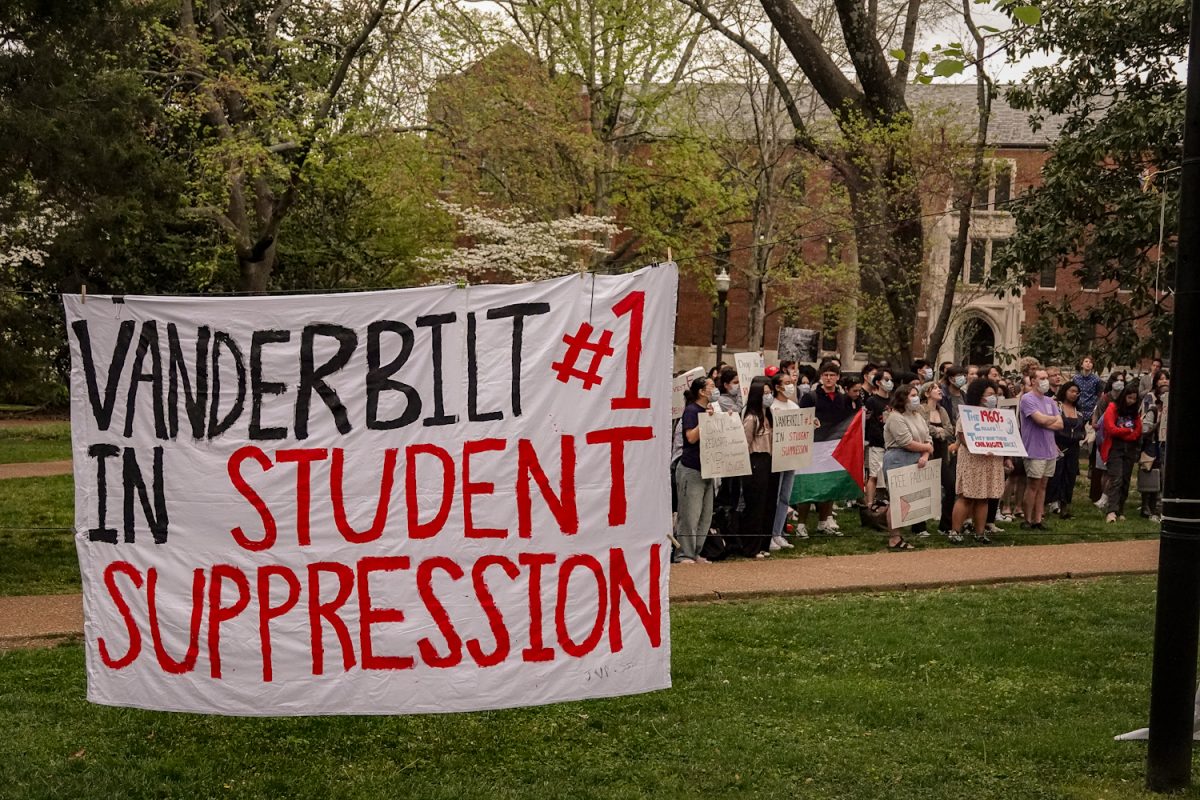
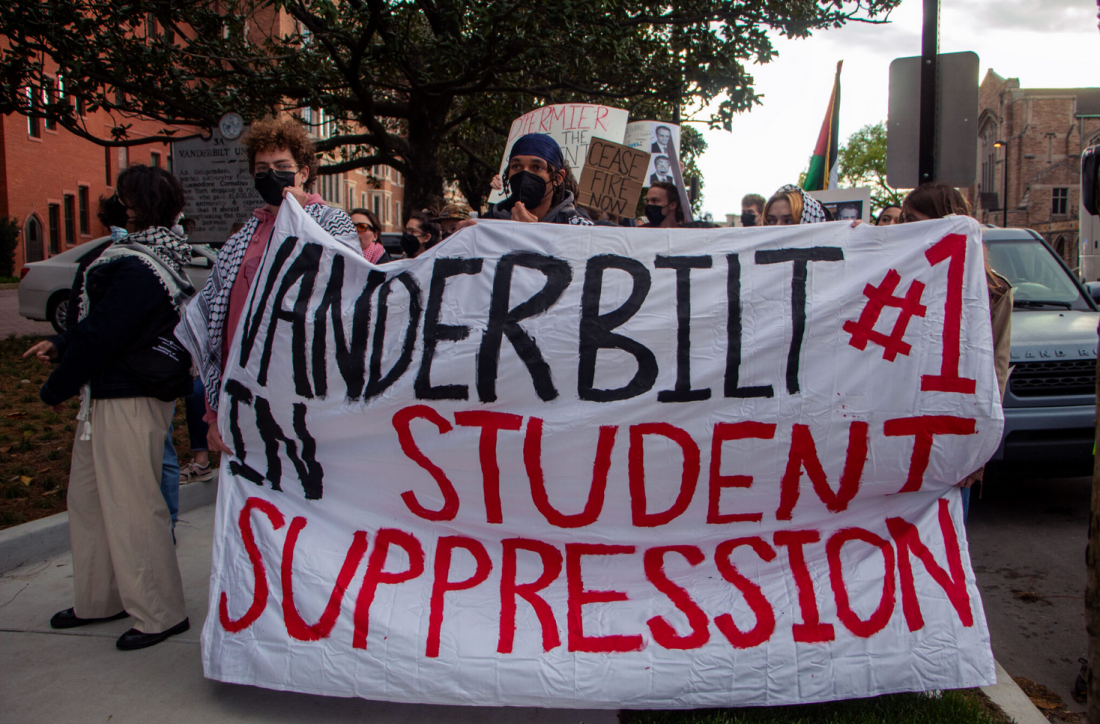
Several weeks later, students and faculty walked out of class to protest the university’s decision to expel three students involved in the sit-in. Nationwide, these constituted the first known expulsions for protesting genocide this spring. Vanderbilt students have also maintained a Palestine Solidarity Encampment since the sit-in. Signs with a particular slogan have been a staple at many of these demonstrations: “Vanderbilt #1 in Student Suppression.”
The banner captures Vanderbilt’s distinctive obsession with its reputation and ranking—but also, more importantly, it suggests how the repression of student protest has become a nationally recognized measure of institutional prestige. Administrators have acquiesced to this expectation at the behest of donors and other powerful interests. This influence was on full display in the most recent Congressional hearing of the Committee on Education and the Workforce, which featured Columbia’s President Minouche Shafik and the heads of Columbia’s Board of Trustees.
Throughout the hearing, Republicans wielded institutional hierarchy as a stick to ensure compliance—both on campuses, and in the hearing itself. Rep. Aaron Bean emphatically declared, “Columbia beats Harvard and UPenn. Y’all have done something that they weren’t able to do.” Along with most of the claims made by Republicans in the session, Shafik accepted and capitulated to the premise, and the implicit threat about her and her university’s standing. It was this perceived threat to the elite university hierarchy that would sparke Shafik’s decision to call in the NYPD (despite police reluctance) to Morningside Heights. As arrests ensued, she remained in Washington D.C., attending a dinner for the Bezos Earth Fund.
The desire to be ranked and perceived within the top tier dramatically impacts nearly all the activities of the modern university. In a telling incident, two years ago, a mathematics professor discovered that Columbia had been reporting its patient care expenses as part of its instruction costs, gaming the university’s position in the U.S. News & World Report higher education rankings. After this revelation, rankings were recalculated upon further investigation—and Columbia dropped from the #2 position to #18.
While Columbia benefits from its association with New York and the Ivy League, universities, like Vanderbilt (itself ranked #18 in 2024), located outside the east and west coasts, have a particularly intense concern with national prestige, both historically and in the present. Vanderbilt has long been recognized as one of the most prestigious institutions in the South. But, unlike, say, Duke University, Vanderbilt has had difficulty shedding the provincial Southern descriptor, with all its connotations. The reputational and public relations challenge has driven its simultaneous efforts in recasting and atoning for its history of racism, bolstering its commitment to students, faculty, and subjects that it previously excluded, and working to embrace and amplify the stature of Nashville as a bastion of liberal, creative possibility.
This kind of status anxiety is, of course, especially pronounced for U.S. colleges and universities that reside in or near the upper echelons of wealth and the top metrics of selectivity. The ongoing national frenzy around protests at these institutions has revealed an unspoken priority: administrations are on a desperate search for novel strategies to discipline students, especially political protest.
Student repression takes different forms across the many tiers of the U.S. higher education system. Elsewhere, it may appear less immediately spectacular than a police cordon. Instead, there are varying shades of repression, some of which arise in the form of dilapidated buildings, gutted academic programs (especially in the humanities, social sciences, and basic sciences), and other indicators of leadership and funding priorities. Or it may manifest in ideologically driven legislation, neglect of student reports of sexual harassment and assault, or the growing weight of student indebtedness associated with increased college costs. (And of course, we have seen academic repression in its most direct and violent form in Gaza itself, where part of Israel’s genocidal campaign has been the full-scale destruction of university campuses and the institutions themselves—and with them, the chance of opportunity and better lives for their would-be students.)
Domestically, austerity-based forms have not stopped student protests or other forms of organized resistance, but they are widely accepted modes of disciplining students—and academic workers of all kinds, from professors to adjuncts to custodial staff. For students, as has been widely described, the growth of student debt and increased college costs have in part resulted from a consciously enacted right-wing strategy designed to thwart what appeared at Columbia in April: i.e., the kind of radical student movement also seen in May of 1968.
Envisioning a future of indebtedness retroactively informs students’ view of themselves in the present, engendering a sense of precarity and limiting their imagined possibilities of what kinds of risks they can afford to take. Conservative and liberal strategies to delegitimize higher education by starving university budgets and legally jeopardizing entire fields of study are a continuation of these efforts; debt pushes students to drift to fields of study that they perceive will provide the most lucrative financial return.
Still, despite high sticker costs, debt has become less of an effective disciplining strategy at the most elite institutions in the country, as these universities have steadily developed programs to either eliminate or significantly reduce the need for loans among their undergraduate populations. (It is a different story for graduate students.) Columbia, Yale, NYU, and Vanderbilt, for instance, advertise prominently that they do not include loans in financial aid packages for undergraduate students. In the absence of debt pressures, university administrators are left with the task of controlling an undergraduate population that is not subject to one of the most effective tools for disciplining political activity on campus.
Now, facing committed students calling for an end to genocide in Gaza, elite university administrators are on the hunt for new repressive measures. As we learned last week, Columbia, at least, seemed to take advice directly from Congressional Republicans. Turning to an especially crude tactic, and furnishing an unsubtle symbol in the process, NYU went so far as to build a literal wall in Greenwich Village. Back in December, Brown University (which also promises no loans) turned its main administration building into a police station, booking students on site.
Nearly all of these institutions have newly adopted a familiar set of strategies: expulsion and suspension, be it interim (and thus without due process) or regular. These strategies rely on the criminalization of students as trespassers—arrest, sparked by campus declarations, can supply a justification and evidentiary support for suspension and expulsion. This necessitates the use of municipal and city police (rather than campus departments, many of which developed as a response to the use of the NYPD at Columbia in 1968).
Arrest can, among other problems it creates, result in the eviction of students from campus housing. If students cannot be subject to debt, then they can be threatened with homelessness. Understanding this implicit threat casts the sudden appearance of tent encampments on campuses in a distinctly new light—not to mention its resonances with the mounting scale of the U.S. homelessness crisis, the commonplace destruction of unhoused encampments via violent confiscatory “sweeps,” and the extensive university real-estate holdings that have squeezed housing markets in many locales.
While it was Columbia’s violent reaction to pro-Palestinian protest that ultimately sparked the current national movement (as well as glaringly indicating the school’s capitulation to the ruling consensus), it is worth thinking about how the early incidence of Vanderbilt’s repressive strategies may have offered up a national proposal of sorts to the ruling coalition, establishing a precedent for how elite colleges and universities ought to act towards anti-war protestors. Marshaling police to arrest so-called trespassers based on flimsy intelligence is now a conceivable strategy for administrators. It is a signal to the university’s vested interests that it will protect their investment, and secure future prestige. In this way it is a tactic that harmonizes with university austerity policies, campus-wide restructuring, or other capital projects that signal continued dividends, while public appearances are kept up by assuaging commitments to free speech. As an indicator of how the national political landscape around free expression on campus has shifted in the last several months, Vanderbilt’s approach towards student organizing has come to represent a new style of reputation management.
If there is any doubt about Vanderbilt University’s overweening interest in burnishing its reputation, one need look no further than Chancellor Daniel Diermeier’s scholarly expertise: “reputational risks for global corporations.” Some of his books include Reputational Analytics: Public Opinion For Companies, Reputation Rules: Strategies for Building your Company’s Most Valuable Asset, and, perhaps most relevantly, Corporate Reputation and Social Activism (co-authored with David Besanko and Jose Miguel Abito). Leveraging crisis to bolster an institution’s reputation: this would appear to be the reason that Diermeier was appointed to become Vanderbilt’s chancellor in 2020. (It also didn’t hurt that he had a record of managing graduate education and warding off unions at his previous position as Provost of the University of Chicago.)
Since his appointment, Diermeier has used larger social and political crises as a means to increase Vanderbilt’s standing. The “shock doctrine” employed by university administrators during the coronavirus pandemic has been well-documented. Yet, under Diermeier, Vanderbilt deployed an inversion of this strategy at least in its public communications: he brought students back to campus more quickly than many other institutions, prioritizing function over student, worker, and community safety. After students returned in the fall of 2020 and Diermeier became one of the protagonists in what can only be described as an institutional hagiography—a book titled A Year Like No Other: How a Global Pandemic Led to Vanderbilt University’s Proudest Moment by Ryan Underwood. In his preface to the book, Diermeier casts himself as equivalent to Winston Churchill during World War II.
Disaster provides an opportunity for making austerity and favorable restructuring schemes permanent, but it also is a moment to conduct the ephemeral work of reputational arbitrage by embracing policies that carry significant material risks for those susceptible to administrative decisions. These decisions are not oriented towards the care of students, workers, or communities, but instead to a risk/reward mechanism that, if successful, can allow for enormous returns. The success of this strategy is not measured by the experience of students and workers on campus, but rather by the flattering narrative—the success of a prestige-polishing public relations campaign.
The pandemic led to other problems for universities, largely because the movement for racial justice that it incubated would soon be met with a scale of reaction that may only now, over the last several weeks, be coming into full focus. Southern states were first to codify this type of revanchism. Though not to the level of Florida or Texas, the Tennessee legislature targeted “divisive concepts”—a euphemism for DEI-related activities—in higher education in 2022 and 2023; it also, in the latter year attempted to signal an anti-trans-rights posture to its (very confused) base by making drag shows illegal. In 2022, it passed legislation that requires any institution with public contracts to certify that it is not engaging in a boycott of Israel. In other words, in the wake of the pandemic, Tennessee Republicans effectively articulated, through their legislative agenda, an intent to repudiate and repress movements for racial justice, trans rights, reproductive rights, and BDS. These laws often were directed at reversing social progress in Nashville, the state’s largest city, its capital, and a relatively progressive blue dot in the center of a deep sea of red.
These were the political conditions under which Diermeier, the head of Nashville’s largest employer, unveiled his signature policy: “principled neutrality.” Principled neutrality came packaged with two initiatives: “The Vanderbilt Project on Unity and American Democracy” and the “Future of Free Speech Project.” The outward orientation of this institutional commitment spoke directly to the free speech concerns wielded by the right in their attack on higher education. The policy received a rave review from former-Senator and now Vanderbilt Board of Trust member, Lamar Alexander in the Wall Street Journal.
Diermeier’s embrace of neutrality and free speech became a mechanism to avoid the reality that the city anchored to the university was facing a growing legislative siege from the state. “Neutrality” was a compliance strategy with an increasingly aggressive state regime. That is, neutrality became the means by which to enforce a political culture on campus that is functionally aligned with conservative forces, but remains rhetorically separate. Students at Vanderbilt must sign a document agreeing to maintain this arrangement via what Diermeier describes as “a student-authored community creed”—which harks back to the loyalty oaths required for students in the 1950s.
Insisting on neutrality has long been important to Vanderbilt. In the late 1950s and early 1960s, the school redounded to an ostensible “neutral” to justify its gradualist approach to integration during the Civil Rights Movement. Vanderbilt, in other words, sought to have it both ways: to draw an advantage over racial politics to bolster its national and international reputation, while skirting criticism of its parochial behavior. The resonances between 2024 and 1960, the moment when Vanderbilt faced “the most divisive episode in all of [its] history,” according to a scholarly history of the university, are undeniable.
A central issue at the time was Vanderbilt’s decision to expel Civil Rights leader James Lawson. Lawson was a student in Vanderbilt’s Divinity School. He is best known as a key Civil Rights strategist and activist, providing architecture for the Freedom Rides; in addition, more relevant to Nashville in 1960, he was a leader of a significant campaign of lunch-counter sit-ins in the city in protest of segregation. Facing pressure from the Board of Trustees and Vanderbilt’s Chancellor Harvie Branscomb, Lawson was asked to leave the university in March of 1960 because he encouraged others to participate in unlawful activity.
Lawson refused, and he was expelled on March 4th, 1960. Lawson’s expulsion made national headlines and interrupted Harvie Branscomb’s decade-long plan to integrate Vanderbilt—very slowly, one bit at a time. Gradual integration was a key piece of Branscomb’s wider strategy to bring the university to national prominence. Institutional neutrality supplied Branscomb with his defense: “The University’s position thus was not to oppose the sit-in movement, nor to discipline the individual for infringement of a particular law, but to state that no student could remain in good standing who in a potentially riotous situation commits himself to an organized program of deliberate violation of law.”
Like many institutions, Vanderbilt has used the bravery of its students and its institutional cowardice in the 1960s to build its present-day reputation. Vanderbilt formally apologized to Lawson in 2006. And, on April 7th, 2022, Chancellor Diermeier presided over the opening of the James Lawson Institute for the Research and Study of Nonviolent Movements at Vanderbilt University in 2022, calling Lawson one of Vanderbilt’s “most revered alumni.” The very next day Tennessee Governor Bill Lee signed the law barring public contractors from being engaged in a boycott of Israel in Tennessee.
This would be one of many laws that would bear directly on the conditions of the sit-in supporting the right of students to vote on a BDS resolution within the student government at Vanderbilt. Diermeier (pointedly ignoring any of the obvious comparisons to James Lawson’s unlawful protests) has stated that the decision to ban an act of student legislation rests on the interpretation that the adoption of BDS by the student government would essentially be illegal activity, given Vanderbilt’s role as a state contractor. In other words, neutrality yields to the structure of the law—and when the law makes a certain form of expression void, Vanderbilt is able to tacitly support it, while saving public face, by declaring a neutral posture. By this rather transparent sleight-of-hand, Diermeier has converted the restrictive operating conditions around speech and expressive activity in Tennessee into a universal principle about free expression. He insistently makes recourse to what he paints as a distinction between speech, which is allowed on campus, and actions, which can be banned.
It is an overworked truism that the contemporary university is shot through with contradictions of these kinds. An institution may bolster its reputation for public and social good through a variety of initiatives. Such initiatives may well have legitimacy in their own right—but nevertheless, the scale of university operations and the financial and reputational pressures informing the functioning of administrators and boards will inevitably render them as selling points—fodder for the university’s Instagram. This is the left critique of DEI: that these activities supply a distraction from more fundamental social engineering, i.e., the racial, gendered, and classed project universities participate in via consensus and coercion alike.
There is benefit in restating this critique anew amidst DEI’s erasure from many campuses, at the behest of right-wing campaigns. Universities inevitably tend to accumulate value and generate institutional gain by exploiting–not ameliorating–racial inequality. Ultimately, this is one of the most nefarious dimensions of the contemporary university. Capital and profit impose perverse incentives that influence schools’ navigation of issues of race, gender, and class—sometimes on the basis of imaginary concerns, like the dogwhistles around the manufactured problem of the “demographic cliff.” But it also means that these are some of the university’s most critical ideological vulnerabilities, which can thus be probed by resistance activity. Lawson’s expulsion, for instance, interrupted Branscromb’s integration plan, and illuminated the workings of this ideological architecture: slowing integration and piecemealing racial tolerance in search of national plaudits for Vanderbilt’s liberal bona fides on race.
At Vanderbilt, like many universities, however, this phenomenon has not been limited to the institution’s relationship with Black people. The university has also sought to benefit from its relationship to Jewish students. Jewish students attended Vanderbilt in relatively high numbers in the 1960s and 70s, largely because east coast elite institutions still had Jewish quotas in place. But when those quotas were lifted, Vanderbilt lost its Jewish students. By 2002, Jewish undergraduate enrollment at Vanderbilt had fallen to 4 percent.
In response, Chancellor E. Gordon Gee (yes, that one) oversaw a strategy to recruit more Jewish students to Vanderbilt. The effort was to attract, by the school’s own admission, students with higher SAT scores and, as some mused at that time, wealthy Jewish donors. Gee called this his “elite strategy” that would secure Vanderbilt something akin to Ivy League status. In effect, Gee stated plainly a longstanding institutional orientation to race and ethnicity: a brazenly opportunist attempt to improve the institution’s status by exploiting the racial formation of the U.S. without incurring serious commitments to social reform.
This would also suggest that at Vanderbilt, support of Jewish students has been equated with ascendancy in the rankings sweepstakes. That assumption is blatantly derived from stereotyping, the perceived intellectual prowess and financial holdings of Jewish people. As Gee imagined it, “Jewish students, by culture and by ability and by the very nature of their liveliness, make a university a much more habitable place in terms of intellectual life.”
This nominally philosemitic antisemitism is of the same Zionist variety that collapses a support for Jewish rights into lockstep support for the state of Israel. Vanderbilt’s overly aggressive stance towards its student protestors in 2024 makes all too apparent the alignment of a 1960s-era white supremacy with a pro-Israel (not pro-Jewish, mind you) politics. Diermeier had to take aggressive action on the students occupying Kirkland Hall, because the architecture of Vanderbilt’s proposed path to elite status relies upon the figure of the minoritized student, whether Jewish or Black. As students press against the institution’s definition of how they ought to express themselves and their identities, the only recourse to discipline this so-called trespass is criminalization. Just as James Lawson trespassed upon Branscomb’s imagination of what integration and national prominence ought to look like, the Vanderbilt Divest Coalition has made clear the policing and militarization required to maintain neutrality in the face of genocide.
There are some peculiar structural features that accelerate the development of this tendency in the South—just look at UT Austin and Emory—but, as the last week has revealed, the ramifications are national in scope. The (omni-) presence of Gee, as a sort of itinerant university president figure, could be taken to suggest that such racialized conceptions of status undergird the broader university project across a number of regions. His relentless tenure overseeing of the consulting firm rpk Group’s dismantling of West Virginia University hints at a connection between the university’s conception of minoritized students and the development of modes of administrative discipline.
There are plenty of similarities between the flavors of repression at Columbia and Vanderbilt—but we might be prompted to ask, more broadly, how the gutting of public institutions through consultancy-driven austerity or via conservative legislation operates to the same effect. No matter the means, the ruling coalition in the United States—whether Democrat or Republican—has come into alignment on the idea that prestige within the university system ought to incorporate a measure of the management of student compliance.
The expanded—and literally hollow, as in non-existent—definition of antisemitism has become the latest unfortunate mechanism in justifying new strategies for disciplining student politics by brandishing material and economic threats. When the police, the bulldozers, and the dumpsters arrive on the college greens in the coming days and weeks, all seems to point to the persistence of this incredible student movement. Their protest continues because and in spite of the fact that the American university, connected as it is to both capital and investment in the U.S. and to the genocidal destruction of Gaza abroad, accumulates for its own gain by the criminalization of the innocent.♦
Cover image: Hamilton Matthew Masters.