

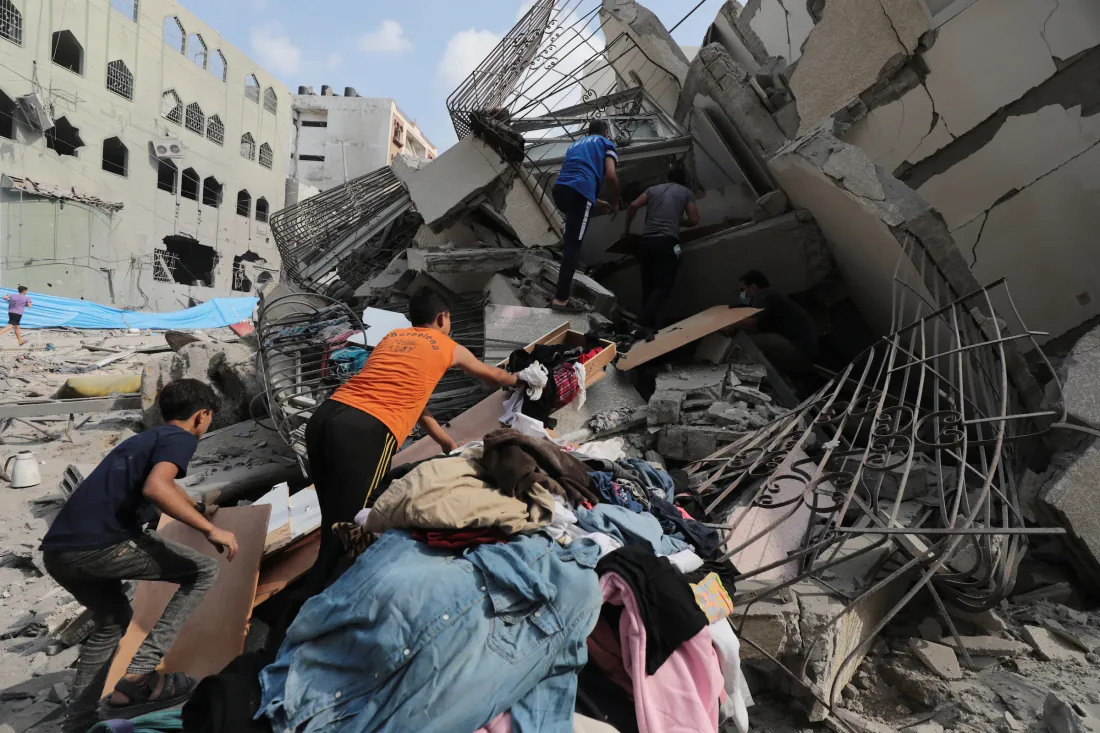
The genocide in Gaza has entered its sixth month—half a year of bombing, starvation, death. As the situation has worsened, the United States’ commitment to the Zionist perpetrators has remained as steadfast as the Zionists’ own commitment to murder. But cracks in the West’s heretofore unconditional support for Israel are beginning to appear. It is the duty of every person of conscience—their numbers grow by the day—to flood these cracks, to turn them into chasms. Still, nothing feels like enough as letters continue to trickle out of Gaza, each describing a new vision of hell on earth—or, as the anonymous author of the first letter states, “whatever hell is, this is worse.” The genocide must be stopped by any means necessary, there is little else to say.
The team at The Institute for Palestine Studies has been translating and publishing these messages so that the world can see the humanity buried under the rubble, and the spirit of resistance that has, does, and will continue to animate the Palestinian struggle.
To help maximize their reach, we are republishing these messages here. This is the eighth post of letters. The rest can be found at the following links:
Part 1 / Part 2 / Part 3 / Part 4 / Part 5 / Part 6 / Part 7
From the river to the sea, Palestine will be free.
♦
Anonymous
March 22nd, 2024
[Editor’s note: The following is a transcribed testimony collected via WhatsApp messages from the author and her relatives, all of whom wish to remain anonymous.]
The author’s reflections on her family members’ experiences on December 7th, 2023 – Deir el-Balah, Gaza
The situation is just desperate. Absolute desperation. A gallon of oil is $300. No salt. No fruits. No vegetables. No water. They [the author’s family members] buy wood for $20 a day—enough for a meal. It’s cold. They queue to charge their phones. All my mother-in-law wants is to be home. My father-in-law is sick. No doctors. No medicines. They went to buy falafel. Four-hour queue. The shelling from Khan Younis reverberates and can be felt all the way to Maghazy and Deir el-Balah. The kids are wearing wet clothes.
A message from the author’s sister-in-law:
Since the bombings resumed, my every thought has been on planning our next forced displacement. The events that drove us from the north are now repeating here in the same manner. Our previous evacuation was marked by panic, which terrified the children, a mistake I can’t make again. It was the most harrowing part of this war for me. My son Karim, only seven, astoundingly asked for a separate emergency bag. His mature understanding of our situation is both heart-rending and awe-inspiring.
Food supplies are dwindling. Today, Hasan, my husband, queued for four hours for gas, but to no avail. I’m stretched thin, caring for my elderly and sick parents and our children, while Hasan spends his days trying to provide for us and his family. The scarcity of aid has led to desperate struggles over water, tearing at the fragile social fabric we once had. I’ve heard of people nearly fighting to death over basic necessities, highlighting the inequality and chaos that have arisen.
Amid all this, I yearn for care and support myself. Your calls are my only respite, the time when I can truly be myself. Never did I imagine living through such times. With each day, the bombings seem closer, and the air is heavy with panic and foreboding. I fear that what lies ahead could be even worse. Is that even possible?
The author’s communications with her brother-in-law on December 17th, 2023, after a period of blackout –Deir el Balah, Gaza
We’ve hit a point of complete exhaustion. There’s simply nothing to eat. Even if the war were to stop right now, it almost feels meaningless. Life itself seems meaningless. Just imagine, 1.8 million displaced civilians crammed into the south, an area already densely populated. Our brains can’t process it anymore—the dead bodies, the explosions, it’s too much. Tensions are high; people can’t tolerate each other. We’ve heard horrific reports from the north about people being buried alive, and women and children being detained. We’re like the walking dead, devoid of life. Aid is scarce, and by the time we get any, we’re buying it ourselves.
Daily, there are fights for food and water. Crime has surged in this new, chaotic environment. There’s no police, no security. Usually, there would be some order maintained during war, but now there’s only chaos, no law and order. It feels like we’re caught in a complex, unfamiliar game. If they opened Rafah, everyone would flee instantly. There are no words left to describe our plight. Our only pastime has become looking at the stars, when they’re visible, and queuing for aid.
The constant buzz of the zanana [drone] is unbearable. You don’t understand, it eats at my bones. It’s so loud, constantly interrupting sleep and conversation. It’s like someone shouting over you alllll the time. Yet, we find ways to cope. We joke, we sing. It’s grim, and we know it might take years for people to return home, for hospitals and schools to function again. There’s a sense of hope about returning home, but the path to recovery is daunting. We need to conserve energy for what comes next—you know how they say “after-party”? Yeah, what comes next is the after-party.
Where I’m staying now, we have nothing — no food, no electricity, no water. The effort to find and break wood for fire, just to eat something, is backbreaking. Even basic needs like using the bathroom become a challenge without water. The relentless task of maintaining a fire is the most draining thing. I’ve been using garlic cloves to treat my fever and flu because medicine is nowhere to be found.
Yes, I still hold onto hope. This war has progressed through many phases, and now we’re in this brutal stage of survival. In the beginning, when I was home, it was different. If we were all home, half the mental pressure would be gone. Being displaced is the hardest part. We’re all in the south now, where space is severely limited, and we don’t know anyone. Unlike the north, there are only low-rise buildings here, incapable of housing so many people. If they had moved us to the north or to Gaza City, it might have been easier. Most of the large businesses and important infrastructure are in the north and the city, not here in the middle and the south. At least there, we wouldn’t be struggling just for food. But much of that [the north and Gaza City] has been destroyed.
A message from the author’s sister-in-law via WhatsApp on January 5th, 2024, after forced evacuation from the Maghazi camp in Deir el Balah.
The [Israeli] army has reached us, and we had to go to the school. There’s no way out, neither to Deir el-Balah nor Rafah. It’s the First Girls’ primary school in Al-Maghazi.
I talked with Saeed, he’s trying to reach someone with a car, but the phone connection is terrible. If we have a chance to move by a donkey cart, we won’t hesitate. The main thing is to get out.
We are sitting all day in the square now. We are in the school. There’s no way to move. It’s not safe.
It’s very tough. Now we are sitting on the stairs with the kids and dad and mom, waiting for dawn. When the army reached Aunt Samia’s house, they separated the women and arrested the men.
They didn’t manage to get out. The army didn’t warn them. May God protect and save them.
They took all the young men in the building, Uncle Abu O., his sons, and those staying with them. May God protect them.
Your cousin Mahmoud is with us, but his daughters are with their mother in the house where they detained the women. He’s trying to get in touch for his daughters’ sake, but no news.
A message from the author’s brother-in-law via WhatsApp on January 11th, 2024. The message relayed news about the brother-in-law’s maternal aunt and uncle who remained in the north, in Gaza city.
An Israeli airstrike in the Shujaiya neighborhood killed three of Uncle Khalil’s children in Nov. 2023.
Uncle Khalil will be staying at our house in Gaza City since his house was bombed.
Aunt Samia’s sons and husband were detained in early January 2024 by Israeli soldiers in Maghazy. They were released two days later. Aunt Samia is 80 years old.
Aunt Samia’s sons are being mistreated, they have been stripped… just like in the videos you’ve seen on social media. The women were released, but Auntie Samia lost all her gold during that long walk [from Maghazy to Rafah].
The author’s reflections on February 13th, 2024 .
In the tent in Al Mawasi [in the south of Gaza]… just dire, dire, dire conditions. Hell, really. Mental health is really, really at its worst. Even on the phone, there’s not much to say. The problem is medical care. They’re all so sick, each with their different symptoms between tooth infections, prostate, hearing aids, and severe diarrhea, any medicine or care is obviously nonexistent. The daily chores are weighing his sister down. It’s just, whatever hell is, this is worse. It is just a very desperate situation.
We are desperate to get them out. But it’s not so simple or straightforward.
♦
Yumna Hamidi: Death Seeks Us in Exile
January 12th, 2024
Yumna Hamidi holds the Shireen Abu Akleh Memorial Scholarship at the American University of Beirut.
and you, Mother
and Father, siblings, family, and friends:
alive, perhaps?
Or perhaps dead
—Mahmoud Darwish, “A Letter from Exile”
As she tries to contact her sister, Tasneem, Iman poses herself the same question Mahmoud Darwish asked his mother in “A Letter from Exile.” She hopes to God that this time her phone will succeed in getting through so that she can hear news about her family, who live in a city whose address has become death itself.
The passing of each day weighs heavily on Iman, burdened with anticipation and fear. She lives every waking moment alongside the terror of one of her family members or friends suddenly becoming breaking news. She’s not in Gaza with them. She’s one of the city’s children living abroad, living through another war that runs parallel to the one her family is in. She spends most of her time absorbed in the war and its events, though the images before her aren’t quite as separate from her as they are to others—she is, in fact, part of those very pictures, as far as she may find herself from her own country.
Iman has lived in Germany for many years. She now watches silently as houses are demolished over the heads of their residents.
“We’ve seen everything in this war,” she says. “It’s a genocide before the eyes of the whole world. The killing, destruction, and burning of everything: the elderly, children, women. Not even stones or trees are spared.” Iman has lived through many wars in Gaza; she was raised in its vocabulary, but this one is more difficult. The deaths of friends and loved ones are broadcast to her by a screen. Despite the monstrosities she sees every day, she’s forced to continue with her life as normal. She lives in a country that, far from sympathizing with Palestinians, struggles to recognize them as humans at all.
“At my workplace in Germany, the only question I’m asked is: ‘Can you work?’ If I were to tell them I can’t, they’d simply find someone to replace me. I live between two worlds: a world in which I exist physically and in which I must work — how can I live without working?—and a world that exists in my heart, my soul, and my being: Gaza.”
I used to exchange long letters with Iman. I would ask her about the conditions of her trying exile despite my shame in asking her this—about how her family was faring faced with the ravages of war, where they were living through this genocide that has left nobody untouched. The occupation, after all, has stripped life from everything, in its view of the Palestinians as nothing more than “human animals,” to quote the Israeli “Defense” Minister Yoav Gallant.
Killing the senses, erasing existence
Iman spoke to me about the horror and cruelty of the scenes witnessed by her family. They had decided to stay in the Shuja’iyya neighborhood (East Gaza City) and refused to move to the south amid the warnings of the Israeli Occupation. For them, death was everywhere, though lethal in different ways. Their city first lost electricity, then water, then food.
One morning, while Iman was at work, she managed to contact her 18-year-old sister, Tasneem. Her voice was strained. She was crying, full of grief, fear, and tension.
“Iman, we left my uncle’s house, and now we don’t know where to go. The tanks have surrounded the area, and you know what will happen next.” Because of the threat of death pursuing them by air, land, and sea, Iman’s family has become displaced. In a mad frenzy, the Israeli tanks came to wipe out what remains of life in the city. The options for survival and safety have become non-existent.
Iman kept in touch with her sister on the phone as they sought a safer shelter. They eventually reached a school housing displaced people from the area.
“I didn’t feel better once my family entered the school. Something wasn’t right,” Iman told me. “I felt like something might happen, so I insisted to my sister—once, twice, and three times—that they should enter any room in the school. I told them not to go into the courtyard.” Her sense was soon confirmed: as she was talking to her sister, Israeli forces suddenly bombed the schoolyard. The sound was deafening and didn’t stop. From her horror, Iman felt like the ground underneath her was shaking. The pain took hold of her body, and her soul tortured. She couldn’t stop picturing the fear and panic in the eyes of her family, their screams ringing in her ears. Survivors abroad are killed by their guilt. They’re killed by life itself.”
The bliss of surviving death.
“Thank God, Iman,” Tasneem used to say. “We’re alive, we’re alive.” Escaping death has become something worth celebrating. Tasneem, who completed high school last year with a grade of 96.5%, wanted to pursue her dream of studying fashion design.
“You should see her drawings. They’re amazing,” Iman says. “She designed an entire dress from scratch and sewed it.” Tasneem, instead, has known despair and misery, seeing enough in the prime of her youth to last her a lifetime. War kills not only people but hopes and dreams, too: it denatures memory and erases existence to a point that the only dream possible is escaping death.
After the bombing subsided, Iman’s family left the school to go to the house of one of their relatives. “I was with them on the phone,” she told me once they’d arrived. “I heard my brother saying, ‘Bring a bandanna so we can tie it on his leg.’ ‘Who’s injured Tasneem?’ I immediately asked her. ‘Our cousin,’ she said quickly, just before the connection was cut.”
Iman then went back to work. She barely had time to cry.
The requested number cannot be reached at this time.
Iman lost contact with her family for about five days. She tried to call dozens of times each minute, sending several messages that no one received. This war, she told me, had disabled her. No ordinary war, it has a way of killing those abroad—those separated—turning them into corpses awaiting burial. Every day, Iman listened to the news from Shuja’iyya—to updates on the cancer metastasizing throughout its streets. The neighborhood quickly became a hotbed for Israeli tanks. Israeli Occupation forces also never stopped wiping it with “fire belts.” For those of you who do not know what that is, picture a large batch of heavy missiles launched by warplanes simultaneously, concentrated in one specific place.
Minutes from heaven.
“Iman, we’re fine.”
One message was enough to bring Iman’s spirit back to her body. She kept replaying different scenarios in her head and was afraid that a message would reach her of her family in mourning. Is there anything more painful than feeling loss even before it happens? Is there anything more cruel than depriving a person of a single, final moment of farewell?
After she was able to contact her again, Tasneem told her sister the details of what her family had been exposed to while leaving the school, and the heartbreak, pain, and fear they experienced in their relatives’ home. The streets in Gaza have turned into a large cemetery—bodies of men, women, and children are scattered everywhere, unburied. No one knows who the martyrs lying on the ground are. Tasneem describes these moments as the horrors of the Day of Resurrection. They were walking, scared, and confused, fleeing from the sound of death enveloping everyone in Gaza. In the hell and destruction inflicted on Gaza, they saw things words cannot describe.
Iman added: “My family was afraid for my little sister, Lola. She’s thirteen. To prevent her from being scarred by all these scenes—scenes the human mind can’t possibly come to terms with—they kept telling her to raise her eyes and look at the sky. She wasn’t allowed to look at the ground.”
Tasneem was injured by shrapnel when the school was bombed. Regarding this, Iman tells me, “As my sister came out of the school and told me everyone was alive, she had actually been hit by shrapnel at that moment. She remained calm though and suppressed her pain so that I wouldn’t worry.” Iman’s brother was also injured by shrapnel; it remained lodged in his leg for several days. He had neither the experience nor the supplies necessary to extract it. Her cousin’s wife was also injured by shrapnel throughout her body. These wounds eventually killed her, making her a martyr.
The luckiest in Gaza are those who can find a grave in which to honor their dead. Iman’s family had no such good fortune, so they were forced to bury their cousin’s wife inside the house they took refuge, which housed another 75 people. Because of the intense bombing and sudden sniping, nobody could leave. “The body remained with them for a whole night. There were many children in the house, but there was no solution. The next day, they removed some tiles from the building they were in and buried her under them.”
Attempts at survival
One day, Israeli tanks advanced toward the house in which Iman’s family was sheltering. The soldiers began calling out over the loudspeakers:
“How many of you are there?” Silence and fear filled the place. Nobody uttered a single word for fear that the soldiers would hit the house and kill everyone.
“‘Who’s there?’ they started calling,” Tasneem said to Iman. “We signaled to each other that we shouldn’t talk, but there was a baby boy who started crying. A man among those present took a pillow and started smothering the child. ‘One dies so 75 can live,’ he said to the baby’s mother as she went to stop him.”
This is one of the scenes that cameras cannot document. But it remains stuck in one’s conscience even with the passage of time. Every day that passes is an ordeal for Iman’s family as they move from shelter to shelter in total blindness, dispersed under the threat of bombing. They move from an area of certain death to the meager safety of slow death.
Survival complex…
As for Iman, her situation is similar to that of many expatriates from Gaza. Her soul is shattered, but she’s tired of counting the days of genocide. She waits for the day when her family is saved so that she can meet them again. She can’t control her tears when she thinks of what had become of Gaza: in the blink of an eye, it had become a cemetery. She had never imagined that her family would live in conditions of this sort and that the list of lost loved ones would grow so long.
“I am ashamed to sleep while my family can’t,” she tells me. “Every breath I take feels heavy in my mind. And if I drink or eat, I feel like I’ve ingested poison. Over the course of this war, I’ve lost 17 kilos, and throughout the war, I’ve suffered from terrible panic attacks, shortness of breath, and pain in my chest and shoulder. All my wishes in this world have now been distilled into one: Lord, save my family and protect them. I want nothing more.”
Iman’s wish is practically the same as Palestinian poet Mourid Barghouti’s, as expressed in his poem “Desires”:
“A desire to answer the phone late at night without fear of disaster.”
Every day, I listen to dozens of stories about Gaza and the war. This is one of the ones I heard from Iman, ‘the expat girl living in Germany.’ I think it deserves to be written down.
Gazans in exile may survive bombings or being buried under the rubble, but they cannot escape the death that comes out of fear for their families. This is how Shazza al-Kafarna (exiled in Turkey) and Samar al-Sheikh (exiled in Egypt) died: their hearts stopped.♦
[Translated by Francesco Anselmetti]
