

In his 1974 work The Production of Space, Henri Lefebvre proclaimed “that repetition has everywhere defeated uniqueness.” With the advent of the industrial age, the domination of repetition (in the form of labor) has homogenized space, while also catalyzing its commodification. The introduction of zoning in the 20th century, whereby land was assigned distinct uses, affirmed the domination of abstract space, colonizing the role of space in daily experience. As Lefebvre put it, in the space of “today’s (urban) planner, the system of localization assigns an exact spot to each activity.”1 Within capitalist society, there is no longer space for spontaneity; instead, space has been privatized and divided into parcels where endless labor and production are performed—isolated but altogether the same.
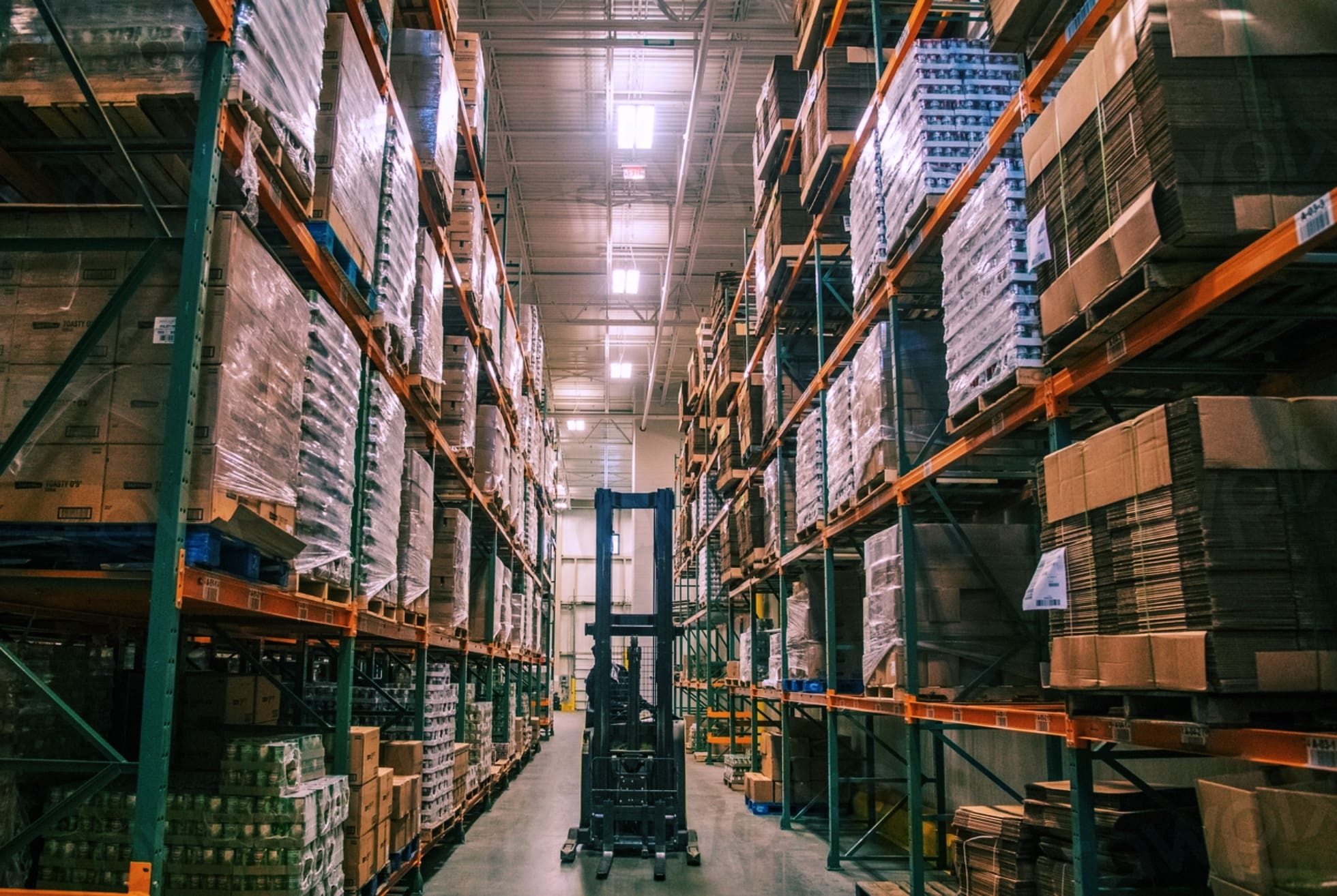
In the Global North, the warehouse has been designated a space through which not only the commodities but also the ideologies of capital are disseminated to its consumers. As a component of the logistical supply chain, the modern warehouse has become increasingly essential, facilitating the spread of online shopping and next-day delivery. A windowless concrete monolith, the warehouse, an emblem of “repetitious space,” has been duplicated across the landscape of the United States. A 2023 report by the Environmental Defense Fund estimates that in 10 U.S. states, an estimated 15 million people live within a half-mile of a warehouse.2 As of 2023, it’s estimated that Amazon alone has 355 warehouses across the country, (to say nothing of its immense operations abroad), totaling an estimated 319 million square feet.
To meet the demands of the just-in-time model popularized by companies like Amazon, warehouses—or “fullfillment centers,” as they’re euphemistically known—often operate on a 24-hour schedule, generating daily truck trips that can number in the thousands, especially at the sites that exceed one million square feet. As a result, nearby communities are continuously exposed to noise and air pollution from diesel particulates and nitrogen dioxide. The results of this exposure can be disastrous, increasing the risk of respiratory illness, heart disease, and pre-term births. Across the United States, warehouses are primarily sited in low-income communities, especially those with predominantly Black and Latin populations. By these means, the warehouse’s duplicative nature extends beyond the circulation of consumer goods; it also serves to reify and reproduce racial hierarchies.
New Jersey has been described as “ground zero” for the ongoing conflict between residential communities and the warehouse industry. The state’s proximity to New York City and Philadelphia means that it functions as a major artery, a metabolic pathway for capital and consumer goods—making New Jersey an “ideal” site for the logistics explosion. The Port of New Jersey boasts that “trucks can access the 44 million local consumers in the New York/New Jersey metropolitan region within a four-hour drive.”3 Within Lefebvre’s “system of localization,” New Jersey has been assigned to sustain the networked superstructure that feeds the modern-day city.
In parallel, an impoverished and racialized population has been “developed,” both by conscious design and in an emergent process, to satiate the demands of capital and absorb its negative externalities. In a state where segregation remains “prevalent and persistent,” Black and Latin communities remain highly concentrated along the highway system and in industrialized areas, particularly in and around the Port. It is estimated that approximately 52% of all Latin residents in New Jersey live within one mile of a warehouse. Such political geographies are well suited to the operational design of companies like Amazon. Employing over 50,000 people in the state, disparity is critical to creating Amazon’s customer experience, “given that the warehouse worker is neither seen nor heard by the customer.” As a result, some “communities are vacuumed up almost completely by Amazon, while in others, people don’t know anyone who works for the company.”4
Here, the lifeless exterior of the warehouse belies the true volume of the financial flows that it directs through its built environment. Warehouse proposals can involve local planning boards, landowners, development companies, leasing companies, and operations and personnel companies.5 Even Amazon has begun subleasing their New Jersey warehouse properties to other entities as a way to “manage their real estate portfolio.”6 Multiple economic actors are intertwined in the economic speculation that comes with each new application, promising to “fulfill a need” within a host community. Throughout this process, the promise of economic development is presented not only as an opportunity but as a necessary condition of survival. A 2022 report from the New Jersey Office of Planning Advocacy states that “it is clear the market is screaming for more supply in available space”—despite more than one billion square feet of already-built warehouses.7 In New Jersey, warehouses and transportation have become a $20 billion-dollar industry, making up 7% of the state’s GDP.
Resistance from local communities has been unable to slow these market forces; once developers submit a successful application, there is little that residents can do in opposition. In areas where local municipalities have attempted to pass legislation that limits warehouse construction, they have faced lawsuits and litigation from well-resourced developers. In 2023, Russo Development won a court case in New Jersey’s Superior Court that overruled a town’s previous application rejection, paving the way for a 2.1 million-square-foot warehouse complex.
Currently, no government agency documents or tracks warehouses at the national or state level, “making it difficult for communities and policymakers alike to learn the identities of owners and operators of these buildings.”8 Instead, researchers have turned to a service called CoStar to obtain warehouse data. CoStar is a web-based company that has monopolized access to commercial real estate property information in the United States. Written in bold, the heading of their website touts “the power of knowing.” The siloing of data means that such power is amplified, with access only a subscription away.
In a July 2023 article on CoStar’s website, “Facing Opposition, Warehouse Developers Focus on New Strategies,” a panel of New Jersey developers laments the “misinformation” campaign of anti-warehouse activists that “both distorts and overlooks any net benefit of industrial projects.”9 Rather than a material issue with implications for environmental degradation and injustice, development is presented as a victim of bad public relations. (CoStar’s business model means that it too benefits from the privatization of the warehouse; in a kind of second-order commodification of warehouse data, leasing companies look to its website for information on where and when properties might become available for sale. It would seem that CoStar and it developer beneficiaries feel that the “power of knowing” should be left to those who know best.)
On September 18th, 2020, New Jersey Governor Murphy signed the Environmental Justice Law. Hailed as a landmark legislative accomplishment, the law mandated that the New Jersey Department of Environmental Protection (NJ DEP) prohibit the siting of heavy-polluting facilities such as incinerators, landfills, sewage treatment plants, and major sources of air pollution if they can be proven to have a disproportionate public health impact on “overburdened communities”—i.e., census blocs that meet a certain threshold of minority or below-poverty residents (40% and 35%, respectively). The law was an acknowledgment that segregated communities had historically shouldered the disproportionate effects of industrial pollution, bearing the true costs of growth.
Hopes that the Environmental Justice Law would also lead to the regulation of warehouse siting were quickly dashed. A 2022 report from the New Jersey Office of Planning Advocacy confirmed that warehouses were “not included in the list of eight types of facilities specified under the law.”10 Despite acknowledgment from the state that warehousing had a disproportionate environmental health impact on overburdened communities, it was determined that any given warehouse was “not in and of itself a direct source of pollution.”11 The Department of Environmental Protection made use of a policy loophole, arguing that warehouses did not emit point-source pollution and were therefore exempt. (The United States Environmental Protection Agency defines point-source pollution as any contaminant that enters the environment from an easily identified and confined place.)
Instead, the NJ DEP issued the Advanced Clean Truck (ACT) rules, requiring that heavy-duty truck manufacturers participate in a credit/deficit program to phase in the production of electric vehicles while contributing to New Jersey’s goal of reducing greenhouse gas emissions by 80 percent by the year 2050. In a report from the Union of Concerned Scientists, the possibilities of this initiative are quantified into capital to demonstrate their merit; the “net social benefits” of the ACT rules are predicted to exceed $11 billion by 2050, while the logistics industry stands to save $446 million in the same period.12 Such reports have made it evident that technocratic policymakers will require that environmental justice “prove its worth” if it is to be brought into a new era of “green growth.”
In Psychopolitics: Neoliberalism and New Technologies of Power, Byung-Chul Han describes the mole as the animal of disciplinary society, symbolic of inhabitants that move in metaphorical tunnels: surrounded by their confining settings and institutions. But in the post-industrial age, total confinement has given way to distributed, networked forms of production; “accordingly, the snake has taken the mole’s place, the snake is the animal of neoliberal control society”; it is an entrepreneur.13 Like the snake, the warehouse produces space through its movement—the movement of capital and consumption.
The connotations of the snake-as-metaphor are apt in a number of ways: the warehouse model has evaded confinement (institutional regulation) while simultaneously constructing tunnels of its own. If the “mole is a labourer,” then that symbol could be said to represent the continued confinement and exploitation of its workers to ensure the timely delivery of consumer goods. The snakes, as it were, continue to be the beneficiaries of this arrangement, of course, themselves able to traverse under- and aboveground, maintaining the confinement of the laboring inhabitants to sustain the flows of capital both physical and immaterial.
Researchers Marc Gonos and Carmen Martino describe the workings of the Port of New York in the 1950s, an industrial hub where the need for labor “varied frequently and widely” and was supplied by a small group of “mostly white workers, of Irish and Italian descent.”14 Fifty years later, the system of surplus labor remains intact, but it has moved 36 miles inland, towards a logistics hub of warehouses and distribution centers in mainland New Jersey, now staffed by an “army of low-wage laborers” that now consists mainly of Latin workers.
Over time, labor unions have given way to a “phalanx of storefront industrial-sector temporary agencies that have mushroomed in gateway immigrant communities throughout the state.”15 These temp agencies, as they are commonly known, operate by setting up recruiting offices in communities of color to funnel labor to distribution centers, creating what has been called a “race-structured hiring regime.” In New Brunswick, the city’s “Latino neighborhoods have the highest concentration of temp agencies in the state—17 offices within a 1.4-mile radius,” with the largest three agencies alone deploying about 14,000 workers daily in central New Jersey. The short-term nature of the work provided means that workers have struggled to unionize and instead are confined to “a labor market characterized by erratic work schedules, poverty wages, hazardous conditions, demeaning treatment, and no voice or job control for workers.”16
This grim reality contradicts one of the warehouse’s principal selling points: that it can offer economic opportunity to “help ease the challenges that lead a community to become overburdened.”17 In a 2022 op-ed, Michael McGuinness, then CEO of NAIOP (a key association representing developers, owners, asset managers, and investors of commercial, industrial, and mixed-use properties), cynically pointed to low income and unemployment as the primary public health stressors in overburdened communities, suggesting that labor can cure the ills created by capital. In a society where unemployment has become a moral stain, “‘any job is better than no job’ has become a confession of faith, which is exacted from everybody.”18
The warehouse is but a final link in the chain that sustains the consumption leviathan. The creation of “sacrifice zones,” areas where “lives and lands are bound to ecologies of death to free others,”19 is not restricted only to the afflicted communities and laborers of the Global North. It extends to wherever and whenever the raw material of capital can be extracted. Beyond the negative externalities produced by the warehouse itself, we find natural resource exhaustion at an immense scale preceding the warehouse node, contributing to environmental degradation further up the supply chain.
As warehouse expansion continues, it increasingly encroaches upon suburban and rural areas, where farmland offers a cheaper alternative for new warehouse development. This has incited outrage from residents, leading to the formation of community grassroots movements and non-profits like the Skyland Preservation Alliance. Formed in 2009 in response to a proposed warehouse project, the Alliance’s mission is to “preserve the rural nature of Warren and Hunterdon Counties.” These counties form part of Skyland, New Jersey, a mountainous area in the state’s northern region.
Tracey Heisler, one of its founding members, has been part of a prolonged struggle—in the course of which capital has not only outlasted resistance, but has integrated, even ingratiated itself into the very forces ostensibly working to negate it. Heisler refers to an “imbalance of power and information,” part and parcel of which is the fact that investing financially in securing the imprimatur of credentials and “expertise” represents the only legitimized means of protest against warehouse development. Heisler estimates that to date, Skyland Preservation Alliance has spent $75,000 on environmental lawyers and engineers to testify before planning boards on their behalf.
According to Heisler, Skyland community members opposed to warehouse development are concerned with preserving “agrarian culture” and “nature” and are working towards a “different kind of environmental justice,” one that seeks to ensure that “nature” will endure. As communities like Skyland are appropriated to form new linkages in the logistical supply chain, there has been renewed interest in land preservation—a nostalgic appeal for designated parcels of land to remain preserved in their “natural” state and beyond the reaches of capital.
But it could perhaps be said that, in these notions, nature is confused with its aesthetics; after all, forests and farmland are also the “outcome of historical layers of metabolic flows between geological processes, human and non-human labour, capital investment and technology… ‘There is no city as such; no nature as such’ instead, there is a perpetual process.”20 In areas like Skyland, the arrival of warehouses has triggered a new process: the dissolution of nature’s aesthetics, the degradation of the same kind of naturalistic tranquil that suburbia once promised.
Fifty miles eastward, in the Ironbound neighborhood of Newark, New Jersey, the Ironbound Community Corporation (ICC) is pursuing a form of environmental justice that is predicated on racial and economic justice. In response to warehouse sprawl, organizer Maria Lopez-Nunez has raised concerns not only with the “dehumanizing labor” that warehouses produce, but also with the urban heat island effects that these concrete megastructures bring to Newark—a city that already has the second-highest average urban heat island index in the country.
Newark attains such heat because 70% of its land surface is covered in impervious concrete, asphalt, and other infrastructure. Here, nature was long ago consumed by industrialization. Ironbound in particular is “home to New Jersey’s largest garbage incinerator, one of the country’s most contaminated land sites—and a former Agent Orange dioxin factory.”21 In Newark, a city that is 47% Black and 37% Latin, approximately one in four children have asthma.
In response, community members have organized toward a “just transition” (a shift from an extractive economy to a regenerative economy), seeking to exert “control over their destiny.” The ICC’s organizing efforts played a critical role in the development of the hallmark Environmental Justice Law that was passed in 2020. However, according to Maria Lopez-Nunez, warehouses have proven a “tricky” aspect of contention, as a result of “trucks not being considered part of their emission profile.”
In a community already “burdened” by the effects of decades of industrialization, warehouses are only one of the multiple fronts on which ICC is fighting for environmental justice. Still, Lopez-Nunez believes that community pressure can propel change, and hopes for a “brighter future, or at least one that doesn’t get worse.”
In the United States, the state planning apparatus has historically refused to address the cumulative environmental health impact of clustered industrial projects like warehouse sites on exposed communities. By treating industrial and commercial sites as independent of one another, the state attempts to depoliticize their intermingled, multiplicative effect on communities. In doing so, it arrives at what Herbert Marcuse describes as a false concreteness: “a concreteness isolated from the conditions which constitute its reality.”22 Consequently, many generations’ worth of environmental harm is interpreted as the unfortunate byproduct of impersonal and infinitely rational market forces, obscuring the planning apparatus’ role in lubricating the growth machine that inflicted those harms.
As climate change finally penetrates the public consciousness, the idea of “smart growth” is gaining popularity among environmentally progressive groups. Originally derived from the idea of the smart city, smart growth is part of a recent movement that has coalesced around an entrepreneurial vision “where digital technologies will support economic growth.”23 Among the central tenets of smart growth is “decoupling” economic growth from its effects on the biosphere. Based this sort of technocratic utopian thinking, smart growth presupposes that economic growth is an inevitability, and that our only agency lies in how it will be realized. Consequently, the “smart” warehouse is being promoted as part of this future: electrified trucks, solar panels, and “smart” planning are all contributing to the “greenwashing” of the warehouse as an ecologically and morally viable source of growth. Smart growth initiatives have so far failed to puncture the bubble of predatory development in low-income communities “that tend to be unable to fund the legal battles to fight this over-development.”24
Perhaps warehouse labor will one day be completely automated. In a Harvard Business Review article, one worker marvels that the integration of “robots has made the warehouse massively more efficient.” The global warehouse automation market—“that is, programmable machines that pick, sort, and return goods to their shelves” is valued at $15 billion and is expected to surpass $44 billion by 2028.25 In Reading, Massachusetts, automated “smart” robots called Proteus and Cardinal have arrived at Amazon fulfillment centers, signaling the dawn of a new era of automation—with the aim of revolutionizing e-commerce for “as long as [Amazon’s] business continues growing. And competitors, as always, will be forced to adapt or perish.”26 For some, warehouse employees and executives alike, the automation of warehouse labor has been a source of optimism for a future of “increased speed and efficiency.” If such a future ever arrives, the warehouse will fulfill its role as a space predicated on the infinite manufacturing of “need,” no longer sustained by the human as a laborer, only as a consumer.
In After the Future, Franco Berardi described the myth that the future will be better as “rooted in modern capitalism, in the experience of expansion of the economy and knowledge… not a natural idea but an imaginary effect of the bourgeois production model.”27 For those subjugated by the consumption growth machine, the future is still to come, but it is no longer to be trusted. The myth of utopia is over. ♦
A list of the sources cited in this article is viewable here as a .pdf.
