

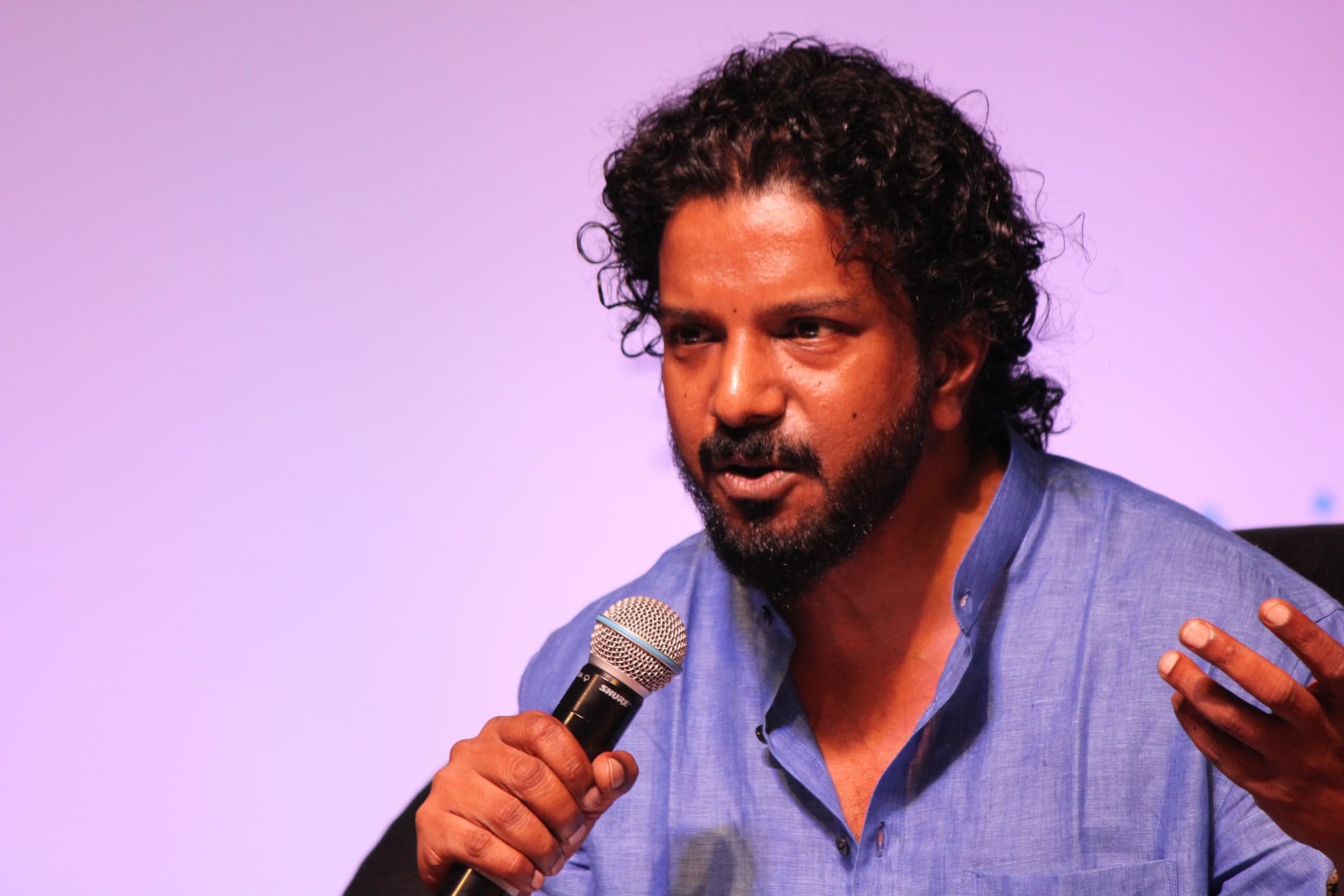
When the world is in crisis, people consult philosophers. However, even when crises occur in Asia or in Africa, it is still European philosophers who are consulted most often. Until today, the majority of analyses of the crises currently occurring in the global south have been proposed by the “white” minority, while philosophers from the non-white regions are rarely consulted, perhaps out of fear that they may not share the western view of the world. Shaj Mohan is a philosopher based in India. His philosophical works span across the areas of metaphysics, reason, philosophy of technology, philosophy of politics, and secrecy.
Mohan’s works are based on the principle of anastasis, according to which philosophy is an ever-present possibility on the basis of a new interpretation of reason. Mohan, together with Divya Dwivedi, is among the most important contemporary philosophers, not only in India, but the world over. They have developed their thought beyond the “western” concept of philosophy within a community of friendship with Jean-Luc Nancy, Bernard Stiegler, Achille Mbembe, and Barbara Cassin. Their project with Nancy is to find an “other” beginning for philosophy beyond the geo-politicized and “racialized” histories of the field, which he has been developing through seminars in École Normale Supérieure (Paris) and publications. Their forthcoming book, Indian Philosophy, Indian Revolution, edited by Maël Montévil, will be published by Hurst Publishers, U.K., in February 2024. This interview was completed on November 22nd, 2023.
♦♦♦
Anthony Ballas and Kamran Baradaran: After six weeks of bombing and fighting in Gaza, there is still no hope to improve the situation. The death toll of the Palestinian people at the hands of Israel has probably crossed 15,000 by the time this has been published. The volume of violence during this period has been unprecedented, considering the very old history of the occupation. On the other hand, we have witnessed a massive wave of support for Palestine from people all over the world who are horrified, which has also been unequaled and unprecedented. Etienne Balibar, Divya Dwivedi and you have published texts in the journal Philosophy World Democracy calling Israel’s actions genocidal or ethnic cleansing.
You say of those who support the Palestinians, “This human animal is capable of bottomless pity, pity in the sense of the desire, without any subjective concern, to purify, or to heal, or to make whole again that which suffers being torn apart, even when such hallowing devastates oneself—the hallowing animal.” In another text on the pandemic from 2020, you wrote, “Health is concerned with the whole, and, for us, the whole is now the world itself” where the connection between being whole and public health is made. What is the philosophical sense of these protests, of these people who want to heal or hallow the world?
Shaj Mohan: I want to be in Gaza. In the same way that I want to be in Treblinka in 1942, in Hiroshima in August 1945, Gujarat in March 2002. I would rather be the ash drifting to the skies than be a lump in my throat as I witness the killing of the Palestinian babies. But this wish is impossible, one cannot be everywhere at all times. The negotiation of this impossibility should be the politics of the world; that is, the reality that each act of healing and helping takes something away from us, and that we can die only once, is faced with the uncounted horrors for which we feel responsible everywhere.
The unlivability of the horrors created by some men (often men) call out to all of us to question the very meaning of our living moments, as they yield to the extinguishing of the lives of others, and to the mutilation of the living possibility of all those who survive from such horrors after being left afield as the maimed and the wounded. This responsibility we see on the streets and on the internet is essentially the the hallowing animal or the healing animal. That is, we who have no gods, no transcendent ends are here now, as the forsaken. We have to save ourselves in the community of the forsaken. These young people in Japan, Morocco, America, Europe, Israel, India and everywhere protesting today are assuring us that we can.
The first step towards the responsible hallowing action should be to distinguish those groups of people who bring such horrors before us, to create an account of them; account, both in the sense of a list and at the same time the reasons for their actions. As Arendt said, a group of people acting in concert who share the same goals, or mutually enhancing goals, is necessary to create such horrors. We know that Britain, America, and other interests were very comfortable with everything Hitler did to the Jewish people for a long time, without which there could not have been a holocaust. It is imperative that we remember this at all times, everyone knows as they continue pretend to pretend that they do not know.
AB and KB: You have also shown that it is “instrumentalized death” that we are witnessing by pointing out the sickening rationality of all this, including mass pedicide. Why this phrase “instrumentalized mass murder”? Could you elaborate on the direction in which we are all forced to go to? You wrote that the western media will soon express pity for the Palestinians but only to force them into Egypt. What is all this for?
SM: Mass killing of children is not new in the “Middle East;” we should not forget the mass murder of children in Iraq. From time-to-time America reads Psalm 34:11 to children [“Come, my children, listen to me; I will teach you the fear of the LORD.”]. In Palestinian lands they do it with the help of Israel.
When something perilous to the world is unfolding in the “Middle East” and when there is opposition to it globally, which is not yet substantial but merely contrary, everything we can say about it can be proven wrong immediately, but not in the long term. It is clear that the poor Palestinian people of Gaza are being tricked and pushed towards the Egyptian border through the wickedness of “western” politicians, media manipulators and the Israeli government. Their movement from north to south is a forcible transfer of population, a war crime. The tricksters want us to believe that the destruction of minimal living conditions and of most hospitals for a maimed, wounded population is without plan. Most likely, the media and the politicians of “the west” will ask the people of Gaza to go to Egypt because in Gaza their wounded cannot be treated and their famished cannot be fed. Forced deportation is also a war crime.
But it is that which has been at work for a while in this region, from the point of view of American Israeli dominance, that should be thought about and discussed. Today the only resistance to American dominance in West Asia is, in two different ways and degrees, India and Iran. The project of an India-Middle East-Europe Economic Corridor will change the trade and military maps forever. These ancient pathways used to be called the silk route, through which armies, philosophers, poets, gods, and goods moved from the Mediterranean to north-east Asia. In the modern period the route was controlled by the Ottoman Empire. This map was the challenge to European colonial powers in Asia, and a component of what the British empire called “the great game” in their rivalry with the Russian empire. Those old wars never came to an end. Among the dead and the living, among the ruins and the nuclear temples, among the ghosts of words and the living tongues, the war still rages on. America is now expecting to control this ancient map of the Mediterranean-Asian-African peoples through the new corridor with Israel at its center.
Gaza as the ancient trading center has strategic importance. It is here that new conversations about the Ben Gurion canal project to displace the Suez Canal are becoming important. It is possible that in the near future the Mediterranean Sea and the Red Sea rush towards each other through Gaza. These are uncomfortable thoughts to entertain, even for us who are looking at it critically. It makes one shudder.
AB and KB: Is the corridor project the reason for India’s political proximity to Israel? Because independent India recognized Israel only in 1950, and full diplomatic relations began only in 1992. What is the relation between the far right in India and Israel? How does the situation in Gaza affect the Muslims of India?
SM: It is true that India was cautious about its relation to Israel for reasons that have to do with the Cold War and the commitment of previous Indian governments to the Palestinian people who were seen as a fraternity under colonialism. There is so much that is obscure about India-Israel-America relations, especially from the time the far right, who are upper caste supremacists, came to power in India which is the mid-1990s. The far right of India gained a certain acceptability during the years of the war on terror campaigns of America, which created an Islamophobia of a monstrous order. In 2002 when the pogroms against the Muslims took place in the state of Gujarat, Modi was its chief minister, and the far right was in power in the central government. Modi is the first prime minister of India to visit Israel.
Islamophobia in India is not simple. It is a method to prevent the majority lower-caste people from asking for their share in power. That is, what is called Hinduism and Hindu majority are masks under which upper caste supremacy operates. Whenever the tensions between minority upper castes (the rulers of India) and the majority lower castes reach critical points, pogroms and riots are unleashed against the Muslims. This present scenario is already being used by upper caste supremacist politicians in state election campaigns. It worries me deeply, because 2002 in Gujarat followed from the 2001 War on Terror. However, what will shed the most light on the Palestinian situation and its relation to India will be a comparison between the Dalits (oppressed people) of India and the Palestinian people. The only scholar to undertake this research is Aarushi Punia, and we should all be awaiting the publication of this thesis.
There is a new equation being formed between a militarized Zionist identity and upper caste identity. This is rather amusing and terrifying at the same time, because upper caste identity is formed from the texts, praxis, and lineages of the ancient people who called themselves “Aryan” and were the composers of the Vedas, which are also the basis of the caste order. They were aligned with the Nazis, who were themselves the products of the Europeanizing process in today’s Europe through the appropriation of this “Aryan” doctrine as their own identity from the 18th century onwards. Divya Dwivedi’s text “The Evasive Racism of Caste—and the Homological Power of the “Aryan” Doctrine” shows the philosophical and philological techniques at work in German and French philosophy to facilitate the appropriation of this oriental “Aryan doctrine” as properly occidental.
It suffices to say that the upper caste supremacists were not fond of the Jewish people. Today the instrumentalized Islamophobia of the upper caste supremacists has found a new relevance through the genocide in Gaza. But this new relation mediated through America has certain business interests behind it. A murky Indian corporation called Adani which developed alongside the political career of Modi recently purchased the Haifa port.
AB and KB: Earlier, why did you say that the global opposition and marches are not substantial? What could be substantial?
SM: Protest marches are important and they are now combined with a kind of intellectual insurgency through the Internet, reminiscent of May 68 in France, Naxalbari India 1967, the Arab revolts of the 1970s, and the campus peace movements of America in the 1970s. Histories and theories should be shared and mastered while we protest. But one should also approach the courts of each country and the international forums for justice. There should be coordinated petitions from the people of the world, in a democratic fashion, for the better future of the Palestinian people and the people of Israel, which I believe is only the two-state solution. Everyone speaks about liberating the Palestinian people from Hamas, which is often an excuse to justify their mass murder. At the same time, it is important that we aim to help and liberate the people of Israel from their fascist oppressive government. It is horrific to be the captives of a government which commits unimaginable crimes, forcing a certain unjustified complicity from its people.
AB and KB: In 2020, you mentioned that “resistance is very useful in all systems and we should know the function of resistance in each instance” but it is not sufficient for politics. Your book Gandhi and Philosophy also deals with the category of resistance and violence with great care and attention. Considering the current situation in the Gaza Strip and the unprecedented increase in violence, the topics of violence and resistance have once again been in the center of attention. In the existing framework, what is the place of these two concepts and should we find other definitions for them?
SM: Resistance is romanticized by liberalism because it achieves so little. In a theoretical and programmatic conflict in politics resistance means accepting what you had been given and then try to protect it from encroachment by the other side. The saddest example of such a failure of resistance can be seen in American politics. Women and the African American people received certain assurances of rights from the state, which was achieved through struggles, and not resistance. However, when resistance was adopted as the strategy those rights were taken for granted, and recently taken away. In politics one must create new terrains constantly; that is, one must create new orders of freedom. This is possible only through theoretical and organizational creativity. The Palestinian people had been condemned to resistance as a strategy since the 1990s. Today the Palestinian non-authority doesn’t want to do even that.
AB and KB: Many have argued that Jewish people themselves will ultimately pay the price for the politics of an ethnic fundamentalism which brings them uncannily close to anti-Semitic conservatism in western countries. Considering the current situation in Gaza and the international support for Israel from the far right organizations from India to America, such a reading seems quite appropriate. On the other hand the statements and actions of Israeli government are leaving no room for genocide denial. There are legal measures underway accusing America and Israel of genocide. Is there an escape for Israel from this path towards genocide?
SM: There is, and it is democracy. The people of Israel will have to save themselves from this shameful and racist government which is committing genocide and other war crimes. They should also free themselves from American foreign policy goals, especially when American politicians are calling for the genocide of the Palestinians from within their legislative forums. It is now undeniable. I am sure that most of us have seen the video of children being made to sing genocidal songs. Do we need to pronounce what it is imitating? The Israeli prime minister said recently “The weak crumble, are slaughtered and are erased from history while the strong, for good or for ill, survive. The strong are respected, and alliances are made with the strong, and in the end peace is made with the strong.” Do we need to say what it reminds us of?
The same rich white countries ignoring now all the signs of genocide in supporting the government of Israel in this moment were complicit knowing everything in the last century too. I feel sadness and alarm for the people of Israel who are almost coercively represented by their racist government, media, and Zionist settler organizations which can be called terrorist in the same way Hamas is described in the USA and other rich white countries.
AB and KB: Very quickly, why do you keep the word “terrorism” suspended? It is now mandatory to use this word since the American war on terror.
SM: First, because it is dehumanizing in the legal sense, it renders an individual human being killable without excuse. One must never accept that. For this reason there is no such term in international law. In countries, including India, this term has gained a license through the Islamophobia unleashed by America to apply to anyone, including intellectuals, journalists and academics that a regime does not like. I worry for climate activists too, who are at the risk of being declared terrorists by many states, especially Britain.
Coming to Hamas, it is complicated by two reasons. Firstly, I am a third world philosopher. Secondly, I might be stepping over both international and domestic laws if I were to speak of it as a terrorist organization, because Hamas is not a terrorist organization according to government of India. Politicians and the media of rich white countries believe that they alone have the power to distinguish beings and name them. This has to stop. Israel created conditions where Hamas came to be the only possibility in Gaza, and it may have even enabled it. The siege is not new, Darwish wrote,
“Under siege, time becomes a location
solidified eternally.
Under siege, place becomes a time
abandoned by past and future.”
In those conditions, which were also the conditions of the concentration camps, one must survive. Nobody should have the audacity to challenge the way an individual (bread thief, sex worker, drug mule or any of those designations of contempt of society) or a people tries to survive. Oppression creates unlivable conditions, and what is evil is the creation of those conditions. In a free Palestinian state, unthreatened by Israel and America, there won’t be Hamas.
AB and KB: What do you mean by “third world philosopher”?
SM: There are countries and regions of the world that are treated as third world, even if this term is now considered a slur. I am based in India, which is a poor country, where the per capita income is around 2300 Euros, lower than Bangladesh. The third world are also countries which are fragile in many other ways. But third has another sense, of being neither this nor that, and both this and that. Third world that is neither global north nor south; neither occidental nor oriental. I am a philosopher without the ground of Aristotlean laws of thought, or classical logic, even in politics. I feel the unrest in this language in which we speak, because I feel the responsibility to produce an experience of heterophony in a language that is both foreign and near to me, and through that to invite a heterophilia in politics. Let us not forget that the Jewish people and philosophers, including Derrida, were living in the “third world” within Europe. The philosophical antisemitism had accused the Jewish people of being the third, or in a more precise and much older sense, “the other.”
AB and KB: Israel’s repeated attacks on medical facilities, health personnel and ambulances in Gaza should be “investigated as war crimes,” international NGO Human Rights Watch has said. In the current situation and considering various violations of human rights what can the UN do?
SM: UN is an undermined organization which is used as a convenient instrument by the countries in the Security Council using the veto power. India has been trying to get a seat there in the security council. The UN can be saved, and in turn it can save more people in the world, through a few steps. The necessary step to begin that process is to dissolve the permanent seats in the security council and end the veto power which is the real stasis of the UN through a resolution in the General Assembly. Those permanent seats are obscene.
AB and KB: We should speak about the Islamization of the resistance of the region. After the attack by Hamas, this question has shown its importance once again. Hamas, Hezbollah and the Islamization of the resistance against the occupation is the result of an old and consequential policy that causes any practically liberating force in the region to be pushed to the corner. How do we understand the transition from Mahmoud Darwish who was born in 1941 to Hassan Nasrallah who was born in 1960?
SM: Islamization of what you call resistance movements displacing the revolutionary, democratic movements in ‘the middle east’ or in the regions once governed by the Ottoman Empire is not a recent phenomenon. But it is an ongoing process. It is difficult to discuss in a few words the necessary theoretical system. So long as we read more than what is written, that is, read poetically, what Foucault had narrated the weeks before the revolution in Iran is a good beginning. He wrote,
‘”‘They will never let go of us of their own will. No more than they did in Vietnam.’ I wanted to respond that they are even less ready to let go of you than Vietnam because of oil, because of the Middle East.’”
I grew up in an atmosphere where the holocaust, the philosophical responses to it, the French resistance, and ‘67 (Naxalbari) and ‘68 (Prague, Paris) were created within a political field based, not on the axiom of justice, but on the suffering of injustice. For me, the critical-theoretical field—the negotiations between the possible and the impossible in politics—was determined by the holocaust. However, I came to know of Palestinian revolutionary movements later, perhaps when I was in high school. Obviously, the Holocaust and the Nakba created a certain traumatically conflicted, torn field of political engagement. The poetry of Darwish, and the works of the polymath Ghassan Kanafani, assassinated by the Israeli government, were inspirations for various currents of politics in India. But how did they come to an end? It was those assassinations; the American- and Saudi-backed inventions of new forms of Islamic fundamentalisms to oppose Arab liberation movements; alongside the oil boom of the 1970s both the Arab nations and Israel together extinguished the last of these democratic revolutionary movements.
But these poetic and lyrical movements were also elitist, which is not a criticism. It is into that space that we should see the emergence of Hezbollah, which is often mistaken for standing for the whole of Lebanon. Britain and other colonial powers encouraged modern sectarianism everywhere it went as a colonizer. In Lebanon’s modern sectarian world, Shia Muslims were mostly poor, concentrated in the south and with little access to politics. Hezbollah emerged in these conditions presenting itself as the response to Israeli war crimes during the 1980s. When Israel bombed Beirut, Ronald Reagan called it a “holocaust” while Israel as they do now blamed it on the dead. Hezbollah is the same as any other political party in the rich white countries today. They run and benefit from what is called neoliberal economies. They are now a party of the bourgeoisie, but when confronted with the class conflict, between the poor who form their base and the rich who are now their partners, their answer is the same as we find from rich white politicians—have faith, the poor should accept what they get, the rich should do more charity. Who is imitating who?
We know that theologization is anti-politics, but so long as oil despotism and oil marionettes rule that region under American control there won’t be any democracy there. The people of rich white countries should study these phenomena, because democratic movements and political freedoms are fragile. When the conditions for democracy are destroyed, people are forced to survive and that threat exists equally in America from both their political parties. That is, when the choice is between Biden and Trump it is not a democracy, but a hostage situation!
AB and KB: You mentioned in your “Teleography and Tendencies: Part 1 Ukraine” that one should perceive the evident tendencies in the world for a democracy of the world. In this regard, one should reject the conventions of negotiations between empires and nations. In other words, one should perceive a new opportune moment for a new beginning, i.e., a democracy of the world par excellence. How do you see “democracy of the world” evolving right now? What should be its principles?
SM: These are the moments where the world is realizing that there is a democracy of the world. The feelings expressed on the streets of most countries show us that this is a struggle for people without exception. The people have come to know that the instruments of nation states are threats to the climate, the poor people of the world, and are the makers of refugees and of their dehumanization. In the same text, I wrote about the destruction of ways of life and the creation of refugees through the American wars on terror. The modes in which these struggles develop further under the schema of a democracy of the world will depend on the oppositions its actors will find along the way, and there will be opposition to anyone who entertains this thought! The protocols for the development of a democracy of the world should not be up to philosophers and the “jurisprudentialists” alone, it should emerge first from the people.
If something philosophical can be offered to the democracy of the world then it is the principle of politics which is freedom—politics is the fight for freedoms where the fights cannot be separated ever from the freedoms as an accomplished accumulated totality. There are three kinds of evils before all politics. Steresis or the privation of freedoms. Stasis or the arrest of a political system through the attempted dominance of its components which come to be the telos or the goal of the system; that is, a political system has several components including the parliament, the businesses, military, social organizations, universities, migrations. For example, a capitalistic system sees the goal of the system as the dominance by a component of that system, which is the capitalist, or in ethnonationalisms, the biologized sense of a group comes to be the purpose of the system. This causes strife among the components creating stasis or arrest. Third, criticalization takes hold when a particular political system reaches the limit of the components which compose it; analogically, an automobile is criticalized when its components—pistons, crankshaft, gears—are worn out. In liberal democracies, we see it today as the inability of these systems to bridge the differences between the rich and the poor, the collapse of public health care where it exists, homelessness, joblessness, and the destruction of the universities. The Palestinians, and also the people of Israel, as you can see, are caught in these evils.
AB and KB: As you and Dwivedi elaborated, some of the most forceful defenders of the Palestinian people have been the Jewish intellectuals from within and outside Israel. In the same text, you refer to Emmanuel Levinas and Derrida. As far as the Jewish philosophy is concerned, one can think of the analytic of violence and neighborliness and its relation to the Israeli-Palestinian conflict. You belong to the tradition of deconstruction through Derrida, Jean-Luc Nancy, and Bernard Stiegler. How are we to understand and analyze the question of “the other” within Jewish philosophy?
SM: At last! And perhaps, this is the most important question! The “other” or “heteros” is not the same in any of the philosophies of the other, which is the power of the other. It means “not this one”, or more than this one shown through the suffix -teros (τερος). It is a shifter on a shifter such as “this one”. For that reason “the other” cannot be identified, it never comes to rest nor to our grasp. Now, my first encounter with this term was through Buber’s “I and Thou” when I was still in school. It is an interesting book for a child because those phenomenologies of encountering the “other” in a horse or a tree are familiar to a child. But Levinas found the demand of reciprocity in Buber’s texts—for example, if the horse whiffs and turns away from me the spell of the encounter is broken—disagreeable. Derrida, perhaps attempted to find a différance between Buber and Levinas through that very concept of différance as that which differs and defers, which retains a certain original sense of the heteros that I mentioned earlier, or the shifting on a shifter.
The problem that I find with this thought of the other is its relation to Heidegger’s ontico-ontological difference, and that relation between the “other” and Heidegger determines much of our theoretical vocabulary. The difference between Being and beings—or those which manifest with their meanings and the very meaning of the manifestation as such—determined the history of metaphysics for Heidegger. Of course, it is important to note that this difference is not logical because we do not know that in which such a difference is posited, rather it suppresses the heteros of this very difference. This history is also the history of the occident for him, into which, following a tradition in German philosophy, Heidegger gathered what is called Ancient Greek philosophy by functionally isolating it from its neighbors and the distant lovers. That is, Germans (and perhaps what he could accept as Europeans) were posited as the inheritors of the idyll of the Ancient Greek world. Divya Dwivedi has posed another logical question to this difference by showing that a decision on the meaning of the orient and a selection of a canon to distinguish something else as the occident preceded the ontico-ontological difference. That is, ontico-ontological difference presupposes what Dwivedi calls the oriental-occidental difference.
When Derrida read Levinas critically in the text “Violence and Metaphysics”, which is a very Heideggerian text, he found in Levinas a tendency to find the category of “the same” between Jewish thought and the Heideggerian Ancient Greek philosophy. The risk of falling into an occidental supremacy for Jewish thought itself had alarmed Derrida—“Are we (not a chronological, but a pré-logical question) first Jews or first Greeks?”, asked Derrida. He would end the text with a quote from Joyce’s Ulysses—“Jewgreek is greekjew”. That is, there is an absence in many of these philosophies of the proposition “MalabariJew is JewMalabari”, or “ArabJew is JewArab”, or “IranianJew is JewIranian”, or “AfricanJew is JewAfrican.” Even that is not enough, why not more than two? Why not a third who refuses to be named, or flees before we are ready with a name for it? The philosophy of the diaspora or the thought of sowing the differences across distances to create the other as ever other or to never let the identical take hold of politics, history and philosophy is needed now.
Historian Avi Shlaim has a certain image of such a philosophy of the diaspora, or heterophilia as an ever-shifting thought of always creating and leading away from “here” and “this”. He said, “The concept of an Arab Jew is still relevant because it enables me to think of what I would like to be the outcome”. I find the possibilities of such philosophical directions in the projects of Etienne Balibar, especially when he speaks of Palestine, through an insistence on a Mediterranean thought. Barbara Cassin had been pursuing the Mediterranean Arab philological openings through her writings and exhibitions. But ultimately, we have to re-conceive without remainders the history of philosophy, without there being an identitarian criteria of selections—European, Islamic, Jewish, Indic, African—and raise it from its current stasis to let the world speak. This task is logical, theoretical, historical, philosophical and political at the same time. It is time for philosophy to have its own very first Intifada.♦
Shaj Mohan is a philosopher based in the subcontinent. His contributions are in the areas of metaphysics, ontology, political philosophy, and philosophy of science and technology. He is the co-author of Gandhi and Philosophy: On Theological Anti-Politics (Bloomsbury, 2019, Foreword by Jean-Luc Nancy), and the forthcoming Indian Philosophy, Indian Revolution (Hurst Publishers).
