

When I was a child, I spoke as a child, understood as a child…
1 Corinthians 13:11
Children of the educated and secular professional class are experimenting. Bloused, pinafored, and ballet-flatted, they’re dressed like the most mutinous Catholic school girls, fashioning recently purchased cross necklaces to look like familial heirlooms, clutching baguette purses embossed with serif-fonted excerpts from Corinthians. (“When I was a child, I spoke as a child, understood as a child,” etc.) They’re adopting new positions on marriage, sex, and religion more broadly: leaving Saturday night’s party so they can wake-up in time for Latin Mass, getting so into Simone Weil, Julian of Norwich, et al. They’re lamenting that they don’t have husbands. Online, at bars, to friends, they’re calling themselves “trad.”
Despite their preoccupation with this “trad” thing, America has never looked so super-modern. Millennial women are waiting longer than any generation in recorded history to become mothers and wives. An ever-fertile dating app market facilitates a stream of casual relationships, increasingly hyperspecific and arterial. Users are looking for semi-regular non-monogamous lovers; they’re emotionally available but not seeking commitment but willing to communicate about commitment. They’re picking and choosing lovers, partners, and cultural signifiers as if selecting toppings at a Midtown lunch-bowl-building establishment.
Suddenly, everything—your sexual habits, your professional impulses, your God—becomes networked, decrystallized.
Be separate from them, touch nothing unclean; then I will welcome you.
1 Corinthians 6:17
An Interval, a Cavity, a Depression
Christ honors the mystery of marriage so highly that he demands a life of chastity. Sex is a gift from God, but if it is isolated from him and his will, it defiles the soul; apart from marriage, it is sin. (Bruderhof Foundations: Marriage)
In Germany, 1920, Eberhard Arnold decides that his small middle-class life has made him complicit in the atrocities of war. He founds the Bruderhof, a community of believers who practice adult baptism, peacemaking, common ownership, and lifelong faithfulness in marriage.
Along the Triassic sandstone and treed inlets of the Hudson, and in the hedge-lined fields of East Sussex, and the Taebaek area of Gangwon province, and at an arcaded-and-buttressed former Catholic seminary called The Mount, and also in a single-family brownstone on 138th Street, the modern-day Bruderhof live in community. Shrouded in Plain dress meant to apprise their inconspicuousness, they are easily identifiable. The women wear long floral skirts or stiff, utilitarian set-waist dresses like other Anabaptists. They pin bonnets to their hair and speak in a distinctively stern but yielding cadence, reminiscent of their native German dialect.
They live in community because they love each other. Bruderhof have what they call a common purse or a community of goods, meaning they own nothing, work for no wages. Everything—food, housing, healthcare—is provided for. The foundations of their faith (to forgive unconditionally, to renounce all violence, to be faithful and committed in lifelong marriage, to live in poverty, to serve the least of these, and to give up all power) are symbolically inscribed in their built environment, in their manner, in the ways they walk and talk.
I was a bridesmaid in the Valentine’s Day nuptials of a couple several years younger than me. The groom was raised on the Bruderhof and the bride was raised on a Hutterite colony (a related communitarian German Anabaptist sect; the Bruderhof were formerly incorporated with the Hutterite Church, but broke from them in the 1990s). Both had left their communities in the year preceding their wedding, but retained many elements of their ethnoreligious and cultural heritage. In the wedding, testimony emphasized the spiritually instrumental nature of their marriage. Love-based marriages are provisional, beholden to moods variegated and unreliable. Marriages that involve the unification of two ministries in Christ endure.
They are precise in their definition of marriage as a convergence of the three subsidiary loves—Eros, Storge, Phillia—into the highest and most enduring love, Agape. Agape love: unconditional, transcendent, irrespective of circumstance, the love that originates from Christ for people. If you pour yourself out, if you make yourself so empty, if you imagine yourself as some kind of discontinuity in an anatomical structure or a lacuna, then maybe, just maybe, you can shine God’s Agape love towards your partner. If you’re an interval, if you’re a cavity, if you’re a depression.
Whatever the love’s genre, her face curls with it. When she walks down the aisle, the open door casts light into the dark chapel room; it’s all rather stagelike, everything spotlit, a feeling of miniatureness. There’s leftover snow on the porch of the chapel, damp and white, and her dress is brilliantly white, too. The music swells. She sees her beloved. Her face curls.
At the afterparty, we eat boiled potatoes and green beans in the mess hall of a Christian camp. We play a game of who knows the bride and groom best. I get right that her first job was as a delivery driver for windows in North Dakota. I get right that they met on Facebook while she was on a mission trip in Iraq. I get wrong that he’s 23. (He’s actually 22.)
The groom’s little sister bakes the most beautiful cake with no fondant. It’s so heavy with real sugar and icing flowers that three people suffer carrying it, and sweat from suffering. We the guests—nearly all Bruderhof wearing Plain dress, and then there’s me—engage in clumsy, pause-heavy conversation: “How does it feel to have fifty-five grandchildren?” I ask a bonneted woman with fifty-five grandchildren. She says something to the effect of, You map out all their names and birthdays in a big calendar which is actually your body and you come to feel yourself some type of receipt of purchase or monument.
I spend Valentine’s evening alone in a cabin at the Christian camp. The whole world is encased in a single inch of ice. The vinyl-covered mattress has been washed down with polyester sponges and soap that smells like apple blossoms. I eat waxy, perspiring chocolate-covered strawberries I bought from Stop ’n Shop. I eat a baguette and some cheddar cheese and write in my diary. If I am sad or lonely, it is in no way specific or remarkable. Like the sound of a droning alarm clock becoming increasingly resolved in waking, a thought coheres: I know nothing of marriage.
Marriage Precedes the Authority of the State
In her 2019 Verso pamphlet The Old Is Dying and the New Cannot Be Born, Nancy Fraser attributes the neoliberal project’s victory to its defensive alliance with non-economic aspirations for emancipation, to its recuperation of marginalized identities. Amazon rolls out seller credentials, allowing users to tag their stores “Black-owned;” your healthcare provider goes rainbow for Pride month, its online presence again and again declaring prismatic, socially conscious allegiance.
Today, on the 2 to Wall Street, a cadmium-colored ad featuring people wearing incongruous accessories as symbolism (barrettes with mustaches, false eyelashes with baseball caps, etc.) alerts me that I should join a “queer bank” where “LGBTQ folks will be rewarded for spending in line with their values.” Its bewildering promise—that the consumption of the correct commodities and bromides will enforce my morality—revolves like a top in my head throughout the workday. I suppose politics is sort of simple after all: it’s just about buying this rather than that.
A new emancipatory spirit infuses economic activity. Writes Fraser, “Thanks in large part to this ethos, policies that fostered a vast upward redistribution of wealth and income acquire the patina of legitimacy.” Elsewhere, she explains how capitalism reappropriates and mobilizes the very institutions intended to subvert it. Liberalism marries plutocracy with a politics of representation: one that does not aim to disrupt the class-stratified social order, but to “diversify” it.
Under this regime, we are decoupled from the institutions and communities that once defined American life. Unencumbered from all the many thorny, troublesome expectations of belonging, you need not be married nor churched nor ever meet a single one of your coworkers at the recently rendered-obsolete “office.” It’s not hard to see why some are feeling a bit, well, alienated. Maybe we were too quick to dismiss the ways of the past in favor of all this fractured, monetized, freaky modernity. A substantive challenge to bloated capital appears to demand, at once, a challenge to the cultural morass it incurs.
For some, the new traditionalism fills this role. Plagued by the hollow demands of their modern little lives, young people on the right, and some on the left, are finding peace and resolution in the fantasy of the tradwife: an early and eager domestic in a formless dress and a secure marriage, shameless in her outward religiosity, demonstrably fertile. As the injustice wrought by capital becomes obfuscated by representational politics, reinvestment in the more traditional trappings of domestic life (young marriage, distinct gender roles, separate spheres, robust religious community) emerges as a type of gestural protest. Gestural protest and irony aren’t always bad, but no wars were won because of a quasi-acerbic quasi-sincere invocation of being trad at the neighborhood bar.
For the trad-preoccupied “leftists,” the redistributive tenets of socialism are reinscribed alongside an unlikely bedfellow: a social conservatism made fashionable only by its aesthetic contrast to progressive neoliberalism. Children of the secular professional class, for whom tradition was always adorably distant, suddenly experience yesterday’s mainstream as counterculture. Untethered from institutions, drowning in all the excess possibilities (why join Bank of America when you could get “Rewards Realness” cash-back returns for supporting queer businesses at the queer bank?) to reiterate the traditional, to grasp at the belonging of a fading institution, and to settle down becomes the radical choice.
Elsewhere, people settle down. I am from St. Louis, Missouri, where I represent a diminishing minority of my high school class who hasn’t married or had a baby. While for conservatives, “tradness” has always represented a de facto ambition, it can still be invoked and flaunted conspicuously in shallow protest of the liberal order. On the Bruderhof, marriage represents one of the highest goods, a sacred and symbolic reflection of Christ’s love for the church. It is a sacrament that precedes and transcends the authority of the state.
In New York, there is much allusion to a desire for something resembling the wholesome, traditional, or parochial life. Friends are “getting into” Christianity, Camille Paglia, purity, WWOOFing, Revelations of Divine Love, monogamy, heaven, corsetry, Substacks about God or the end of the known universe or vibes, logging off, being straight. Yet for all this aesthetic adoption and rhetorical consideration, no one gets confirmed, no one marries, no one has a child, no one “gets out of the city”—whatever that represents, geographically, thematically, or spiritually. No one fesses up to being a dilettante (which isn’t a crime!) either.
While the trad-preoccupied “leftists” are not demographically significant, their dabbling in social conservatism is nonetheless insidious. Their contrapose desires—for a traditional home life at once with the sordid escapades of an adolescence ever extending—remains hopelessly at odds with many poles of contemporary life. Instead, their contradiction enforces itself: for all the posturing, freedom is awfully hard to relinquish. They’re bloviating; they know they’re bloviating. What does the transference of their discontent onto a new traditionalism symbolize about the American sociopolitical landscape?

Your Stupid, Modern, Marvelous Little Life
The Bruderhof, at the very least, offer an interesting refraction of this inquiry. Rooted in shared obligation to Another, they enact that to which the children of the professional and secular class can only gesture or allude: an abandonment of the self as defined by capital. The inverse of the aesthetically trad, they are a people who have relinquished money and private property in favor of the rootedness of community, for a life defined by a proclamation of Christ. On the Bruderhof, cooperative ownership and social conservatism coexist in a sort of parochial harmony.
There are also a lot of rules. Communities require obligations, norms, and obedience. Alongside the romantic aspects of agrarian, communitarian life, the Bruderhof endorse strict adherence to traditions we’ve eschewed in our secular and urban lives. Their pacificism, compassion, and notions of commonly held property, resembling something like an insular socialism, are interwoven with a deeply held social conservatism: as the Bruderhof website has it, you should not divorce, engage in premarital sex, or act on any “same-sex attraction.”
Women and men are regarded as equals but inhabit ontologically different roles: in accordance with a Biblical view of marriage and gender, a husband is expected to lead his family and church, while a wife takes on the role of, as they describe it, a “helper.” Along with vows of poverty and obedience, Bruderhof take a vow of chastity: Because there are more Bruderhof women than men, in their twenties many women will discern singleness—and thus, celibacy—as a lifelong vocation. Some, too, will not feel a vocational call to singleness, but, instead, while watching their classmates wed, have children, and occasion upon life’s other milestones, will have to “come to terms” with the fact that the “opportunity for marriage is not given to us.”
What’s more, sitting in the Christian camp mess hall reception of the Bruderhof wedding, playing a sober game of Code Names with an amassment of cousins, bearing witness to the substantiation of the tradwife, its reality, I couldn’t help but think, if the NYC cool-girl-gone-quasi-Catholic had this life, she would be so bored.
The pervasive alienation of modernity has led some to look over their shoulder and ask: is a more traditional life really that bad? But just like you probably wouldn’t be fulfilled by more consumption, more promotion, more “self-actualization,” nor too would you by retreating from your life to don a bonnet. Surely there must be some other way.
Let’s just be honest about what the tradwife trope represents: a rhetorical disassociation from a sinister American sociopolitical landscape. This is no new trend. Historians and cultural critics from Christopher Lasch to David Brooks have advocated for a return to orthodoxy as a means of circumventing contemporary mores. An overemphasis on the tradwife can be viewed as an extension of this history. Wouldn’t it be so nice if domestication were the answer to all this alienation!
As capital continues its mass assimilation of all the institutions meant to attack it (as the question goes, “What if you held a protest and everyone came?”), walking away in favor of an (ostensibly) subversive and erotic social conservatism may feel awfully seductive. I argue that a sublimation of sociopolitical distress into the “tradwife” and a leftist economic politics inextricably welded to social conservatism, this abrogation, arises from the reactionary ferment of a Gramscian interregnum.
Here’s a truly morbid symptom: the trad-preoccupied “leftist” who believes in economic redistribution, but whose overexposure to progressive neoliberalism causes them to overinflate the cultural purchase of “identity politics.” They see a hegemony of “cancel culture,” queer people, and minorities, rather than as the establishment’s bad-faith instrumentalization of identity and social justice. In turn, they come to believe that the good life can only be obtained by throwing in the towel on rescuing social progressivism from the neoliberal order. While we all wish to feel ourselves embedded in historical narratives, bolstered by loving and good community, the self-declared trads should ask themselves—do they really believe that being “trad” is the best way to accomplish this? And, if you answered yes, what’s stopping you from taking it further?
Because, as Believers, the Bruderhof regard marriage’s commitment as “solemn and unique;” they do not date, but instead “court.” The process, imbued with a formality and spiritual potency, involves a progression of discernment, meetings with Church Elders, and discussion of the gospels. Eventually, the couple will receive permission to begin written correspondence, mediated through the Elder. I can’t imagine what the letters contain. If things go well, there will be a simple wedding, in which the bride may choose to skip the white dress in favor of her usual floral skirt, the veil for a headcovering with a floral wreath. The Bruderhof tagline: Another Life is Possible. So this could be your life, too, but you didn’t choose it.
In Brooklyn, you are turning twenty-eight. You do not have a “career,” per se, but a variety of field-unspecific jobs have loosely directed you towards one thing or another—you hate food service, publishing is okay, maybe you want a job that involves “helping people.” Life is all about developing a position of curiosity, generally. You are single, dating, involved in a four-month “thing,” single again. You constantly reference the fact that when your parents were this age, they were married, with you as the sweetest little replicative proof.
When my friends and I imagine why we have reordered the rites of adulthood, why we have front-ended financial and professional security in place of our more domestic desires, in general we blame the economic. We say, in fact no one in our generation will be able to have houses or husbands or careers or cars; we can’t have what our parents had. Things are different now. When confronted about their non-adoption of the lifestyle to which they allege aspiration, the trad-preoccupied are liable to claim something similar. Maybe they say that their more traditional wish has been thwarted by the reality of our economic and political situation. Maybe they say something flippant or glib, and wouldn’t it be so nice if they could just retire to spiritual solace, but we all have to work, etc. I think that’s true, anyways. But when you look at all the silly pleasantries and charms of your stupid, modern, marvelous little life, I think you’re lying when you say You Didn’t Want This.♦
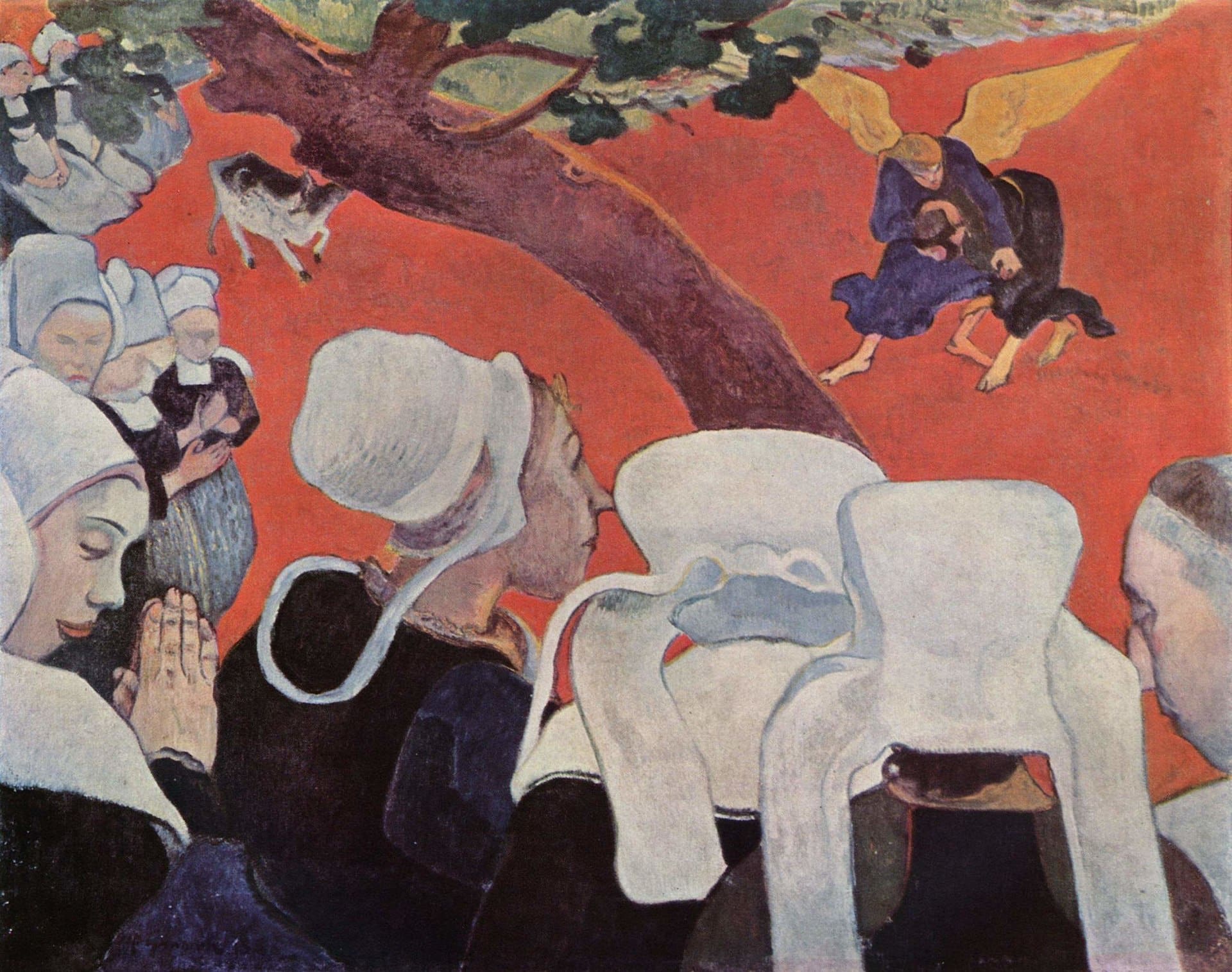
Cover image: Paul Gaugin, “Vision After the Sermon,” 1888
Corrections, November 4th, 2021: An earlier version of this essay stated that the bride and groom were members of the Bruderhof, when in fact, they had recently left the Church at the time of their wedding. The prior version also stated that the Bruderhof utilize a community genealogist because of issues with genetic bottlenecking. This is true of other Anabaptist sects, but not of the Bruderhof.
